'Slumdog Millionaire': Rags-to-riches tale is outstanding
"Slumdog Millionaire" is certain to emerge as a leading contender for this year's Best Picture Oscar, despite a mostly unknown cast and some subtitled Hindi dialogue (don't worry, it won't slow you down a bit).
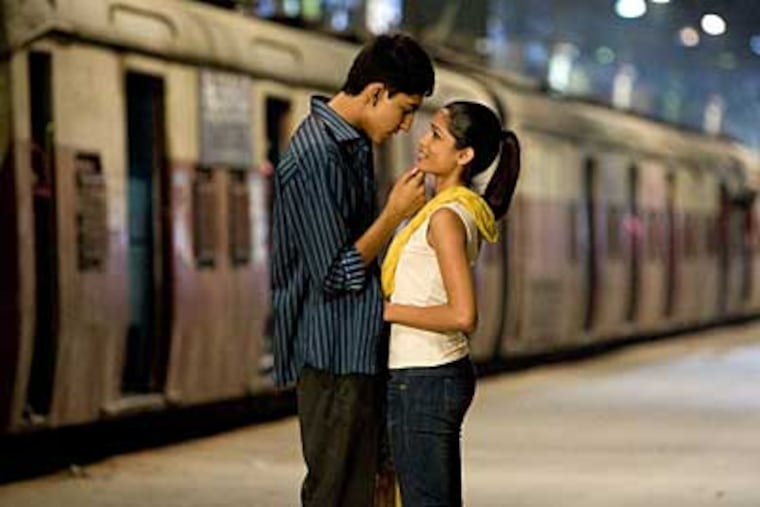
One hallmark of the economy that just blew up in our faces was the extreme contrast between its frothy wealth and stubborn poverty.
There is a great movie to be made in that dramatic range of outcomes - easy-money riches and intractable rags side by side, with the right story line in between.
Good news: Somebody's made it. It's called "Slumdog Millionaire," and it's certain to emerge as a leading contender for this year's Best Picture Oscar, despite a mostly unknown cast and some subtitled Hindi dialogue (don't worry, it won't slow you down a bit).
The title's derived from a derogatory term (slumdog, not millionaire) used to describe the lost, wayward children of Mumbai, where this lively saga of rich and poor is set.
The movie is full of vivid characters, not the least of which is the city itself - an emblem of explosive economic growth that granted unprecedented upward mobility to some but certainly not all.
The premise is an ingenious window on the easy-come, easy-go, rags-and-riches context - a dirt-poor Muslim boy named Jamal (Dev Patel) lucks into a spot on the Indian version of "Who Wants to Be a Millionaire." Though ignorant and destitute, he sets impressive records for correct answers and makes a big pile of rupees.
This, alas, is not the only consequence of his success. There's a kind of Indian caste-system door No. 2: Jamal is arrested and tortured, on the assumption that a young man of his origins must be cheating. (Bollywood star Anil Kapoor is terrific as the show's hostile host.)
Irrfan Kahn is the brutal but thoughtful policeman who interrogates Jamal, and the movie is inventively structured as a flashback - each question prompts a biographical story, and Jamal gradually reveals how the bleak, street-hustler circumstances of his life explain how he's come to know the answers to random, baffling questions.
We get his full, Dickensian story - orphaned at an early age (mother murdered), recruited by an awful, Fagin-esque crook into a gang of child hustlers, some of whom are disfigured to amplify their earning potential as beggars.
Jamal finds a way out, but his best friend (Mahur Mittal) becomes a hustler for life, and his childhood sweetheart Latika (Freida Pinto) disappears into the city's prostitution industry.
Jamal finds menial jobs and goes straight, but never abandons his dream of finding the girl he still loves. He earnestly believes the show will raise his profile and bring his true love out of the shadows.
True love? After all the horrifying squalor we've just seen? The movie is a strange, ambitious mix of Bollywood soap opera and social chronicle. It's exotic, but also in keeping with the personality of British filmmaker Danny Boyle, whose movies display a unique mix of cynicism and humanity, despair and hope, the latter usually winning out.
No Oscar contender, of course, can exist without detractors, and "Slumdog" has been dogged by suggestions that Boyle's lively use of color, motion and music (it's the best soundtrack I've heard in a while) make poverty too pretty.
But that's not quite right. The movie gets its attitude toward Mumbai's poor from screenwriter Simon Beaufoy (adapting an Indian novel), whose research among the city's working poor left him stunned by their energy and zest, their commitment to being paid, not pitied.
And from Boyle, who junked preconceived notions of how to film this screenplay when he learned that the daily chaos of Mumbai made planning impossible (he didn't even know which actors would show up on a daily basis). So he traded his film cameras and lock-down hardware for mobile digital models. And with the help of Indian co-director Loveleen Tandan, he improvised and let the ever-changing nature of the city define the film.
The movie is always coherent, but the sense of the city's unpredictable pulse is there, thumping in your ear.
In a year of DOA movies, this one is unquestionably alive. *
Produced by Christian Colson, directed by Danny Boyle, written by Simon Beaufoy, music by A.R. Rahman, distributed by Warner Independent.