'Inception' follows dream thief DiCaprio on devious missions
Let's begin with a couple of citations:
Let's begin with a couple of citations:
"All that we see or seem, is but a dream within a dream." - Edgar Allan Poe
"What if nothing exists and we're all in somebody's dream? Or what's worse, what if only that fat guy in the third row exists?" - Woody Allen
Inception, Christopher Nolan's epically silly, overwrought noir, is all about dreams, and about an international dream thief - Dom Cobb, played with his customary white-knuckle intensity by Leonardo DiCaprio - who enters other people's subconsciousness and comes out with valuable secrets. The process is called "extraction," and Cobb has an Impossible Missions Force team to assist in his (literally) highbrow heists: There's Arthur (Joseph Gordon-Levitt), the details guy. There's Eames (Tom Hardy), a shape-shifting identity mime. There's Yusuf (Dileep Rao), a chemist whose concoctions put the subject(s) to sleep. And there's Mal (Marion Cotillard), whose relationship with Cobb is complicated by the fact that in the real world, she is dead.
In Cobb's dreams, however, she is very much alive, even if the actress who won an Oscar for her portrayal of Edith Piaf seems unable to inject life into the line-readings. (Ironic homage alert: A Piaf song, "Non, je ne regrette rien," is a crucial mechanism in Inception's plot.)
Cobb's specialty is corporate espionage, but for his latest job, the terms are trickier: Instead of extraction, he needs to plant an idea in somebody's head. His client is Saito (Ken Watanabe), a corporate titan who needs to have the competition put down. To do so, the dreams of Robert Fischer Jr. (Cillian Murphy), the heir apparent to a giant global concern, must be invaded, and a notion embedded in the deepest layers of his noggin.
And oh, by the way, this Fischer fellow has issues with his father. "We need to shift his animosity from his father to his godfather," somebody says, as they prepare to mess with Fischer's mind. Freud for Dummies, anyone?
Full of sun-burnished cityscapes (Tokyo, Paris, Mombasa) and visual references out of M.C Escher and Magritte, Inception looks dazzling. When Cobb first meets up with his new recruit, a young maze-building brainiac named Ariadne (Ellen Page), the two stroll around Paris - a Paris that flies apart and folds in on itself like a pop-up book. A crazy chase sequence through the streets of Los Angeles takes place in a silvery downpour, the crashing cars joined by a giant locomotive barreling down the middle of Wilshire Boulevard. Of course, there are no tracks.
But the dream logic of Inception - which deals, like Nolan's far more intriguing Memento, with the architecture of memory and the nature of reality - is stymied by a clunking script, crammed with expository exchanges and urgent blather. "The stronger the issues, the more powerful the catharsis," says DiCaprio. "The subject is partial to postwar British painters," he observes, noting the screaming visage of a Francis Bacon portrait on a wall. And if you like the phrase a leap of faith, Nolan piles more meaning onto it every time it's uttered (and it's uttered a lot).
Like an illustrated dictionary of dream symbolism, Inception rolls out churning waves of ocean (the film's opening: DiCaprio washed up on a faraway shore), the claustrophobic enclosures of elevators and hotel rooms, the vertiginous perspectives from ledges and bridges. And while there is the occasional effort at levity, DiCaprio and his crew are mostly stony-faced and severe as they hook themselves up and venture into the various dream scenarios. If some of this trippy business, with its tiers of alternate realities, recalls The Matrix, well, recall it it does, but the head-spinning innovation and energy of the Wachowski Brothers' film are lacking.
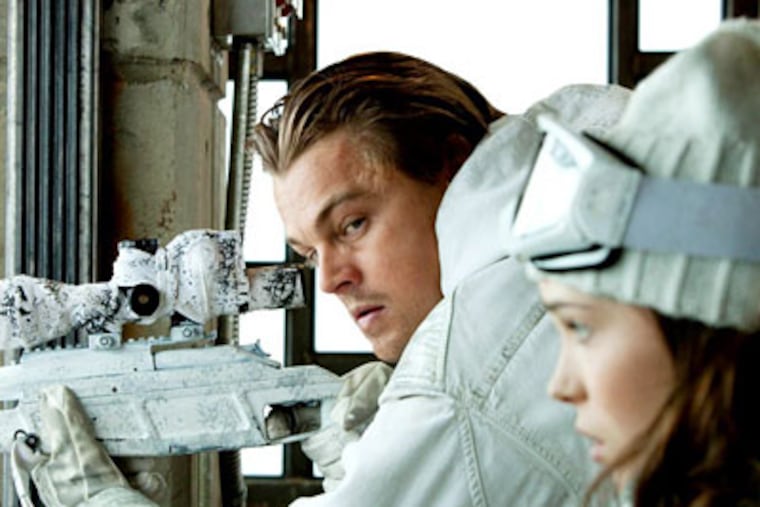
Inception's roiling third act is constructed as a dream within a dream within a dream, and if you think you're experiencing deja vu - well, haven't we seen that snow-covered mountain fortress and its army of white-suited henchmen in a whole mess of old spy movies?
"Wait, whose subconscious are we going into?" asks Ariadne at one especially critical juncture.
Good question. But, alas, the answer is "who cares?"