'Killing Them Softly' deals strong hand of comedy, drama
THE MOVIE IS CALLED "Killing Them Softly," but you'll find nothing of the sort in this stylish bloodbath about crime and punishment among low-life hoodlums.
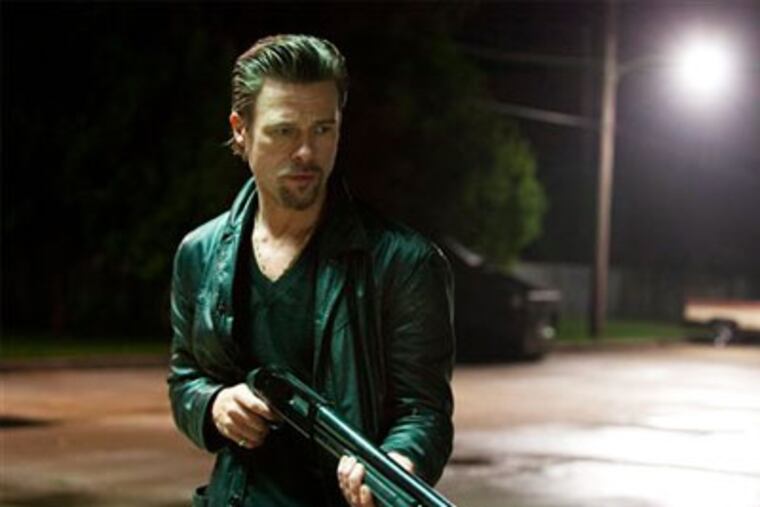
THE MOVIE IS CALLED "Killing Them Softly," but you'll find nothing of the sort in this stylish bloodbath about crime and punishment among low-life hoodlums.
It's based on the 1974 George V. Higgins novel, written in the author's unique style - bleak, hard-boiled noir/near-comedy, located near the intersection of Elmore Leonard and Charles Bukowski.
It's a tone that director Andrew Dominik and star Brad Pitt (they made "The Assassination of Jesse James by the Coward Robert Ford Poster") understand perfectly and deliver with verve and style. That is, when Dominik isn't transparently and clumsily trying to bend Higgins' story into a lecture about the recent financial meltdown.
You take the good with the bad here, and it's mostly good - Dominik gets the essential things right, the way Higgins' narrative uses wrong turns to dead ends to paint an accidental (but amusing and lucid) portrait of a heist gone wrong.
A crook (Vincent Curatola) hires a couple of lunkheads (Scoot McNairy, Ben Mendelsohn) to rob an illegal card game - they think it's the perfect crime, since the man who runs the game (Ray Liotta) is known to rob his own establishment, and will no doubt be suspect No. 1.
We see immediately the scheme is doomed to fail - it's transparent, and it's executed by two stickup guys who are flagrantly incompetent.
Enter mafioso Jackie Cogan (Pitt), a hit man and syndicate fixer dispatched to clean up the ensuing mess - kill the proper people, send the proper message. He's the one figure of efficiency in a morass of blundering, and his conversations with a sympathetic headquarters man (Richard Jenkins) are mini masterpieces of comic understatement.
This is mostly how the movie is arranged - oblique conversations about things that have happened, or will happen, punctuated with grisly depictions of messy things as they actually happen. Or don't - sometimes, the character arcs have an amusing abruptness, and, sometimes, a hit man (James Gandolfini) doesn't feel like leaving his hooker-laden hotel room.
Everything comes together, the performances turning the stylized dialogue into a just-right blend of gilded grunge, and the scenery serving as a handsome peek at downscale New Orleans.
But Dominik can't leave well enough alone, and hammers home overt comparisons between the recent Wall Street bailout and Cogan's ruthless cleanup on behalf of corrupt gambling interests. Dominik resets the movie to 2008, the time of the election and the TARP bailout, and features blaring TV coverage of the whole mess in dozens of shots.
Do people having illegal card games really watch Hank Paulson press conferences on CNN? Don't they get SportsCenter? Or Skinemax?
The movie needs none of this. The message is plain enough. In today's America, it's every man for himself.
If that's true, and if we've made it this far, we don't need Dominik to hold our hands while he explains it all to us.