'Rocky' director on the film's rocky origins
Rocky director John Avildsen talks about the seat-of-the-pants filmmaking that went into making the first Rocky movie.
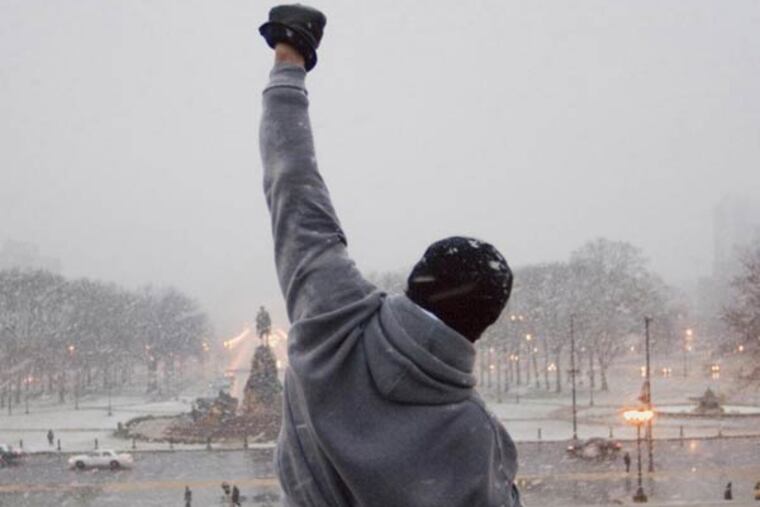
FOLKS MILLING about the art museum steps at this week's special "Rocky" screening didn't notice the dapper, elderly gent standing next to the boxer's statue.
A few asked him politely to move so they could snap a photo next to the bronze figure, and he did so, ending up near a T-shirt vendor, who wanted to sell him a Rocky shirt.
But there would be no Rocky shirts and statues without this gentleman, director John Avildsen, who made the first "Rocky" with Sylvester Stallone and helped shape the character who's gone on to become an American folk hero.
Stallone invented Rocky, of course, but the story of how the the character made it to the screen is the classic illustration of the chaos that often surrounds movie-making, with Avildsen and Stallone often forced to make things up as they went along, hamstrung by their shoestring budget.
The first bizarre twist for Avildsen was landing the job at all. He'd been in Europe to make a Richard Burton movie, scouting locations in Malta, when financing suddenly fell through.
That same day, he was badgered to read Stallone's script.
"I wasn't interested. I thought of boxing as a sort of dumb sport. But I read it, and by the second or third page, this guy is talking to his pet turtles, Cuff and Link, and I got hooked."
Avildsen knew Stallone slightly - turned him down for bit parts in two previous films, but had seen him in "Lords of Flatbush" and knew he could act.
So, he thought, did the folks who put up the Rocky money. But it turns out, they had no idea who Stallone was - even after they hired him.
"I was showing them dailies and they were asking, where's Stallone? I said, that's him, right there. And they were saying, no, the blond guy. Where's the blond guy? They thought they had hired Perry King," Avildsen recalls.
By this point, though, everybody was all in, and Avildsen and Stallone were trying to make the most of their tiny budget - making up for lack of funds with bursts of inspiration.
"It was great. Sylvester was a starving artist, and there's nothing better. They're attentive and appreciative and they do what you ask. And it was the 1970s, so there were no cellphones."
One of Avildsen's first suggestions was to rewrite the scene of Rocky meeting the fight promoter. Initially, Rocky was to accept immediately, but Avildsen wanted his fighter to show more self-doubt.
"My feeling was that Rocky was not educated but he was not dumb, he has to know he has no business fighting this guy. Now the promoter has to con him into it, and that works for the movie, because Rocky is a lot more sympathetic."
There were other, seat-of-the-pants changes. The Rocky-Adrian skating scene was originally set at a cafe, but Avildsen wanted movement, so he wanted to move it to a rink, full of extras. Alas, the production had exhausted its budget for extras, so they shot in an empty rink in LA (the penny-ante production, he said, was run out of Philadelphia by union costs).
Avildsen remembers the first day of shooting for Rocky's big fight with Creed. The fighters' banners were unfurled, and Rocky's had the wrong color trunks.
So they wrote a scene on the fly, Rocky complaining about the mistake, getting rebuffed by the promoter - again, reinforcing his underdog status and ramping up audience sympathy.
"You don't write mistakes into the script, but sometimes they can be the best thing to happen," he said .
Avildsen, in "Rocky," was also the first guy to use the Steadicam in a Hollywood movie, mounting it on the back of a pick up, following Stallone on his famous run though the 9th Street market, then up the museum steps.
"It was guerilla filmmaking. We didn't have permits or police escorts or anything like that, and we didn't get caught," he said.
Most of what you see in those scenes is the natural reaction of bystanders.
"The guy who throws Rocky the orange, that just happened."
And so, in the end, did "Rocky," a phenomenal box-office success, and Oscar winner.
It spawned five sequels, now a Broadway musical, a new digital DVD (part of a six-movie set). The six movies are running this weekend on AMC.
Rocky's a winner.
Of course, he didn't start out that way.
"The producers wanted some kind of shot at the end to make it apparent that Rocky didn't win. But it's not important whether you think he won or not. What's important is that he went the distance.
"That's what makes the story is timeless, really. This notion of wanting to be significant, of feeling that your life has not been a waste of time. That's universal."
Online: ph.ly/Movies