Ben Affleck is a prime suspect in 'Gone Girl'
David Fincher directs Gone Girl, an intrictae adaptation of Gillian Flynns bestseller about a husband (Ben Affleck) suspected of killing his wife
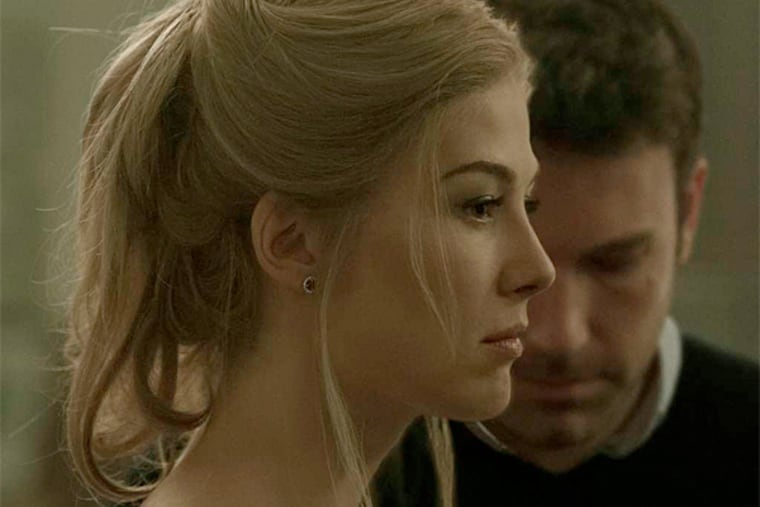
WALKING rudely into our national debate on domestic violence is "Gone Girl," which commences with a guy talking about cracking his wife's head open.
Bad timing aside, it's a doozy of a sequence - prologue to a mystery about a middle-aged failure named Nick (Ben Affleck) suspected of having killed his wife Amy (Rosamund Pike), who's missing from a domestic crime scene awash in blood.
Amateur plot sleuths will be thrown right away. Stars like Affleck don't usually take roles like this unless they get to unmask themselves in the dramatic third act as homicidal maniacs.
But "Gone Girl" makes an immediate show of the man's possible/probable guilt, his violent impulses. So he's innocent, right? Or, wait . . . it's a double head fake!
Stop trying to game it, folks. Here's one thing I can promise you (unless you've read Gillian Flynn's book): Ain't no way, no how, you're going to be able to guess ahead.
So sit back and enjoy the creep show.
We start with the happy profile of an idyllic courtship/marriage/Manhattan success story. It quickly sours - job losses, family illness and a forced move to a suburban Midwest McMansion full of the sort of yuppie decoration in which Tyler Durden, of "Fight Club," would take a dump.
It's amid this collapsing marriage that Amy turns up missing, Nick emerges as the prime suspect and two detectives (Kim Dickens, Patrick Fugit) close in.
What follows is an ambitious procedural that follows a tricky three-track POV: The cops, who think Nick is a liar; the missing wife, whose voice emerges from the diary she leaves behind, as if from beyond the grave; and, finally, there's Nick, who retreats to the home of his appealingly loyal twin sister (Carrie Coon, from "The Leftovers").
It's all clever, lucid and intricate, and we haven't gotten to the movie's most memorable feature - Flynn's ingenious story twist.
Ingenious, and also preposterous, at least on film. So much so that you can feel the movie fairly bursting to embrace it, to become trashy fun - a piece of high-style Hollywood snark. It flirts with this - one early scene finds Pike making fun of Affleck's superhero chin, and the actor's unsettling smirk is put to sinister use. Comic actor Neil Patrick Harris has a small, almost-campy role as a weirdo with a late-breaking role in the plot.
But "Gone Girl" is stubbornly somber, with a self-serious streak that keeps getting in the way, as if it has something sardonically important to say about relationships. Amy's ghostly voice tells us that the ultimate question in a marriage is, "What have we done to each other?"
If you say so. In my house, it's, "Guess what I paid for this at Ross?"
The movie also edges toward satire of contemporary scandal-driven media (Flynn is a former television critic who obviously knows this territory well). Nick gets crushed in the court of public opinion until he hires a celebrity lawyer (Tyler Perry, having great fun) who can play the image game. (Sela Ward turns up as a Diane Sawyer-ish interviewer; Missy Pyle does a blistering riff on Nancy Grace).
But its media critique is also peripheral, and David Fincher settles in the end for what is meant to be horror - people caught in a hell of their own making. It's a tinny note. Especially as what seems to bother Fincher most isn't hell, but that it was furnished at Pottery Barn.
Online: ph.ly/Movies