A fashion icon steps onto the big screen
When that lion of documentary filmmaking Albert Maysles died in March at age 88, he left behind his wife of nearly four decades and their three children, one of whom, Rebekah Maysles, had been his protégé and producer. But in his final years, another woman had swept into the center of his life, as well - a Liberacean swirl of sequins, spangles, beads, and boas topped by cropped white hair and Mr. Magoo glasses, an irrepressible sprite always larger than anyone else in the room.
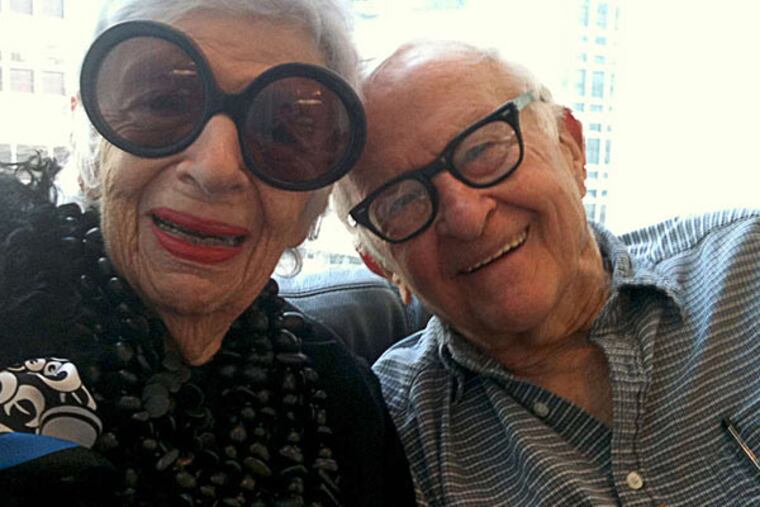
When that lion of documentary filmmaking Albert Maysles died in March at age 88, he left behind his wife of nearly four decades and their three children, one of whom, Rebekah Maysles, had been his protégé and producer. But in his final years, another woman had swept into the center of his life, as well - a Liberacean swirl of sequins, spangles, beads, and boas topped by cropped white hair and Mr. Magoo glasses, an irrepressible sprite always larger than anyone else in the room.
Maysles couldn't keep his lens off Iris Apfel. And who could blame him?
By the time they met in 2009 - both octogenarians, she five years his senior - the Cult of Iris was at full throttle in New York. A fashion adventuress always on the hunt for "another mad outfit" (haute couture mated with flea market, accessorized to topple a Clydesdale), she already had been the subject of an exhibition by the Costume Institute at the Metropolitan Museum of Art, 2005's Rara Avis (Rare Bird): The Irreverent Iris Apfel. She had been photographed endlessly. Blazoned larger-than-life in a Barney's display window. Elevated to icon by the fashion press for her perfectly absurd, absurdly perfect eye. A duck-feather coat and thigh-high purple boots - but of course!
Maysles, in his penultimate documentary, ensured the legend. Iris premiered at the New York Film Festival last fall and opens here on Friday. In the spirit of the direct-cinema genre that he pioneered, Maysles traveled with - OK, traipsed after - Apfel during three peripatetic years of acquiring "looks." And you thought you liked to shop.
Apfel, now 93, is still on the move, promoting the film (while plowing through racks and stacks wherever her tour takes her) and pondering her role as a self-described "geriatric starlet." She's also the new face, along with supermodel Karlie Kloss, 22, of Kate Spade's spring ad campaign.
"I think the whole thing is kind of crazy, you know? Even if being a 93-year-old cover girl is fun," she allowed in a phone interview at a stop in Dallas. "People say I am my own best canvas."
At the end of a long day holding court at magazine offices and TV stations, Apfel sounded no worse for the wear. "They have me on a treadmill, but it's fine," she said. She brushed off the suggestion that the media rounds must keep her in good shape. "That's what you think."
A pause. "Did you like the film, by the way?"
What's not to like? Whether applying strands of beads and layers of fabulous fabric, or haggling her way through just about every purchase she makes, Apfel is a fount of bons mots, Oscar Wilde without the attitude.
"But you have to know with whom you can haggle," she advised. "Some of these guys, if you don't bargain with them, you've ruined their day, and they want to hang themselves."
In the documentary, she's often accompanied by her sartorially splendid husband of 67 years, Carl Apfel, with whom she gained renown in interior design circles as co-owners of the Old World Weavers textile firm from 1950 to 1992. They proved their eclat with restoration projects in the White Houses of nine presidents, from Truman to Clinton.
"I'm not a fashion person," said Apfel, the businesswoman and decorator.
She apparently wasn't much of a movie person, either. The Apfel/Maysles collaboration nearly didn't happen. He had never heard of her, and she had never heard of him or his covetable reputation as master of direct cinema, the filming of reality, straight up. Among the classics from him and his late brother, David, were Gimme Shelter (1970), on the Rolling Stones' calamitous Altamont Free Concert; and the recently remastered Grey Gardens (1976), on reclusive mother-and-daughter socialites Big and Little Edie Beale.
Mixing Maysles and Apfel was the chemistry experiment of Jennifer Ash Rudick, who wound up an Iris coproducer. "She phoned and said she had a good idea," recalled Rebekah Maysles, also a coproducer, along with Laura Coxson. "We did some research."
Apfel's reaction: "I said 'no,' just 'no' when they asked. I didn't know Mr. Maysles or who he was, and I didn't see the point in it. Who was I? Nobody knows me. I had nothing to sell. I had no ego problems. Thank you very much."
She then told several friends, who yelled at her. Turning him down, they told her, would be akin to the Mona Lisa dissing DaVinci. " 'Who do you think you are, ignoring a man of his stature?' " Apfel recalled them scolding her. "People would drop dead just to have Albert take a still picture of them."
Apfel relented. "We fell in love," she said, "decided to do it one-two-three."
She soon realized that Maysles was as instinctual a filmmaker as she was a dresser. "There's what I've learned, and there's all that's a part of my DNA," she said. "But everything I do when it comes to dressing is on the spur of the moment, improvisational, like jazz."
About that DNA: Apfel was once Iris Barrel, growing up in Astoria, Queens, as the only children of Samuel, who owned a mirror business, and Sayde, who had a clothing boutique. "My mother was very stylish," she said. "She had a lot of taste, that woman. She was very smart, so yes, I'd say she was my first inspiration."
Apfel studied art at New York University and the University of Wisconsin, worked for Women's Wear Daily, for interior designer Elinor Johnson, and for illustrator Robert Goodman. When she got married in 1948, she was so practical that she had a wedding dress made "so that I could wear it again," she said. "Who would want something that costs a fortune, but that you can only wear once?"
In his on-and-off filming for Iris from 2010 to 2013, Maysles worked with no script, no schedule. "It's the see-what-happens approach," his daughter said. "Dad was game for anything."
He had to be.
Maysles was a very nice man who probably captured all that one could of her life, Apfel said. "He was so unobtrusive. Maybe that's how he got it all down. I mean, there are a lot of facets about me - most of the people who know me well say that he got it exactly right.
"More than that," she added./ "I'm overwhelmed by the response. I never thought people would take to it so kindly, let alone be interested in me."
MOVIE
"Iris"
Opens Friday at Ritz at the Bourse. EndText