'Lambert and Stamp:' Backstage with The Who
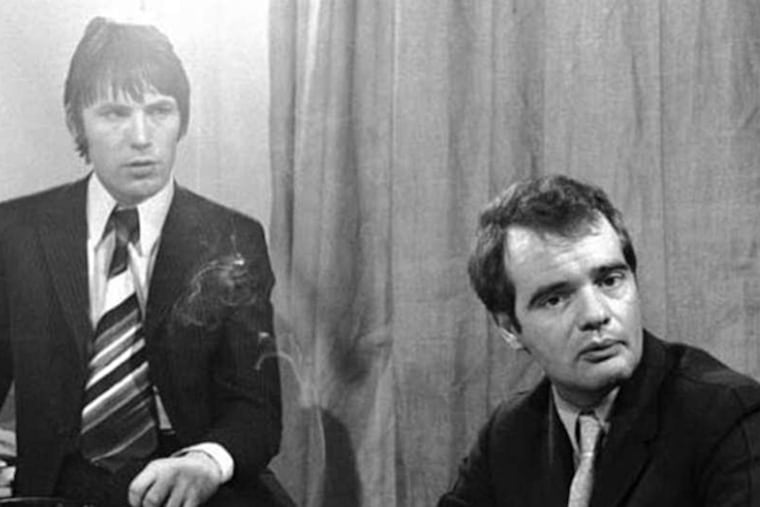
The documentary Lambert and Stamp profiles the odd couple duo who discovered and managed The Who.
TOO UGLY - that's how the gatekeepers of the 1960s UK rock scene responded when asked if a new group called the Who might take off like the Beatles.
That judgment, by the way, came from a woman who'd later become Roger Daltrey's wife, so we can take it with a grain of salt.
Still, it's one of many offbeat bits of origins story information we pick up in the new documentary "Lambert and Stamp," about the producing odd couple Kit Lambert and Chris Stamp, who took on management of the band as a film project.
Lambert was an upper-class homosexual, Stamp (brother of Terence) a blue-collar partyer whose one-word description of his life's ambition was "girls." These were incidental differences when it came to their shared love of New Wave cinema and experimental music.
They bummed around the edges of the film biz, had the idea to break through as documentary directors and went looking for a band that might allow them to capture the rock scene and youth culture of the time.
They chose a pub band then called the High Numbers, fronted by Daltrey and known around town for its eccentric guitar player, Pete Townshend, who liked to scrape his instrument along the mic stand to generate ear-shattering feedback.
You can see this in rare Lambert and Stamp footage of the documentary that never materialized; the duo became better at managing than filmmaking.
The band was cinematic from the outset. Lambert, Stamp and art-student Townshend always conceived of the packaging and presentation of the Who as an art project, impulsive and improvised, of which music was but one of several components.
Townshend, for instance, says his guitar-smashing and noise explosions were meant to convey a form of music designed to self-destruct, which is what he wanted. By the mid-Sixties, he was already itching to try something completely different and, egged on by Lambert (whose father was a classical musician), began work on what would become the rock opera "Tommy."
This was possibly the band's creative zenith - and the moment when it all began to fall apart. At the center of this was Lambert, who had the unique ability to manage all the band's quarrelsome individual elements but came to feud with Townshend over creative control of "Tommy," particularly the film adaptation. Lambert never relinquished his film dream.
Accelerating band dissension was the usual mix of drugs, alcohol and addiction. These eventually killed Lambert. In the documentary, the survivors look back on their ragged past with sadness and regret.
There is actually too much of this, and the movie loses its early momentum, when "Lambert and Stamp" so vividly captures the energy of 1960s England, the sounds and images of a generation coming of age.
Online: ph.ly/Movies