On Movies: Primed for documentaries
According to the remarkable documentary What Happened, Miss Simone?, we have the Curtis Institute of Music to thank for jazz vocalist and songwriter Nina Simone's blazing career. Trained from early childhood as a classical pianist, the then Eunice Waymon of Tryon, N.C., was in New York with a one-year scholarship to Juilliard when, in 1951, she applied for admission to Philadelphia's storied tuition-free conservatory. She was rejected.
According to the remarkable documentary What Happened, Miss Simone?, we have the Curtis Institute of Music to thank for jazz vocalist and songwriter Nina Simone's blazing career. Trained from early childhood as a classical pianist, the then Eunice Waymon of Tryon, N.C., was in New York with a one-year scholarship to Juilliard when, in 1951, she applied for admission to Philadelphia's storied tuition-free conservatory. She was rejected.
Liz Garbus' new film, released last month by Netflix, more than implies that Simone was turned down not because her audition wasn't up to snuff, but because she was black. A 2010 biography disputes this assertion, but in any event, the musician believed it to be true, fueling her anger over the racism she grew up with, the racism still rampant in America. (Shortly before her death in 2003, Curtis awarded Simone an honorary degree - an acknowledgment of past wrongdoing, or an honor accorded a great talent?)
To support herself, she headed to Atlantic City, landing a gig at the Midtown Bar & Grill on Pacific Avenue, under the name Nina Simone. At first, she just played instrumentals, but the owner told her that if she wanted to keep her $90-a-week job, she needed to sing. The rest is history - a history very much tied to the civil rights movement of the 1960s. Simone's fiery anthem "Mississippi Goddam," written in the aftermath of the bombing of a church in Birmingham, Ala., that killed four black children, was a poignant cry of anguish and alarm. After the Rev. Dr. Martin Luther King Jr.'s assassination, Simone's views on race relations became increasingly radical. In one concert performance in the Netflix film, the singer with the rich, husky voice advocates taking up arms.
What Happened, Miss Simone? is just one of a number of amazingly strong documentaries available right now on theater screens, home screens, and iPhone screens (if you must). When a swarm of top-quality nonfiction films tumble out one after the other, as they currently are, there's the inevitable journalistic reflex to hail this as a new golden age of docs. I won't go that far, but it is a doc moment, to be sure.
Not quite on the same tier as Garbus' revelatory Simone portrait, another Netflix release, Tig, about standup comedian Tig Notaro, is nonetheless riveting. Directed by Kristina Goolsby and Ashley York, and deploying a lot - a lot - of iPhone video shot by Notaro and friends and family, Tig chronicles the life-changing events that the L.A.-based deadpan comic faced in 2012. After just recovering from a horrific intestinal-bacteria malady, Notaro was diagnosed with breast cancer.
At one of her regular comedy venues, Notaro came on stage and did an entire set about her cancer. Intensely personal, painful, and - yes - funny, the act, or tweets documenting her act, went viral. Louis CK hailed Notaro's courage and comedy genius and went on to release an audio recording of the show on his label, Pig Newton. The album became a huge seller and won Notaro a Grammy nomination.
At times, the film plays like a 24/7 selfie, with Notaro's courting Stephanie Allynne, an actress she worked with while filming In a World . . . . The comedian, who underwent a double mastectomy, desperately wants to have a child, but she's unable to carry the fetus herself, so she interviews a possible surrogate and her husband in Seattle, both of whom are Notaro fans. It's a strange relationship, to say the least.
David Thorpe's documentary Do I Sound Gay?, which opened Friday at the Ritz Bourse, offers another deeply personal take on the gay experience. A journalist and filmmaker, Thorpe, who jokingly describes his voice as sounding "like a very small man," sets out to discover why he and many of his friends use intonations, inflections, and registers that immediately identify them - or misidentify them - as gay. The film offers more than just a new angle on linguistics; it's a provocative look into cultural perceptions, self-perceptions, and sexual identity.
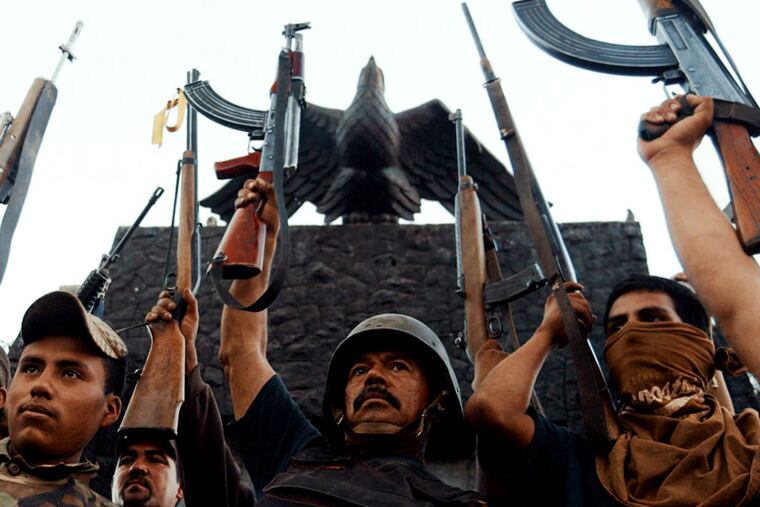
Cartel Land, from Matthew Heineman, playing at the Bryn Mawr Film Institute, is a boots-on-the-ground doc about violence and vigilantism on the U.S.-Mexico border. The filmmaker embeds himself with Autodefensas, a band of citizens in the Mexican state of Michoacán who have taken up arms against the powerful Knights Templar drug cartel. In Arizona, he tags along with Tim "Nailer" Foley, a leathery vet with a defiant worldview, who leads Arizona Border Recon, a paramilitary outfit out to thwart the illegal entry of people, and drugs, from the south.
The Wolfpack, which just ended a successful run at the Ritz and is available on Amazon Instant Video and other platforms, brings the viewer inside a drab apartment in a public-housing tower on Manhattan's Lower East Side - an apartment that the six brothers in Crystal Moselle's startling film have barely ever left. Home-schooled, living under the despotic hand of their Peruvian immigrant father, the Angulo boys would be allowed outside three or four times a year. Some years, they didn't go out at all.
What they were allowed to do was watch movies - and they watched, and rewatched them, to the point where they could and would reenact whole scenes from The Dark Knight, from Reservoir Dogs. The film is both a vivid family portrait and a commentary on how pop culture and the popular arts - particularly film - impact and influence our lives. And how they don't.
In Point and Shoot, released in theaters last year and slated to air next month on PBS' documentary series POV, Marshall Curry trains his camera on Matthew VanDyke, a sheltered Baltimorean, who decides to go on a "crash course in manhood," riding a motorcycle across Africa and the Middle East and winding up fighting alongside rebel forces in the Libyan revolt.
And Saturday, Barbara Attie, Janet Goldwater, and Sabrina Schmidt Gordon's BaddDDD Sonia Sanchez, a documentary portrait of the acclaimed poet and activist - Philadelphia's first poet laureate, a longtime resident of the city - premieres at International House, part of the weekend's BlackStar Film Festival. Sanchez, like Simone, found herself in the thick of the 1960s civil rights movement. The two women were friends. The respective documentaries in which they appear attest to their greatness.
215-854-5629@Steven_Rea