On Movies: After MLK portrayal, Oyelowo transforms for murderous role in "Captive"
To be sure, the idea of portraying the Rev. Dr. Martin Luther King Jr. on screen presented David Oyelowo with vast challenges: How to capture the spirit of a hugely historic figure, his timbre and tenacity, the oratorial power, the vision, the flaws? When
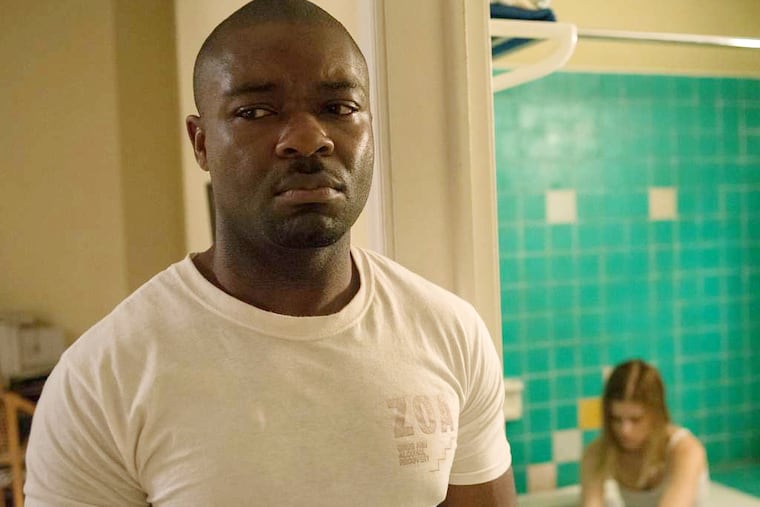
To be sure, the idea of portraying the Rev. Dr. Martin Luther King Jr. on screen presented David Oyelowo with vast challenges: How to capture the spirit of a hugely historic figure, his timbre and tenacity, the oratorial power, the vision, the flaws? When Ava DuVernay's Selma was released at Christmas, the consensus was just about universal that the British actor had nailed it. He won the approval of King's family and was nominated for a Golden Globe and an Indie Spirit Award; the film was in contention for a Best Picture Oscar.
Yet, Oyelowo (pronounced oh-yeh-LO-wo) faced an altogether different sort of challenge when he opted to take the role of Brian Nichols, a man on trial for rape, who over the course of 26 hours in March 2005 escaped an Atlanta jail, shot and killed a judge, a court reporter, a sheriff's deputy, and a federal agent, and held a woman hostage.
Captive, the film that chronicles this chilling sequence of events, opened Friday.
Oyelowo, reached last week in Los Angeles, said he had to go as "all-in" with Nichols - now serving multiple life sentences in a Georgia penitentiary - as he did with the revered civil rights leader.
"It was very difficult, because as a man, as a father, just as someone who likes to picture himself a good person, it's a difficult head space to put yourself in," Oyelowo said. "But because my job, what I do with the characters I choose to play, I try to fully inhabit them. And the way to do that is to try to understand why they do what they do.
"It's one thing when you're playing Dr. King to not only put yourself in that head space, but to want to put yourself in that head space," he said.
"But it's a totally different thing when you're dealing with someone who - you know, to do what Brian Nichols did that day, you have to be in a very dark place. You have to be thinking very dark thoughts. You have to have turned off certain parts of yourself, and turned on other parts of yourself. . . . And in order to portray it truthfully, you've got to go to those places. So, yes, it was not a comfortable experience."
With Kate Mara in the role of Ashley Smith - a single mother struggling with a methamphetamine addiction, who manages not only to survive her night in the company of Nichols, but to persuade him to surrender to the police - Captive is an intense ride.
It's a violent ride, too. When Oyelowo's Nichols bursts into an Atlanta courtroom and shoots the presiding judge at close range, the scene conveys the what-just-happened? horror of real life.
"Unfortunately, in Hollywood, in Hollywood movies, a scene like that, a moment where a guy in a suit with two guns points them at someone and kills them at point-blank range, has been glamorized, glorified," Oyelowo said. "There are stills from Captive, taken out of context, where you could think of [Nichols] potentially being the hero, the protagonist, the guy we should be rooting for in the movie.
"So we had to fight very hard and work very hard at making it as cold-blooded and as horrible as it is, as it was. . . . Because of television news, because of certain video games or certain movies, we've become anesthetized to this kind of violence and its pervasiveness. We really wanted to make you feel just how horrific it is when these things happen."
In 2008, Oyelowo, now 39, moved with his family from London, where he had been working steadily in theater, TV, and film, to Los Angeles. He set up a production company with his wife, Jessica. Captive and the forthcoming Five Nights in Maine, which premiered at the Toronto International Film Festival last weekend, both bear the Oyelowos' Yoruba Saxon Productions logo. But one of his first projects on the West Coast wasn't an acting job, but as director of the comedic, romantic short "Big Guy," about "an obese guy and a bulimic girl." Josh Gad had the title role, Mara had the eating disorder.
"Kate's actually become one of my best friends," Oyelowo said of his Captive costar (also soon to be seen as one of the NASA crew members in Ridley Scott's The Martian). "She and I met not long after my wife and I moved here. And as I say, she's one of my dearest friends - but she's also an actress who I truly, truly believe in. I feel like the world hasn't seen anywhere near the level of depth that is within her.
"She's a beautiful woman, and as tends to be the case in Hollywood, that beauty can sometimes be the primary focus. But I was very keen for her to play Ashley Smith, not least because I feel like it's a role that really shows depth. She has that combination of fragility yet strength within her."
Oyelowo seems especially attuned to the collective shortcomings of the industry he loves. At the Toronto debut of Maris Curran's Five Nights in Maine, in which he stars opposite Rosie Perez and Dianne Wiest, Oyelowo took a moment during the post-screening Q&A to say a few words about female directors.
Pointedly, about their scarcity in Hollywood.
"I have just been such a huge beneficiary of female filmmakers," he told the audience. "I'm very dedicated and devoted to this idea that there is this huge travesty in cinema when it comes to female directors. Women make up 50 percent of the population, and it doesn't make any sense that, cinematically speaking, we have so few women's voices. . . .
"I was there when men were attached to [direct] Selma, for instance, and I know the difference that my sister Ava DuVernay made when she came onto that film. You know, I recently did a film with Mira Nair," he continued, speaking of Queen of Katwe, about a Ugandan chess prodigy.
"We are lesser for not having these voices," he said. "These things really matter to me. And I think until everyone makes it their problem, like the Toronto Film Festival does in terms of how it champions people of color, women - just inclusiveness, in general - until we make it all of our problem, it will not go away."
215-854-5629@Steven_Rea