Tobey Maguire plays Bobby Fischer in 'Pawn Sacrifice'
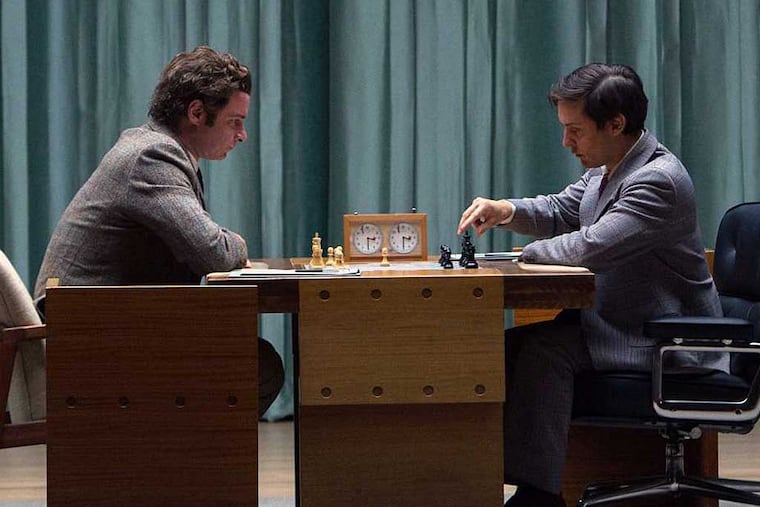
Tobey Maguire plays tormented chess genius Bobby Fischer in Pawn Sacrifice, which recreates his monumental Cold War match with Boris Spassky
A PAIR of interesting movies this year have looked at the Cold War from the standpoint of its proxy warriors.
Reluctant warriors, often - men who excelled at chess or hockey and were drafted, often unofficially and against their will, into a high-stakes struggle between superpowers.
The fascinating documentary "Red Army" looked at this dynamic through the eyes of the Red Army hockey team and its cagey leader, Viacheslav Fetisov.
Now comes "Pawn Sacrifice," a weirdly trippy movie that recreates the monumental 1972 chess match between tormented American chess prodigy Bobby Fischer (Tobey Maguire) and Soviet grandmaster Boris Spassky (Liev Schreiber).
As the title rather clumsily implies, "Pawn Sacrifice" presents the descending-into-madness Fischer as an expendable gamepiece in a ruthless geopolitical contest waged by shadowy intelligence agencies on behalf of powerful governments.
And while that all sounds weighty and deadly serious, the movie itself is often up-tempo and a color-drenched affair, awash in playful, decorative period fashions and music (late Sixties to early Seventies) that time-stamp Fischer's rise through the ranks of top U.S. players.
It's a jaunty early journey - as an adolescent and young man Fischer's brilliance still exceeds his eccentricity, and it's good fun to see the prodigiously talented "kid from Brooklyn" defeat older and more experienced players, becoming a national phenomenon in the bargain.
It is here we see Fischer's "game" develop its unique characteristics - he played with a combination of skill and intuition that often expressed itself in wildly unpredictable moves (chess purists will find much to quibble with, but the movie is not for them).
His style yielded brilliant maneuvers and occasionally catastrophic mistakes, but made him a particularly dangerous foe to the Soviets, who played a regimented style based on disciplined mastery of classic techniques, with Spassky as the apotheosis (Schreiber, in limited screen time, expresses this nicely, while adding a dash of humanity to his character).
The erratic Fischer unnerves lower-ranked Soviet opponents, and, because the matches function as an expression of national prestige, some Soviet players feign illness rather than concede defeat.
Not Spassky, who remains unflappable and unbeatable to Fischer, beset with increasing and sometimes debilitating anxiety. Fischer finds his own set of excuses for losing, blaming conspiracies that grow ever more real as his psyche fails.
By the time they meet as equals, in Iceland, Fischer is barely holding on to his sanity, as his bizarre behavior poses a severe test to other players, his handlers (including Michael Stuhlbarg) and tournament organizers. (It speaks well of Spassky and the endlessly patient Icelanders that they put up with Fischer.)
In the end, the movie itself seems not entirely sure how to handle Fischer's mental illness (his final collapse is documented in a short epilogue) - it wants us to join a bruised Nixon-era nation in cheering Fischer's unlikely victory, but the man's mental state augers against an upbeat reading of the win.
"Pawn Sacrifice" is helped, though, by Maguire, who strikes a consistent and believable note throughout, and never leaves us in doubt as to the severity of Fischer's deteriorating condition.
Also good: Peter Sarsgaard in a small but typically resonant role as the priest, de facto psychologist and and chess whiz who helps manage Fischer in the months leading to his big match, and is the one person who sees that Fischer's genius, his demons and his place in history are tracing a tragic and inevitable arc.
Blog: philly.com/keepitreel
Online: ph.ly/Movies