'When Voices Meet' documents transformative journey in postapartheid South Africa
Sharon Katz was raised on the privileged side of apartheid, in a white, Jewish, liberal South African family. By 15, she was sneaking into black townships, befriending actors and musicians. "I was living in this white world, and now I had my eyes opened to how black South Africans were feeling."
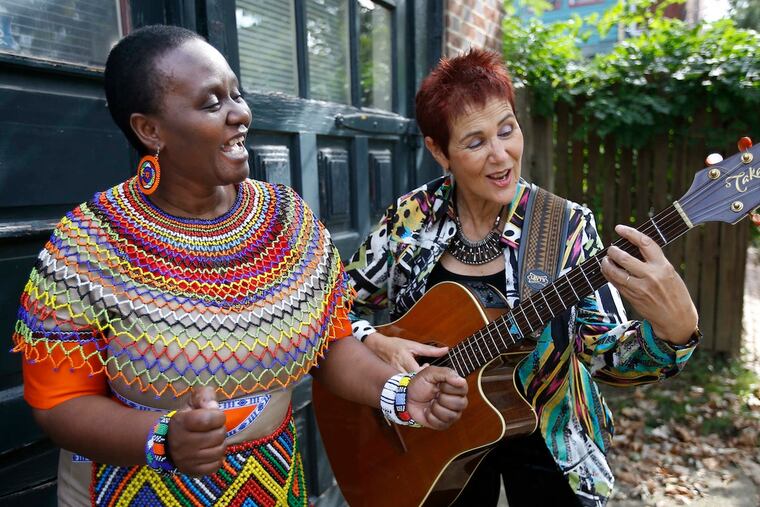
Sharon Katz was raised on the privileged side of apartheid, in a white, Jewish, liberal South African family. By 15, she was sneaking into black townships, befriending actors and musicians. "I was living in this white world, and now I had my eyes opened to how black South Africans were feeling."
Nonhlanhla Wanda grew up scared. Apartheid kept South Africa's races - blacks, whites, Indians, and "coloured" (mixed-race) - apart with separate schools, hospitals, parks, and neighborhoods. The system imposed curfews on blacks, forced them to carry "pass" documents, and strangled their hopes of education. "We'd never been exposed to white people to have a friendship; we called them 'superior' races," Wanda recalls.
Meanwhile, Marilyn Cohen was coming of age in Philadelphia, where she was swept into the civil rights and women's liberation movements; police in riot gear were summoned to quell racial unrest at her high school.
In 1992 - with Nelson Mandela recently released from prison and South Africa quivering (and sometimes erupting) on the verge of change - these three women found a common language.
Katz, who had come to Philadelphia to earn a degree in music therapy, longed to return home after Mandela's release. She persuaded Cohen, a city mental health administrator who had seen the impact of Katz's work in prisons, to accompany her. Shortly after arriving in Durban, they met Wanda through a mutual friend.
Music brought them together - initially, with the dream of a 500-voice multiracial chorus of South African children, then a concert tour by train through a fast-changing country. Now, a new film documents their unlikely, transformative journey.
When Voices Meet, which will be screened twice at the Philadelphia Film Festival, captures how two musician/educators (Katz and Wanda) teamed with an organizer/activist (Cohen) to create a concert at Durban City Hall in 1993, a groundbreaking performance that brought together a group of children and parents, school principals, tribal chiefs, and community elders.
The idea, Katz said, "was to gather as many children as we possibly could from all different walks of life. We started writing songs in English and Zulu, and other languages, incorporating the cultural dances of each group as well."
They called the concert "When Voices Meet," a phrase lifted from the lyrics of one of their songs: "We won't miss a beat / when voices meet / We are the children of South Africa."
By then, three years after Mandela's release, different races were permitted to perform together. But four blocks away from the concert venue was a whites-only beach.
Playing in front of thousands - especially with white co-performers - felt intimidating to Wanda. "But with Sharon and Marilyn, I had another feeling: that I had sisters who were looking after me."
The children felt it, too. "The spirit among the children was very high. They felt accepted. Kids from different races were able to welcome each other," Wanda said. "It changed people's minds."
Cohen recalled her own anxiety as audience members lined up around the block and jammed the concert hall, some sitting on others' laps. "I held my breath for an hour and a half. I was afraid it was going to be attacked by extremists."
Instead, the concert sparked radio and television publicity and a raft of invitations to perform. "We hatched another idea," Katz recalled. "The Peace Train, to travel the country by train and use music to build trust between people."
The film traces the journey of the Peace Train, which carried 150 singers and band members - children and adults of different races living together in first-class coaches - on a two-week trip from Durban to Pietermaritzburg to Bloemfontein, at the time the nexus of Afrikaner nationalism. There, when the travel-weary chorus traipsed to a local swimming pool, the locals got up and left.
In Ladysmith, there were threats of violence; organizers rushed everyone off the train and into buses, with police escorts, to travel to the stadium where they would perform.
Every concert was free; Cohen and Katz maxed their credit cards to pay for the train, and the venues donated space, sound, lights, and crew members. The kids brought their own bedding. Bakeries and other vendors met them at each stop with donated food.
Meanwhile, the country readied for its first postapartheid election. "It was really a momentous time," Katz recalled. "We wanted to instill hope in the midst of all this chaos." The tour ended by Christmas 1993; the following April, Mandela became the country's first democratically elected president.
The film - made on a lean budget of $100,000, much of it raised $10 and $20 at a time - chronicles all of that. And it returns, 20 years later, to a still-evolving South Africa to interview Peace Train participants about the impact of their journey.
Katz, Wanda, and Cohen are traveling with the documentary - this time, their "Peace Train" is a Roadtrek 190 camper van - as it opens in festivals around the United States. In Toronto's Global Community Film Festival, it won the top MADA Award for "making a difference in the world." At the St. Louis International Film Festival, it will screen just miles from Ferguson.
America's own racial fissures - so painfully exhibited in the last several years - make the film timely and relevant, Cohen said. Being part of the Peace Train "taught me to open my heart more," she said. "We have a limitless potential to be good and kind and to love."
Wanda, whose experience with the Peace Train transformed her shyness into an exuberant love of performance, said she learned "how to make life meaningful to each and everyone in the world."
And for Katz, who said she always knew apartheid was wrong, the chorus, the concerts, the Peace Train, and the film have fueled her conviction that change is possible. "I've learned to have the courage to do what you set out to do. You can make a difference. That's what I continue to believe."
WHEN VOICES MEET
Movie Screenings
5:05 p.m. Sunday at the Prince Theater, 1412 Chestnut St., and 4:55 p.m. Nov. 1 at the Roxy Theater, 2023 Sansom St.
Tickets: $13 (Sunday) or $8 (Nov. 1). Information: www.filmadelphia.org/festival
Dance Party and Concert
Sharon Katz and the Peace Train at noon Nov. 1 at World Cafe Live, 3025 Walnut St.
Tickets: $15. Information: www.worldcafelive.com