'Whiskey Tango Foxtrot' inspiration on what it's like to be a Tina Fey-type
It's not unlikely that Tina Fey would have eventually found her way to Kim Barker's book - a book, called The Taliban Shuffle, about a journalist embedded in war-torn Afghanistan, a book that is now a movie called Whiskey Tango Foxtrot.
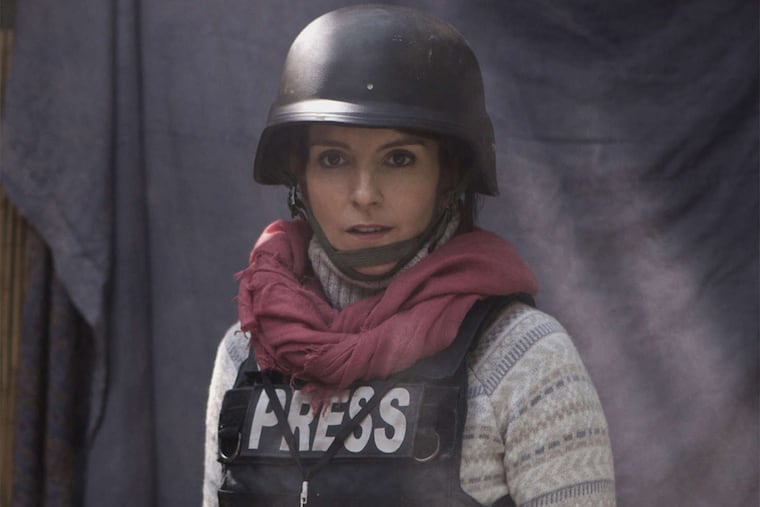
It's not unlikely that Tina Fey would have eventually found her way to Kim Barker's book - a book, called The Taliban Shuffle, about a journalist embedded in war-torn Afghanistan, a book that is now a movie called Whiskey Tango Foxtrot.
But thanks to the Pulitzer Prize-winning literary critic of the New York Times, Fey, the star of 30 Rock, and Barker, a former Chicago Tribune foreign correspondent, were matched up before they even knew what hit them. In Michiko Kakutani's rave review of Barker's 2011 memoir, the critic wrote: "It's not just that Ms. Barker is adept at dramatizing her own adventures as a reporter - though she develops the chops of a veteran foreign correspondent, she depicts herself as a sort of Tina Fey character, who unexpectedly finds herself addicted to the adrenaline rush of war."
Call it casting by Kakutani.
"I was so in fear of what that review was going to say," remembers Barker, who dropped into Philadelphia last week to talk up her film. "And then she named it one of the top 10 books of the year and describes me as creating a Tina Fey character . . .. And Tina Fey read that review, and then read the book, and within two weeks after the review came out, she had Paramount option it on her behalf."
By 2014, with a script (by Robert Carlock, the showrunner on 30 Rock and cocreator of The Unbreakable Kimmy Schmidt) about ready to go, the comedy star and the "sort of Tina Fey character" were having lunch together.
"It was actually Sept. 11, that's why I remember the date," Barker says. "We talked, we had a really nice lunch, we spent probably a couple of hours there.
"I was so worried about seeming funny, and I can't really even remember what I was talking about with her. She was very nice, down to earth. I think she wore a flannel shirt and black jeans and tennis shoes, T-shirt and a hot-pink, aspirational sports bra that we joked about."
Barker didn't feel she was being scrutinized, assessed, as though Fey were sitting opposite her taking mental notes. It was just two women talking about stuff.
"I think there are two kinds of actors in the world," says Barker. "Those who really try to take notes and get inside the person that they are portraying, the real person, and then there are those who want to make the character their own and do their own interpretation. And I think that's what she was doing.
"Obviously, if she was trying to do me exactly, she would have spent a lot more time with me, shadowing me around the newsroom. Much to my editors' dismay, she didn't do that. They were always saying, 'When's Tina coming by? When's Tina coming by?' "
One of the remarkable things about Barker's book, captured with varying degrees of success in the Glenn Ficarra and John Requa-directed film that opened Friday, is that she evokes both the horrors and hardships of war and the surreal comedy that comes with it.
About Taliban suicide bombers, who often ended up blowing themselves up, Barker wrote: "It was a known fact: Afghans and Pakistanis were probably the worst suicide bombers in the entire spectrum of militants."
About being a woman in a culture where women are, to say the least, hardly treated as equals, Barker wrote: "We were rarely felt up in public, and we had an easier time than the male reporters. We could interview women who could never reveal their secrets to a man. And we got bizarre access to the men, even the conservative mullahs, who seemed secretly charmed by the idea of Western women running around. We were the third sex, immune to the local rules for women and entitled to a more exclusive status than Western men."
Barker is the first to acknowledge that Fey and company took liberties in the transition from printed page to big-star movie with Margot Robbie, Martin Freeman, and Billy Bob Thornton also in the cast.
"It's Hollywood, right? There's a lot more bombs in the movie, and I do things that I did not do in real life in terms of running toward explosions, or not listening to my fixer, my translator. I tended to do what I was told to do, for the most part, although sometimes I went off the reservation because, well, I'm a journalist.
"So it's definitely got some stuff in there that's fictionalized, but it's very true to the core of my story," she says. "And it gets the 'Kabubble' - the weird, intense party scene that you have there, because you just really can't have any other sort of release when you're covering these difficult things."
One significant change: In real life, Kim Barker is a print reporter, and she filed her stories from Afghanistan and Pakistan during the middle-'00s for the Chicago Tribune.
Fey's Kim Baker is a TV reporter, filing her stories from in front of a camera for the network news back home.
"Let's face it, a lot of people get their news from TV, and I'm not going to diminish the work that they do and the fact that it's really hard to stand up there and all of a sudden give a concise explanation of a story," Barker says. "It's a different skill set, and I don't think that print journalists can necessarily do TV. And I have respect for what they do.
"And I get why they did that in the movie. It's more dramatic to have the camera, you've got to get the shot. . . . They use the camera very much as a device in the movie to tell part of the story, to do exposition.
"And I get that it's not that exciting to watch me type. . . . The biggest drama is whether I can get an Internet connection or not. But, of course, part of me is like, 'Damn, I'm a print journalist and what we do is important!' . . . But at the same time, I understand. At least we have Spotlight, right?"
215-854-5629
@Steven_Rea