Meet the great director you should know, but probably don't: France's Arnaud Desplechin
Arnaud Desplechin, whose playful movie My Golden Days, about young love, is now in theaters, is the greatest contemporary French filmmaker no one has ever heard of.
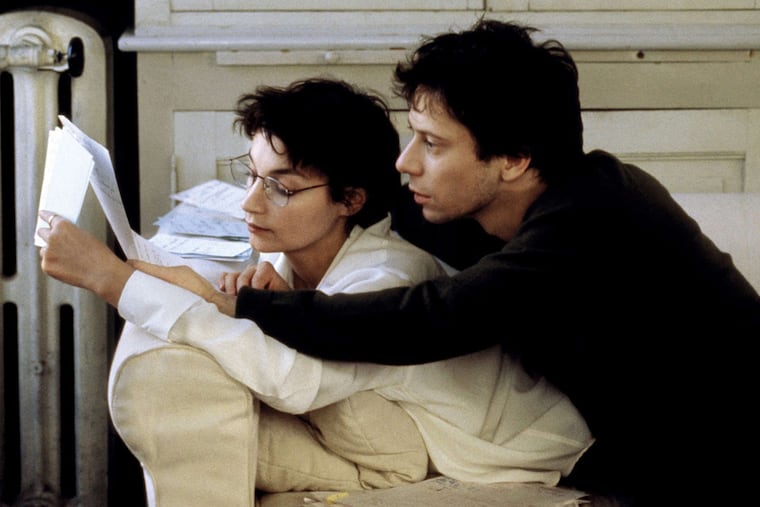
Arnaud Desplechin, whose playful movie My Golden Days, about young love, is now in theaters, is the greatest contemporary French filmmaker no one has ever heard of.
Well, maybe "no one" is a bit of a stretch. Last month, to honor the U.S. release of My Golden Days, the Film Society of Lincoln Center hosted a retrospective of the writer/director's work. It is possible, in his movies, to see Francois Truffaut (restless romance) and Martin Scorsese (gear-shifting, genre-switching), and to catch shards of influence - ideas gleaned from vintage Hollywood, Asian cinema, the French New Wave.
In his homeland, Desplechin and his movies get nominated for - and often win - the Cesars, France's version of the Oscars, just about every time a new one is released. He joins Wes Anderson, David Fincher, Richard Linklater, and Scorsese as one of the directors musing about moviemaking in the great documentary Hitchcock/Truffaut. His movies surprise and delight and are filled with insights about the human condition, the folly of humankind.
Desplechin's breakthrough film was 1996's My Sex Life . . . Or How I Got Into an Argument, an epic (three hours) survey of the life of a young, jittery academic, Paul Dédalus, as he falls out with his old girlfriend, falls in with his best friend's, and then fools around obsessively, hopelessly, facing humiliations at once comic and profound.
The film, starring Mathieu Amalric as Paul, is a gem, winning festival prizes and the hearts of ardent fans. It marks one of the earliest screen appearances by Marion Cotillard. To know My Sex Life . . . is to belong to a lucky band, a secret club. Catch it on the streaming service mubi.com, or get the DVD from Amazon.
My Sex Life . . . is also where My Golden Days springs from. Now in its second week at the Ritz Bourse - see it, it's imperative - My Golden Days revisits My Sex Life . . .'s hero-in-crisis 20 years on. Amalric is back as Paul, now firmly established in the world of anthropology. But then the film goes flashing back to his youth and adolescence. The third, and longest, part of My Golden Days stars newcomer Quentin Dolmaire in the role of Paul. Yes, it's a prequel, but Desplechin insists you needn't be familiar with the original to get what's going on.
"I had started out with just the idea of writing about young characters, which was something that I never did before," Desplechin, 55, said on the phone recently from Paris. "I didn't plan to explore the character of Paul again. But I realized that this depiction of a young couple, one being a Parisian, living in the big city, and the other one from the provinces . . . was not that far from the past I had imagined between Paul and his girlfriend, Esther, in My Sex Life . . . . So I thought, 'Let's go for the prequel.' "
Desplechin told his young, untrained stars - Dolmaire and Lou-Roy Lecollinet, cast as the seductive Esther - not to look at My Sex Life . . . .
"I remember both of them were quite shy and nervous, because it was their first casting, and when we met, they asked, 'Should we see My Sex Life . . .?' and I really begged them, I said, 'Please never look at it. Never. You are here to invent something new, to speak for your generation.' "
Instead, he had the pair, in rehearsals, doing scenes from films Desplechin holds high on his list of love stories: All the Real Girls from David Gordon Green, starring Zooey Deschanel; and Bird, Clint Eastwood's Charlie Parker bio, with Forest Whitaker.
"This may sound surprising, but I think Bird is one of the most wonderful love stories I've ever seen. And I love the fact that, like Paul and Esther, Charlie Parker and Chan [Diane Venora] don't belong to the same class, they aren't from the same backgrounds. . . . We could say that these two couples, Paul and Esther, and Bird and Chan, each of them are a perfect match. A perfect match and a total disaster at the same time."
Amalric - known to U.S. audiences for his challenging, riveting portrayal of a completely paralyzed man in the Oscar-nominated The Diving Bell and the Butterfly and for his villainous turn in the 007 blockbuster Quantum of Solace - is in My Golden Days only long enough to supply an amusing framing device. Still, the project marks the actor's sixth collaboration with Desplechin.
The two are good friends, kindred spirits, and Amalric clearly functions as a kind of on-screen alter ego for his director. You could say Amalric is to Desplechin as Jean-Pierre Léaud, the precocious protagonist of The 400 Blows and a suite of autobiographically tinged endeavors, was to Francois Truffaut.
You could say that - I did, to Desplechin - but then you would be corrected, in gentlemanly fashion.
"If I had to name one famous actor/director collaboration in the history of cinema, one that perhaps bears a similarity to mine with Mathieu's, I wouldn't say Jean-Pierre Léaud and Truffaut," Desplechin says.
"We could say that Truffaut was the adult and Jean-Pierre Léaud was the child. . . . And that is not the relationship that I have with Mathieu. . . . Our relationship, if you are going to make comparisons, is much more like Marcello Mastroianni and Fellini. Mathieu's art is really close to Mastroianni's art, in the sense that he can go for tragic parts but still keep a sense of humor. This was the great strength of Mastroianni, his sense of humor. He doesn't want to be the hero, he doesn't need to prove that he's the best.
"I didn't admire Mastroianni that much, I didn't notice how much of a great artist he was when I first saw his films. . . . But Mathieu told me that I should go and see his films again, and watch what the guy is doing. I started to appreciate Mastroianni through Mathieu's eyes."
Desplechin is in preproduction on what he plans to be his next film, Ishmael and His Ghosts ("No connection to Moby-Dick - no white whale in this one"). He describes the project as a contemporary drama with three pivotal roles for women.
"I will shoot it in France, certainly, but also in India, in Tel Aviv, Prague, several locations," he says. "Perhaps Mathieu will be in it, perhaps not. Right now, I'm focusing on [casting] the ladies - it's the portrait of three women, and I don't know who these three different women will be."
He does know, however, that the sense of anxiety and dread that hangs in the air across much of the world right now will be at play in his new film.
"The feeling on the streets, the mood in Paris right now, is very stressful," he says. "It's shocking, these new attacks on Brussels, and this attack we just heard about in Pakistan. I'm not able to make political films, but the film that I'm writing - everything becomes more complicated by what is happening in the world.
"When I'm going to a bar, I ask myself, 'Do I go into the bar to have a drink or stay outside at a table? Which would be safer?' When I take the subway, I think, 'What if there's a bomb?' We have to think about it all day long.
"It's very strange. This quantity of hate is really disturbing."
215-854-5629
@Steven_Rea