A rapper's rebirth
Out of prison, John Forté has Carly Simon, Sen. Orrin G. Hatch, and former President Bush to thank.

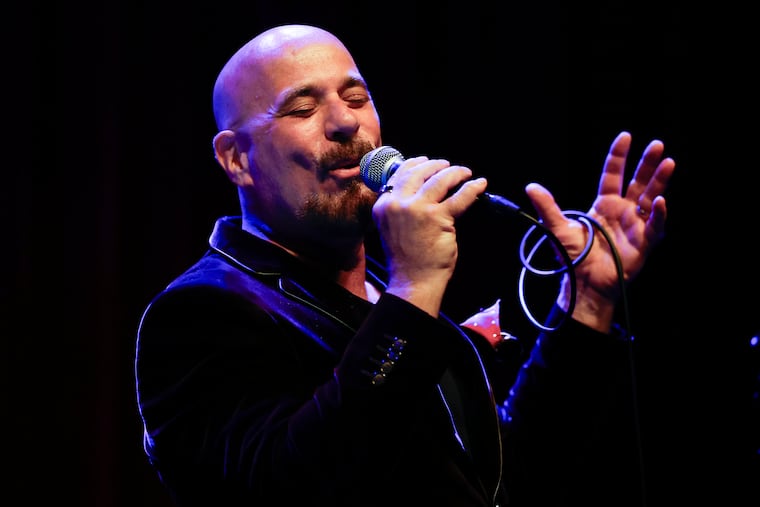
NEW YORK - John Forté, the rapper and singer-songwriter, was not just celebrating StyleFREE, his first new music in seven years, as he performed at a swank nightclub in Manhattan's Meatpacking District.
Looking out through rimless glasses at a packed Bastille Day crowd in a basement boite, his words carried a bit more weight than the usual release-party patter.
"Nine years ago today, I was arrested, and this is a rebirth for me," said Forté, 34, after a set in which he was variously accompanied by guitarist Ben Taylor, rapper Talib Kweli, and guitarist-producer Joel "JK" Kipnis. "This is like an operating room right here, because I feel very much reborn."
Forté's rebirth comes after serving more than half of a 14-year mandatory-minimum sentence for possession with intent to distribute about $1.4 million worth of liquid cocaine. He was arrested July 14, 2000, by DEA agents at Newark Liberty International Airport.
His reemergence - which continues with shows tomorrow at World Cafe Live and Friday at the XPoNential Music Festival in Camden - came through the efforts of two unlikely champions: singer Carly Simon, who is Taylor's mother, and Sen. Orrin G. Hatch (R., Utah).
But if Hatch, who has called Forté "a genius," and Simon, who says that working for the reduction of the musician's sentence "became my calling," were the midwives at Forté's rebirth, the delivery-room doctor was even more improbable.
In one of his final acts as president, George W. Bush on Nov. 24, 2008, commuted Forté's sentence. A little less than a month later, Forté walked out of the Federal Correctional Institution in Fort Dix a free man.
StyleFREE, a seven-song EP available on JohnForte.com, marks the return to recording for Forté, who made his name as a producer on the Fugees' mega-selling 1996 CD The Score. Forté, in an interview on the day of his celebration, said the new EP got its name from several things.
"It's a play on words," he says, sitting for an interview at Pulse, the downtown Manhattan studio owned by Kipnis, where Forté created StyleFREE (Theory 7 ***) and I, John, his wide-ranging 2002 artistic breakthrough, recorded under house arrest.
"StyleFREE," he says, "refers back to the halcyon days [in the late 1980s] when teenagers from Brooklyn and the South Bronx and Harlem would converge in Greenwich Village and freestyle for hours."
Raised in the Brownsville section of Brooklyn by his mother, Flo, who stood beaming behind him as he performed last week, Forté said he was "a little black boy who loved classical music." But along with his violin and Vivaldi's Four Seasons, Forté - who won a scholarship to attend the elite Phillips Exeter Academy prep school in New Hampshire - loved hip-hop acts like the Ultramagnetic MCs. He was one of those kids in Washington Square Park.
"I don't freestyle very much anymore," he says, sitting on a sofa in a sun-filled room, with Supreme Court nominee Sonia Sotomayor's confirmation hearing playing soundlessly on a flat-screen TV. The dreadlocks he hasn't cut in 18 years are bundled atop his head, making him look like a pensive mullah.
"But the style of the music is free." He breaks into a broad smile, and laughs. "And I, along with the music, am free."
For a good part of his life, he wasn't. He spent seven years and eight months "away" - first in a federal prison in Texas, then in Loretto, in western Pennsylvania, and finally in Fort Dix. He was moved there in 2004, thanks to Hatch, not only a member of the Senate Judiciary Committee but also a songwriter. Simon, a Democratic fund-raiser, says she turned to Hatch in frustration after getting little assistance from the other side of the aisle.
In a 2006 letter obtained by the Salt Lake Tribune, Hatch did not deny that Forté was guilty of a crime, but argued that the artist should be freed in part because "he was no risk to society, because he was not a drug-user. And frankly, he's a genius." Hatch, who could not be reached for comment for this story, obtained privileges for Forté to have a guitar, which he taught himself to play in prison. Forté has called Hatch a "superhero of a mentor to me."
In prison, Forté decided that when he got out, "my greatest promise to myself was to not take the present for granted. To not look too far ahead or too far behind, but to really appreciate and savor the moment. . . .
"Twenty or 30 or 40 miraculous things happen to me in the course of a day. Just being able to get a sandwich, or see a child's face - these are the details I missed and I really yearned for."
Today, Forté lives in Manhattan, writes a blog for Tina Brown's Web site, the Daily Beast, and is at work on a memoir for Simon & Schuster. And he leads songwriting workshops for children of inmates.
With StyleFREE, he moves confidently between edgy paranoia ("Nervous") and open-hearted optimism ("Best That Love Could Be"), while displaying a melodic inventiveness and a slightly raspy soul voice. "He has a very unusual blend," says Kipnis, his production partner, "of being a lyricist with a depth that very few lyricists have, in addition to having an incredible melodic sense, and the production chops to really know how to put those components together."
The EP's often-mellow sound will be a surprise to anyone who knows Forté primarily though his hip-hop-centric work with the Fugees, or his 1999 streetwise solo album, Poly Sci.
While at Fort Dix, Forté devoured old-school media. Now, he's a Rip Van Winkle fully awake to the digital age - he's on Facebook, MySpace and Twitter.
But in prison, he was without an iPod, CD player, or computer, so he turned to publications like the New York Times and Foreign Policy, and listened to music on an AM/FM Walkman, usually tuning in to adult alternative station WXPN (88.5 FM).
"It inspired me," he says, "hearing new groups break on 'XPN, listening to people like Chan Marshall [who records as Cat Power], José González, and Regina Spektor and Sia, and just to be floored by what I considered a return to musicianship. It made me want to spend more time with my guitar."
And Forté had plenty of time on his hands after the events of July 14, 2000.
Forté and his supporters have always insisted he was not what the government made him out to be. "John was not a dope dealer," Simon says.
In a 2002 Rolling Stone jailhouse interview, Forté said he believed he was helping Jamaican drug-dealer Chris Thompson move large sums of cash, which turned out to be two suitcases filled with freezer packs of liquid cocaine. DEA agents, tipped by two drug couriers they captured in Texas, arrested Forté in Newark after he put the suitcases in the back of a taxi.
A year earlier, Simon had taken Forté under her wing and put him up for six weeks at her Martha's Vineyard home. Her son, Ben, and Forté had become best buds after meeting in New York in the '90s. She considers him her "godson," and he calls her "Mama" and his "spiritual guru."
"He was eager to make money," says Simon by phone from the Vineyard, "and acquiesced to people who were using him to be the fall guy."
With the Fugees, Forté didn't get rich, but came into "more money than I'd ever seen," he says. After that run, he was dropped by Sony when Poly Sci underperformed.
"It was a combination of factors - not knowing where the next check was coming from, still desiring to have a career in the business," he says. In addition, "in the industry back in the day, the wrong people were always around."
He doesn't claim to be innocent.
"We committed crimes and were punished for our poor choices," he wrote for the Daily Beast in March, referring to himself and other inmates. Those working on his behalf argued more against what Simon calls "the underlying racism" of the federal sentencing laws that left the Texas judge no option but to sentence Forté to 14 years.
With the help of Hatch and attorney Michael Nussbaum, Simon was able to see to it that Forté's portfolio wound up on Bush's desk.
"I'm grateful," Forté says, when asked what he makes of being given his life back by President Bush - a president who, fellow rapper Kanye West famously contended, "doesn't like black people."
"People ask me that all the time, like they're waiting for me to say something reckless and irresponsible," Forté says. He has no intention of doing so.
Forte says that in prison and out, he has never allowed himself to be consumed by anger at himself, or at anyone else.
"There is an urge to get despondent," he says. "That's the human impulse. A lot of guys will say, 'I gave the feds five years,' or 'I gave the feds eight years.' I fought as hard as I could to not give anybody anything. . . .
"Anger is counterproductive, and I'm all about productivity right now," says Forte, who has a full-length album, Water, Light, Sound, due early next year. "Not to say I'm denying the journey of emotion, the ups and downs. It's the vicissitudes of living. . . . I feel consumed with the alacrity to live."
Now that he's free, he says, "I want to have the time of my life. I need to make a living, but I don't need to be the No. 1 man on any list. I want to be sincere about the craft and the art. It behooves me to love the music I release. Nothing I do will begin in a contrived place. I think the music is going to speak for itself."