Jazz whiz
She doesn't like to hear it, but Esperanza Spalding is a musical wonder woman, with a talent she'll display here.
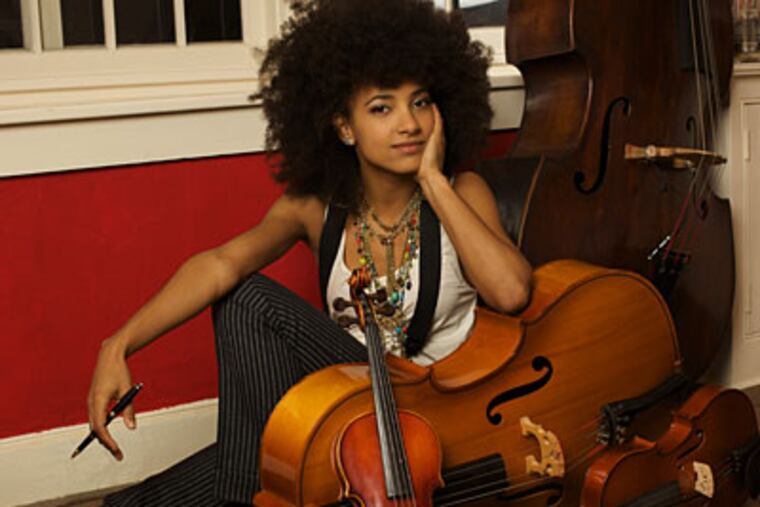
Esperanza Spalding doesn't like being pigeonholed. Even when labels are in her favor, as they've been since she started playing music at 5, she's not fond of them. She'd rather not be known as a "prodigy" who mastered the acoustic double bass by age 15, or as the youngest instructor in Berklee College of Music history at 20.
But her reputation(s) precede her. This weekend Spalding will appear with a who's who of jazz greats, national and local, at the West Oak Lane Jazz & Arts Festival.
Her acclaimed 2008 CD Esperanza ushered in two huge years, two appearances at the White House, a Banana Republic ad campaign, the Jazz Journalists Association's 2009 Jazz Award for up and coming artist of the year, and the 2009 Jazz Week Award for record of the year. Last year was capped by an invitation from President Obama to perform at both the Nobel Prize Ceremony in Oslo, Norway, and the Nobel Peace Prize Concert.
Still, Spalding could do without the focus on her gender that came with the May issue of O (for Oprah) magazine's "Women on the Rise" feature. Despite widespread praise for the blend of Latin, soul, Afro-Cuban, and classical music found in Esperanza and her coming CD, Chamber Music Society, she's unsatisfied with being known as a jazz instrumentalist, composer, and multilingual vocalist.
Of the intuitions and obsessions that guide her and her sophisticated brand of music, Spalding says only, "It's a real hodgepodge, what inspires me, what I do." The 25-year-old has always had a restless spirit.
Raised by her mother in a single-parent household, Spalding was homeschooled in Portland, Ore. She decided she wanted to play her first instrument, the violin, when she saw one at age 5 on Mr. Rogers' Neighborhood. "The violin," she says, "was my entrance into music, but it wasn't my passion."
The bass was. When Spalding finally attended a formal high school, she walked by a stand-up bass in the band room. "Sonically, I was captivated," she says. "The resonance of the instrument, the idea of putting my head on its shoulder, the way it vibrated."
From the bass, Spalding learned she had another passion: improvised music. That spoke to her beyond any single instrument, any single musical genre. Laughing, she imitates her own delighted discovery back then: " 'I can make up music using my ears? Well, awwwwwright.' "
She plays with the elegance and force of legendary jazz bassist Ron Carter, and composes songs that are complex and catchy. But another gift is unfairly underrated, one with a big role in her improvisational yet inviting music: her voice. Her contralto tones and sharp phrasing show off a love of Betty Carter and Blossom Dearie with a multilingual twist. She grew up speaking Spanish, Portuguese, and English - why shouldn't she sing in them, too? "Being multilingual offers me a broader arsenal," she says, "to do something as holistically as possible."
Spalding won acclaim as a session musician, playing bass and singing on recordings led by jazz masters such as saxophonist Joe Lovano, trumpeter Christian Scott, and guitarist Mike Stern. She released Junjo in 2006, but she does not consider that her true debut as a leader. "Junjo is cool, but it was made to highlight the trio I was with," she says. "If there's any trajectory to be heard in my recordings, it starts with Esperanza."
Her musical conversation continues in August with Chamber Music Society. "My classical past and present are part of the new album," Spalding says. "With chamber music, I'm highlighting one specific area of my musicality. But every idiom of music goes through evolution and takes into account everything we're hearing."
Chamber Music Society is a darker, more intense album than Esperanza, with propulsive percussion, moody strings, and rich vocals (Gretchen Parlato and Milton Nascimento are but two of the singers) besides her own. The result, she thinks, is a more coherent recording.
Comparing Esperanza with Chamber Music Society, she says, "The first time you met me you might've just wanted to see if you could hang out with me at all. The more you got to know me, we'd figure out what was next. I love that adventure."