Sigur Ros, transcendent at the Mann
Almost every song that Sigur Ros played at the Mann Music Center on Friday night contained at least one moment of thrilling transcendence. Sometimes it came as a thunderous climax, sometimes as a subtle shift in dynamics, often as a part of vocal line fro
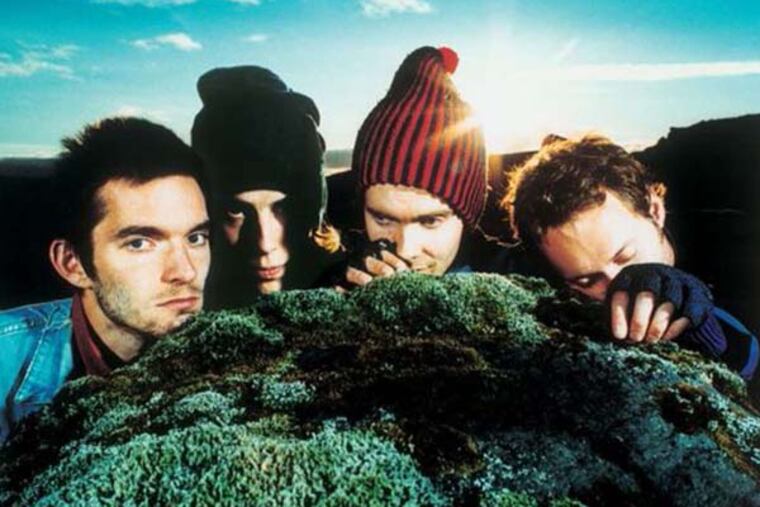
Almost every song that Sigur Ros played at the Mann Music Center on Friday night contained at least one moment of thrilling transcendence. Sometimes it came as a thunderous climax, sometimes as a subtle shift in dynamics, often as a part of vocal line from the inimitable Jon Por Birgisson, better known as Jonsi. The Icelandic trio, bolstered by eight other musicians at the Mann, plays a sui generis form of orchestral rock, full of spacious passages of meditative bliss, carefully constructed crescendos, and remarkable vocals. It's music that foregrounds its seriousness of purpose - which, for some listeners, can come across as pretentious - and it creates its own world and emotional soundscape: once you enter into it, it's totally absorbing.
It's doubly absorbing to witness the band create that music live and see how they produce those magical, alien sounds. At the center is guitarist and vocalist Jonsi. He uses a cello bow on his electric guitars, which creates a swooning, deep drone that gives most songs a dense but shifting base. Sometimes, his guitar produces something akin to a Doppler effect, where the chords rise slowly into clarity and focus then fade; sometimes, it's a frenetic, insistent set of tones. It's unusual, and on the recordings, it often scans as a keyboard sound more than a guitar one, so seeing Jonsi stand bowing his guitar makes Sigur Ros make sense in new ways.
And then there's his voice. In contrast to the dark, oceanic tones of his guitars, he sings in a clear, choirboy falsetto that's full of sighs and cries; it's celestial and direct. And, for those of us not fluent in Icelandic, it comes across as pure melody, unimpeded by denotative meaning. He has a look of intense concentration as he sings, even when the melodies soar into the stratosphere, but his voice is so unique that it's deeply fascinating to see it emanate from a human on stage.
Although Jonsi is the source of Sigur Ros' most singular, signature sounds, he is just the center of the swirl of orchestration. Bassist Georg Holm and drummer Orri Pal Dyrason, stationed in the front line of the stage with Jonsi on Friday night, anchor and drive the shifting dynamics, whether it be the gradually quickening gallop of "Yfirborð" or the pummeling, metallic wall of "Brennisteinn," the night's opening songs. Both those tracks come from Sigur Ros' most recent album, Kveikur, which is its first as trio after the departure of keyboard player Kjartan Sveinsson. The nearly two-hour set drew heavily on that album and on 2005's Takk, the band's two most immediate and direct works.
Adding to the grandeur were three horn players (trumpet, French horn and trombone), a string trio, a keyboard player and an additional guitarist, although the musicians shifted often, adding percussion, xylophone, flute and vocals. The band constructed an impressive cathedral of sound, but the startling moments of beauty often came before the climaxes: a calming flute solo during "Olsen Olsen"; an elegiac piano melody to open "Hoppípolla"; the precise, clear xylophone notes leading the stately, regal finale of "E-Bow"; the one-note bassline kicking in late in the set-closing "Popplagið" to drive the song, and the evening, toward an electrifying conclusion.
Beneath a video screen showing impressionistic scenes of forests, landscapes, swimmers and floating objects, the band was, for the most part, impassive and absorbed in the music. Until late in the evening, Jonsi rarely strayed from the center-stage mic or acknowledged the audience. But while the performers may have been static, the performance itself was full of dynamics, of startling clarity and thrilling power.
Julianna Barwick opened with a brief set of hymn-like vocal music. The Brooklyn-based Barwick recorded her most recent album, Nepenthe, in Iceland, and like Sigur Ros, she communicates through pure sound more than through conventional grammar. Backed by a guitarist playing sustained, feedback-edged tones, Barwick sampled and looped single vocal lines to build a dense choir of her own voice. The video images of a floating, drowned body made it unsettling, but the sound was beautiful.