Blues greats come alive again
New releases from the vaults of Pops Staples and Lead Belly recount the sounds of struggle.
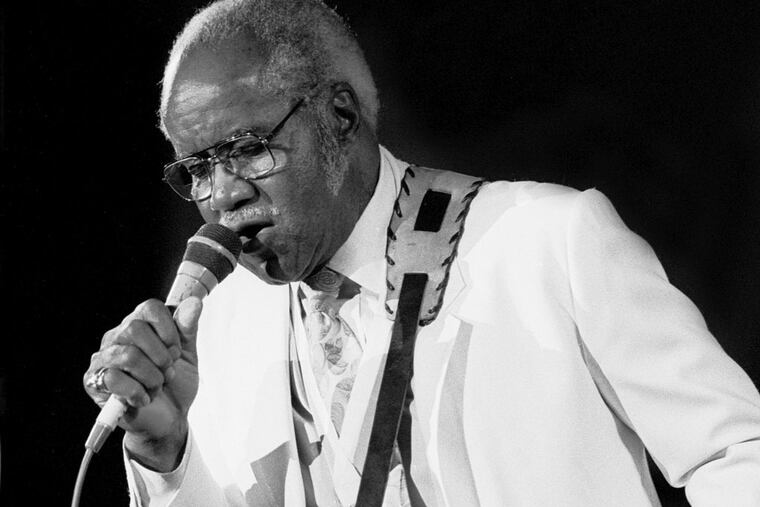
If you wanted to write a song that would resonate through the ages, you could do worse than call it "No News Is Good News." That's the third song on Don't Lose This, the "new" album of music by Roebuck "Pops" Staples, the Delta blues guitar great who played with such progenitors as Son House and Robert Johnson.
The Staple Singers patriarch died in 2000 at age 85, but not before recording vocals and guitar for an incomplete final album. On his deathbed, he handed the master tapes to his daughter Mavis and said, "Don't lose this!"
She didn't. And last year the powerhouse vocalist asked Jeff Tweedy, the Wilco songwriter and fellow Chicagoan who has produced her last two albums, to help her flesh out the music. He has done so, with the help of his drummer son Spencer.
Don't Lose This (dPbm/Anti nolead begins ***1/2 nolead ends ) arrives with Freedom Highway Complete: Recorded Live at Chicago's New Nazareth Church (Legacy nolead begins **** nolead ends ), a 1965 album credited to the Staple Singers, the family band that included Pops, Mavis, and her sister Cleotha and brother Pervis. And there's a new 5-CD box simply called Lead Belly (Smithsonian Folkways nolead begins ***1/2 nolead ends ) and dedicated to the singer born Huddie Ledbetter.
So the Staples and Lead Belly sets are part of a clutch of Black History Month releases that shine a light on the enduring power of African American roots music.
"No News" surveys a grim landscape: "Too many sidewalks are stained with the blood of our precious children and those that we love," the bottleneck slide player sweetly sings. "Disasters in the paper, violence on TV / Hatred on the radio, and crime in the streets."
"No News" is driven by a snaky, captivating guitar part and a quietly hypnotic groove. But it describes misery and woe as familiar now as they were back when the Staple Singers marched with the Rev. Dr. Martin Luther King Jr. during the civil-rights struggle of the 1960s.
That struggle will be musically recalled on Sunday's Academy Awards telecast, when John Legend and Common perform "Glory," the Oscar-nominated song from Ava DuVernay's Selma. "Glory" artfully parallels MLK's '60s struggles and recent protests over the police shooting of Michael Brown in Ferguson, Mo. It also calls for intergenerational effort: "No one can win the war individually," Common raps. "It takes the wisdom of the elders and the young people's energy."
That wisdom can be heard on Freedom Highway, which vividly brings to life the charged period in American history dramatized in Selma. Recorded in April 1965 in Chicago, the recording, long out of print, is of a church service little more than a month after the family walked with King on his march from Selma to Montgomery, Ala.
The album has a you-are-there feel, from Pops' opening remarks ("When we're in God's house, we should be there for the good that we can do") to the sound of a collection plate being passed.
One high point is Pervis Staples' recitation of "The Funeral," a haunting soliloquy penned by Hank Williams. The title cut, "Freedom Highway," was fresh, written after the Staples' experiences in the Deep South. "From that march, word was revealed and a song was composed," Pops says. The song points out injustice ("The world is wondering what's wrong with the United States") while rising with enough spirit to convince skeptical souls that the march up Freedom Highway will surely culminate in peace and enlightenment.
The Staples soulfully drew from many strands of American vernacular music: gospel, blues, even country. The profoundly influential Lead Belly - of whom George Harrison once said, "No Lead Belly, no Beatles," and whom Kurt Cobain called "my favorite performer" - was similarly multidimensional. A key 20th-century pop music figure, he died of Lou Gehrig's disease in 1949 at 61. With his 12-string guitar and attention-commanding voice, he's often mischaracterized as a pure bluesman, but in fact was what folklorists like to call a "songster," a troubadour who gathers up all manner of tunes, writing them if need be.
Ledbetter's first name rhymes with "foodie." His story is well told in The Legend of Lead Belly, a documentary that airs on the Smithsonian Channel at 8 p.m. on Monday. Being a "songster" could mean singing protest songs like "Scottsboro Boys," about nine black men accused of raping two white women in Alabama in 1921, or chronicling the "Jim Crow Blues." And it could mean writing a song like "Governor Pat Neff," in which the singer, then serving time in a Texas for murder, appealed to the highest office in the state for a pardon. He got it.
Lead Belly also sang children's and cowboy songs. A fan of Gene Autry's, he hoped to go Hollywood and star in Westerns. His signature song, "Goodnight, Irene," became a million-seller for his friend Pete Seeger's group, the Weavers, the year after Lead Belly died.
The Smithsonian box is a reminder of how much fun Lead Belly's music is. The quiet Beatle wasn't kidding: It was Lead Belly's frenetic version of the convict song "Rock Island Line," after all, that was covered by Lonnie Donegan and became a massive skiffle hit in Britain in 1956. Along with Elvis Presley's "Heartbreak Hotel," it sent the Fab Four on their way.
The Smithsonian documentary features interviews with Van Morrison and blues man Chris Thomas, who starred in the Coen Brothers' O Brother, Where Art Thou? It also explores how Lead Belly fits into the narrative of cultural appropriation, still hot thanks to Australian rapper Iggy Azalea's "blaccent."
Pictures usually show Lead Belly nattily dressed, often in a bow tie and suit, rather than the work clothes favored by Woody Guthrie, who said Lead Belly was "the hard name for a harder man." But when folklorist John Lomax brought Lead Belly to New York in 1935 after recording him in a Louisiana prison (where he was serving a term for attempted murder), Lomax convinced the singer to sing in prison clothes.
"It was like he was presenting King Kong," Thomas says. " 'We've got this wild beast in chains, and he's going to sing for you.' " In a practice typical at the time, Lomax and his son Alan also took partial writing credit for Lead Belly's songs.
The Lomax-Lead Belly relationship was hardly equitable. But Alvin Singh Jr., the songster's great-great-nephew, says it helped them both, and music-lovers everywhere: "Because when you look at Alan Lomax, how he discovered so many musicians, like Muddy Waters and Mississippi John Hurt - it started with Lead Belly."
215-854-5628 @delucadan