Curtis Institute's Jason Vieaux: Q&A with Grammy-winning classical guitarist
It was magical. Classical guitarist Jason Vieaux (pronounced vee-OH), 41, just won a Grammy for best classical instrumental solo album for Play. At Curtis, where he teaches, he's sitting on stage at Field Concert Hall (the one you see in the TV concerts),
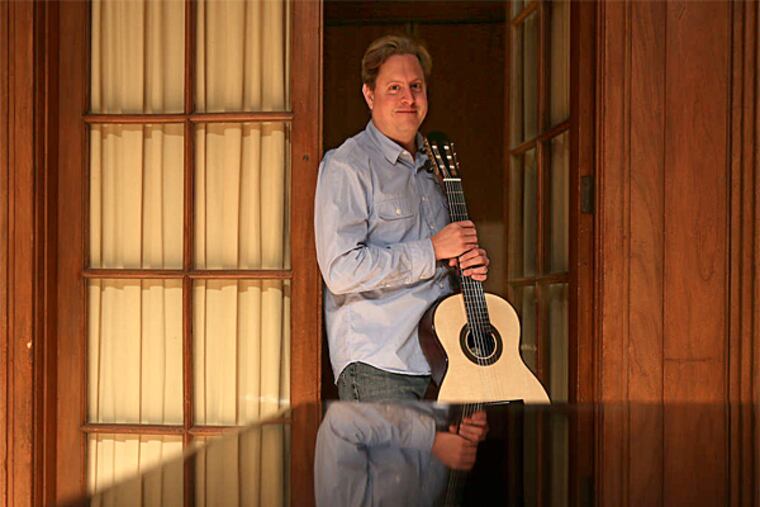
It was magical. Classical guitarist Jason Vieaux (pronounced vee-OH), 41, just won a Grammy for best classical instrumental solo album for Play. At Curtis, where he teaches, he's sitting on stage at Field Concert Hall (the one you see in the TV concerts), tuning up his Gernot Wagner guitar while a photographer gets ready. (You know someone's serious about music when he tunes up for a photo.) Then he breaks into a heartbreaking arrangement of "What a Wonderful World," and suddenly you remember why they call music beautiful: New emotions emerge in the old Louis Armstrong hit, something you already loved, but now you have new reasons for loving it.
Vieaux has been at Curtis since 2011, when he and fellow guitar star David Starobin were recruited to start a guitar department. He lives in Cleveland with wife Erine and daughter Gabriel. Cleveland he calls "a great arts city, with plenty of great restaurants, a lot like Philly, which is my favorite U.S. city." In demand for concerts everywhere, he comes to Curtis every two weeks for intense work with his students. Below, he speaks of winning a Grammy, his road to a classical guitar career, and . . . Eddie Van Halen:
Congratulations on the Grammy. What has that whole thing been like?
We're still in shock. The first big shock was getting nominated, because there were more than 400 excellent albums submitted for that category. So to get to the last five was amazing. We did not expect to win. But my wife and I went to L.A. and enjoyed it. It was a magical weekend.
Did you want it?
I really did. Now that you've gotten to the last five, you're thinking, "This actually has a chance of winning."
Tell us about "Play." Did you have a concept or approach going in?
We totally did. It's called Play, which of course means playing the guitar, but also it means being playful. Play is a lot like my recitals. It's full of short pieces, Latin-American, Spanish, fast, encore-type pieces: It's a celebration for me and my label, my management team, of 20 years of good work and being a professional touring guitarist.
How did you come to music - and the guitar?
I grew up in Buffalo. We didn't have any classical music in the house, but my parents had a very cool record collection. I dove into it every day. I had just goofed around on guitar until the Buffalo Guitar Quartet came to my school. My mother approached Jeremy Sparks of the quartet and asked if he would come to the house and give me lessons. And he said yes! I was 8 then. When I was 12 we did a full-length recital in Buffalo. So that was the moment I thought, "This is really fun - and I'm much better at this than I am at soccer."
Do you listen to any pop these days?
Right now, I'm really into Mastodon. Their six records are really interesting. I totally fanboyed them at the Grammys: "I have all your albums, I think you guys are great, can my wife and I take our picture with you?" And I'm a child of the '80s in Buffalo, so I've always been a big hip-hop fan. All my students are telling me I have to listen to Kendrick Lamar.
You say you really love Philly. How about Curtis?
Teaching at Curtis is a very special thing, and I'm very blessed to be a part of it. When they called David [Starobin] and me to help start the department, we both said, "What? Us? Well . . . yeah!" As in, "Of course!" As a teacher and a musician, you are seeing a slice of the very best the world has to offer, and they want to come to study with you. It's humbling, but also, I can't wait to pass on my experience and let them take it from there. This is a golden age of the guitar. It won't be my generation that brings the guitar to the top, but the students now coming up, in numbers that we've never seen before. They won't be denied.
Grammy-winner Jason Vieaux talks guitarists
Jason Vieaux reacts to a "lightning round" of names of historic guitarists:
George Harrison. My favorite band of all time. The Beatle that really brought real spirituality and Eastern music into their mix and made them all the better. [Plays "Within You Without You."]
B.B. King. He's like David Gilmour of Pink Floyd, or Prince, in that he can say an awful lot in one note. An amazing quality in a great, great artist.
Fernando Sor. One of the great 19th-century classicists. One of my favorite composers to play on the guitar. He writes actual composing parts for guitar, which is why they're so hard to play.
Jimi Hendrix/Eddie Van Halen. For my generation, our Hendrix was Eddie Van Halen. I'm an Eddie Van Halen fan. But Hendrix changed electric guitar, just changed it. Rock and jazz guys, it changed the game in a huge way. Hendrix gave a lot of guitarists license to play big and overdriven. Van Halen changed the guitar, too, with new techniques, which took it in another direction.
Sharon Isbin. A great representative of the instrument. Her energy in getting current composers to write for the guitar, such as Lukas Foss, Christopher Rouse - just a great service to music and the guitar.
Joe Pass. One of the great jazz guitarists of all time. I saw a solo show of his, and I heard his records in college. He inspires you: "You can do this, make entire records of just you playing."
John Mayer/Prince. John Mayer gets slagged a lot because he's an actual celebrity in the spotlight, but that dude can really play the blues. My wife and I saw him in Ed Sheeran's band at the Grammys, that amazing band, and he was playing some great stuff. He's a real, natural musician, an awesome guitarist. A lot of people can play the blues pretty well, but there aren't a lot of people where you say, "Oooh, that is him." Mayer has that quality. Prince is another one. You either have that or you don't.EndText