Q&A: Joyce Carol Oates on Wonderland, Happy Chicken, and becoming a writer
Joyce Carol Oates opens the door of her Princeton home and says, "Come in. It's very warm." It's also a day of arrivals. Copies of her new book, The Lost Landscape, a collection of autobiographical essays, are here ("I haven't actually seen it yet," she says, taking one out of the box). So is a new kitten. Princeton professor, novelist
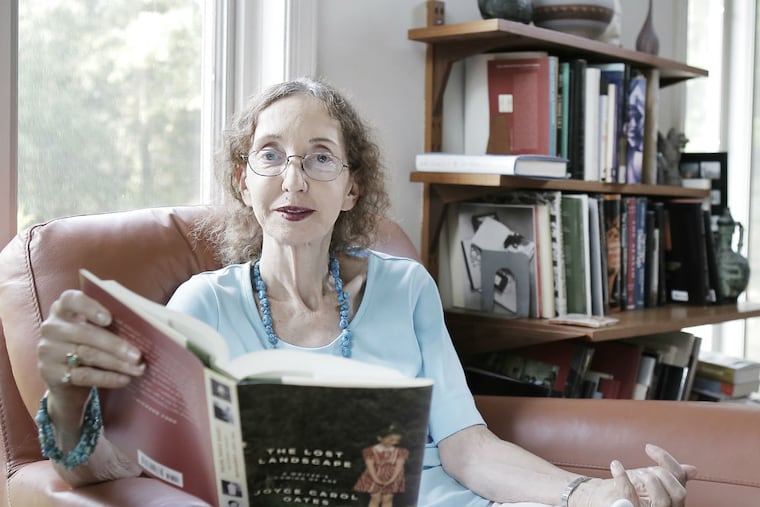
Joyce Carol Oates opens the door of her Princeton home and says, "Come in. It's very warm."
It's also a day of arrivals. Copies of her new book, The Lost Landscape, a collection of autobiographical essays, are here ("I haven't actually seen it yet," she says, taking one out of the box). So is a new kitten. Princeton professor, novelist (with an amazing 56 to her credit), essayist, poet, much-mentioned Nobel possible, and now accomplished Twitter presence, with 130,000 followers, Oates comes Monday to the Free Library.
Gracious, open, with a wide-ranging mind and a quiet sense of humor, Oates speaks about The Lost Landscape, about being a little girl growing up on a farm in Upstate New York, about the impact on that little girl when she read Through the Looking-Glass, and the formative power of loss and solitude.
In the essay "Happy Chicken: 1942-1944," we meet a chicken who is the narrator. This was a real pet who took on a lot of meaning in your imaginative life.
I was a little girl, and the chickens, especially the rooster, were big figures in my life. I was closer to these animals than to the adults. As for the narration, I was looking for a different perspective. When you're writing from a child's point of view, you look for a way to convey information the child herself does not know. So Happy Chicken, for example, can see into the future.
Children connect with animals in ways adults either lose or forget.
Oh, yes. Children talk to them. That's why the essay starts off as so nostalgic and tender. It's a photograph of a time in a child's life. But as it continues, into the future, my grandfather is going to die, my parents will die, and the chicken disappears. My friend commits suicide. And you feel that's one of the reasons childhood seems happy - it's that a child's perspective is so limited. Also, people were protecting me. My mother was protecting me from a lot of things, a lot of what was happening in the world. I suppose all parents do.
I was struck by how much you were alone. Was solitude formative for the little girl who became a writer?
Yes, I think so. Being a little girl on a farm, I was with animals a lot, and they weren't talking. [Laughs.] I would wander around, go in the barn, go down to the creek. I used to catch little crabs out of the creek, or go wading in the water. We wandered around on our bicycles, more or less on our own, unsupervised.
My father was working on the farm, my mother might be there or inside the house working, and I would just wander around. So there was a great deal of time you had to yourself, much of it quite happy time, some of it dark, time with your imagination.
Your parents came from a different era.
They came from the Depression and never felt secure economically. They would never waste money. They would never waste food. These were people of action who worked all day with their hands. To sit and read a book - that was something that would never have occurred to them.
You've said that the Alice books were what made you want to be a writer.
[At this point Oates lovingly opens a 1946 Grosset & Dunlap edition of Alice's Adventures in Wonderland and Through the Looking-Glass, by Lewis Carroll, with illustrations by John Tenniel.] This is the original book I had back then. It's gotten a little grimy over the years. But it's such an important book in my life. My grandmother gave it to me when I was 8 or 9 years old. I read it again and again. I just couldn't stop. What struck me was the whole imaginative world of this wonderful book, of course - the animals talk - but also that it had a little girl as the main character. She's really very courageous. A normal child would be terrified if put into that world, where you step through a looking glass, or go down a rabbit hole into a world full of all these creatures. But Alice is sort of a stiff-upper-lip kind of girl. Alice gets very big and gets very small, which reflects anxiety children have about their size and their growth. It's also scary. The Walrus and the Carpenter are walking with all these little oysters, and at the end, "they had eaten them all, every one." The oysters are little, which might make a child think of children, and the Walrus and the Carpenter are big, like adults. When I got older, I realized it has much to do with Darwinian evolutionary theory. The animals are changing their shapes; they are being eaten by other animals. It's a very unsentimental look at nature. Wonderful language; I just love "Jabberwocky," so brilliant, in which the words are nonsense, but somehow you feel you know what they mean. Alice always wins in the end, because Alice is the dreamer, and she controls the dream, and when it turns into a nightmare, she makes it end. In Through the Looking-Glass, Alice pulls the tablecloth off, knocks everything down, and cries, "I can't stand this any longer!" And she turns on the Red Queen, which is much like turning on your own mother. "As for you," she says, "I'll shake you into a kitten, that I will." And she does - she wakes up, in the middle of choking Kitty. Under the influence of Alice, I'm sure, I took to writing little novels on pads of paper, little stories illustrated with drawings - chickens, mostly. And cats.
You've really taken to Twitter. You've made it your own. What about it is so congenial?
I'm part of this kind of circle of other Twitterers, including Steve Martin, Katha Pollitt, Peter Singer, and Steven Pinker - and much of what I write is reacting to them. We discuss news events, or just topics that arise. And I do tweet a lot about the nature of social media. I really do feel it's a revolutionary kind of populist uprising. Minorities or marginalized groups that once lacked access now can make formerly covered-up events into worldwide news stories, on their own. Ferguson [Mo.] is an example of that. It shines a light into all the parts of the world that were hidden before. If there is corruption, brutality, or abuses of power, it's much harder to hide now: Somebody somewhere is going to tweet about it.
215-854-4406@jtimpane