Ellen Gray: Coming to America
BBC's Scit-Fi series 'Torchwood' features a bisexual hero
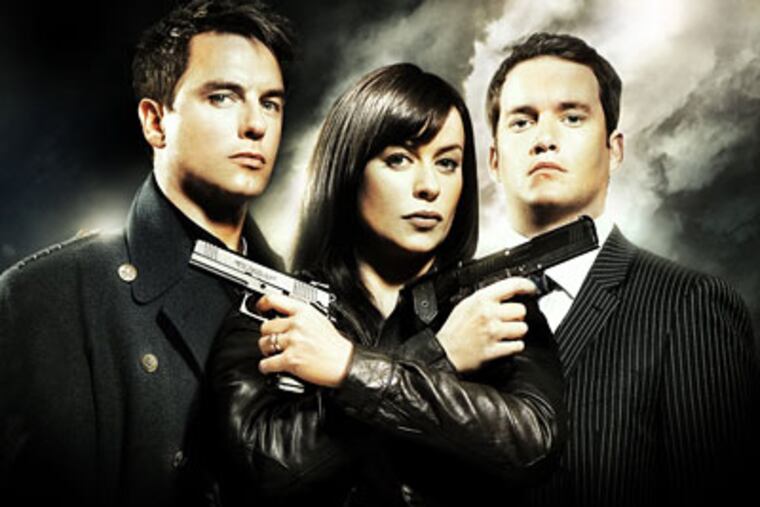
TORCHWOOD: CHILDREN OF EARTH. 9 p.m. tonight through Friday, BBC America.
IS AMERICA ready for "a swaggering, bisexual hero who laughs and jokes his way through every situation"?
Because Britain certainly seems to be.
"Torchwood: Children of Earth" is scheduled to launch on BBC America tonight, but earlier this month, nearly 6 million Britons tuned in for five consecutive evenings of the miniseries, as Russell T Davies' "Doctor Who" spin-off about alien-hunters in his native Wales made the leap to the nation's premier channel, BBC1.
It's a sweeping story whose controversial ending viewers may be debating for years, and in a country with a population a fifth the size of ours, it was watched by the equivalent of nearly 30 million U.S. viewers.
In July.
That may have brought a whole new level of attention for John Barrowman, who plays "Torchwood's" lead character, the literally indestructible Captain Jack Harkness.
A 42-year-old Scottish-born actor and singer with an American accent he picked up living in the U.S. - where he attended grade school, high school and college - Barrowman tends to remind people of Tom Cruise.
If, you know, Cruise were taller.
And had done a lot of musical theater.
And was openly gay.
"He's in the remarkable position of being a gay man who's both known as a singer and a presenter and an actor as well," Davies said in a recent phone interview of Barrowman, who's currently featured as one of the judges on BBC America's "How Do You Solve a Problem Like Maria?"
"He's adored by children. It's quite extraordinary to see John out in public in Britain, where children, they love this character, they're not bothered by the sexuality at all," said Davies, who's also gay.
"So he's a huge, swaggering character, played by a very clever and a very brave man. John is professionally out, always has been, which provides a magic combination that makes the character just sparkle on-screen, I think. He's larger than life but at the same time every detail is played, you know. We were very lucky," he said.
"He's a phenomenon. I can't think of any other equivalent. He's the first," he said.
Harkness, too, may be a first for mainstream sci-fi.
Initially seen in Davies' revival of "Doctor Who," he's been the central character for two previous seasons of "Torchwood" - which appears here on BBC America - where his swashbuckling ways and unapologetic flirtations with both men and women sometimes distracted from the fact that we didn't really know all that much about the guy.
In "Children of Earth," where Davies is writing for the series for the first time since the pilot, we find out a bit more.
And some of it, frankly, isn't pretty.
Davies, who's worked on British soaps, including "Coronation Street," and whose pre-"Doctor Who" work includes the creation of the gay-themed "Queer as Folk" - a version of which was later made for Showtime - has long enjoyed playing with people's expectations, and it's possible that the final hour of "Children of Earth" in particular may defy the expectations of some "Torchwood" fans.
But maybe less so in the U.S., where, as I pointed out to a laughing Davies, the show isn't on BBC1, but BBC114 (114 being its location, at least on Comcast's digital tier).
Chances are, few Americans have expectations of the miniseries, which, in any case, represents a relaunch of "Torchwood," moving it well beyond the smaller, "X-Files"-like cases it had been focusing on to something much more threatening.
"I think all programs should do that, they should bear in mind a new audience every time they relaunch," Davies said. "Science fiction shows do become very wrapped up in their own mythology. The whole point is to get new viewers."
So what would he tell people who may never have seen a single hour of "Torchwood" about "Children of Earth"?
"For the new viewer, it's a modern-day story, very much ingrained in the real world, but asks some very big questions about how much would you fight for what you believe in, what do you believe in, how far would you go?" he said.
"It's a story of a sort of eccentric bunch of people in that world in Britain who have spent their lives fighting aliens and being alien-hunters, and in a sort of very small and eccentric way. And now this time, it appears that everything they've faced goes global," he said.
At the same time, the agency known as Torchwood "is stripped of power. They find themselves very much down to being refugees, and almost terrorists. But almost like freedom fighters, having to go underground and find contacts and manipulate people in forced situations to get on top of the problem that's on its way," Davies said.
In a summer when our own networks have been serving up one disaster-based miniseries after another - we've been struck by meteors twice already and NBC's "The Storm" is just around the corner - the issues raised by "Torchwood's" alien invasion are surprisingly gut-wrenching.
It's five nights of stimulating and ultimately disturbing television, and I'd like nothing better than to have more people to talk with about it.
The miniseries also displays a cynicism about government that's far deeper than even what we've been used to from the show, which has always been more challenging than its more family-friendly parent, "Doctor Who."
Davies, who grew up watching the original "Doctor Who," an idiosyncratic British series about a time-traveling character who periodically moved into new bodies (so other actors could play the part), said, "I can remember being 3 and seeing the first Doctor regenerate into the second . . . It's such a huge part of my whole life," he said.
And while children loved the show, he said, it was never specifically a children's show.
"The currency of the schoolyard would be whether you were brave enough to watch" "Doctor Who," he said.
This summer, the currency of the water cooler may be whether you're enough of an adult for "Torchwood: Children of Earth." *
Send e-mail to graye@phillynews.com.