Jonathan Storm: Very naughty boys
A six-hour Monty Python documentary profiles the troupe whose absurd and irreverent wit changed comedy forever.
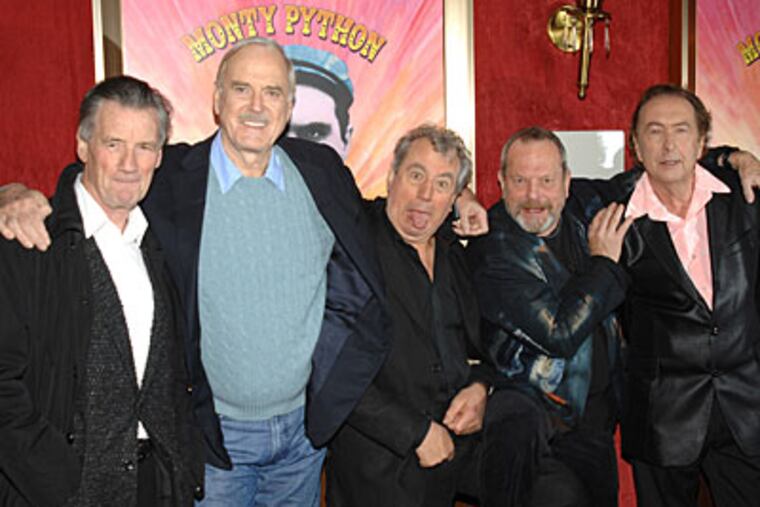
Premiering 40 years and 13 days ago, Monty Python's Flying Circus ran only 39 episodes, the equivalent of less than two seasons of a contemporary American sitcom, as it changed the course of English-speaking comedy.
Monty Python: Almost the Truth (The Lawyer's Cut), a monster documentary that starts tonight at 9 on cable's IFC, lasts almost as long as the show's entire first season.
It profiles six somewhat self-satisfied, thoroughly middle-class blokes who perpetrated comedy that started several steps past normal, say with transvestite lumberjacks. Then, assisted by the startling animation of the only American in the group, Terry Gilliam, it often wound up in daft dada land - fish-slapping dancers, Vikings chanting the wonders of Spam, and all that.
The Pythons were not pioneers. In the '50s, Philadelphia's own Ernie Kovacs lived in the world of the absurd. In Britain, radio's Goon Show and Peter Cook's Beyond the Fringe, which Python Eric Idle says "attacked everything that I'd just spent 19 years being oppressed by," broke the path for subversive silliness. The Smothers Brothers Comedy Hour, more flat-footed than Python, premiered nearly three years earlier. Rowan & Martin's Laugh-In, less socially conscious, bowed nearly two years before.
But Monty Python went far beyond any of them, with visual humor that could appeal to a 5-year old, naughty bits that got many a junior high-schooler's blood moving, and an unbridled disregard for the status quo that so completely characterized a generation coming of age in the late '60s.
The Pythons have been compared to the Beatles. Comedy does not have the same cultural influence as music, but it's safe to say they were worthy contemporaries.
"If older people start tut-tutting," says one of the hordes of talking heads in the documentary, "and younger people are having a wonderful time, you probably know you've hit on something really interesting."
Almost since Python premiered, there have been geeks in colleges from Australia to the Hebrides who can recite sketches verbatim. "Beautiful plumage" ("The Pet Shop Sketch") is good for an instant laugh in some precincts; "It's just a contradiction" (at the argument clinic) in others.
Like the Beatles, Monty Python eventually caught on with at least some parents.
British comic Sanjeev Bhaskar, who was 5 when Flying Circus premiered, says he and his immigrant parents came together over "The Fish Slapping Dance," 20 seconds of silliness in which Michael Palin, prancing to a merry tune, gives love pats with teeny trout to the much taller Python John Cleese. Cleese ends the proceedings by producing a honking halibut and knocking Palin off the pier 10 feet to the water below.
The visual humor of the dance crossed generations and the British-Indian cultural divide, Bhaskeer says. Just for a little more fun, Gilliam transforms the live Palin at the end of the sketch into a little cartoon drowning man who's gobbled up by the cutest Nazi submarine.
Quick cuts from live action to film to animation were pretty much unheard of before Monty Python.
The six-hour film airs at 9 nightly, tonight through Friday on the Independent Film Channel, part of the cabler's Python-a-thon, which includes an hour a night of the documentary, followed by a feature Python film (Live at the Hollywood Bowl tonight and Wednesday, The Holy Grail Monday and Thursday, Life of Brian Tuesday and Friday), and, every night, at 11:30, an episode from the first Flying Circus season.
The best part of the IFC revival: The channel continues that first season Mondays at 7:30 p.m. and Fridays at 11 p.m. through the end of the year, and plans to show seasons two and three in 2010, as well as the six episodes of a 1974 show called simply Monty Python, shot without the group's tallest and most famous member, John Cleese.
Cleese rhymes with "Cheese," the perfectly normal British name that Cleese's father, Reginald Francis Cheese, discarded in 1915. The documentary is full of such informational tidbits.
All five surviving members - Cleese, Palin, Idle, and the Terrys, Jones and Gilliam - were interviewed extensively, and there's plenty of archival chat with the sixth, Graham Chapman, who died in 1989 of spinal cancer. Lots of others, friends and fans, ranging from Jimmy Fallon to Seth Green to Eddie Izzard and Russell Brand, add their tuppence worth.
And all five Pythons were on hand Thursday in New York for a red-carpet extravaganza at the Ziegfeld Theatre, where they received a special award from the British Academy of Film and Television, and everybody got to watch the theatrical version of the documentary, trimmed to a more tolerable evening's worth.
Only a member of the huge Python cult or an academic could possibly sit still for six hours about the Pythons, as opposed to watching six hours of Python merriment. Even the documentarians recognized their problem, naming tonight's episode "The Not-So-Exciting Beginnings" and tomorrow's "The Much Funnier Second Episode."
It's funnier because it includes some comic sketches, but they are truncated. Further down, whole episodes focus on the Python movies, one for The Life of Brian, one for Monty Python and the Holy Grail. You get funny excerpts, but also lots of blah-blah.
The boys, despite flashes of personal flamboyance and naughty language, do not seem to have overcome their stiff-upper-lip upbringings in postwar England. It's as if writing and performing - everyone uses the word subversive, but irreverent is probably better - was the only way they could escape.
They do not come off as the pleasantest troupe. They didn't have "the slightest interest in each other as people," Idle says. Cleese, who worked closely with Chapman, admits he had no idea for years that his writing partner was a raging alcoholic.
Eventually, at the famous 1989 memorial for their fallen comrade, genuine feelings seem to appear.
Idle remains the most active in showbiz. Spamalot, for which he wrote the book, was a hit on Broadway and has played around the world, including a run in Las Vegas.
But in many ways, the Pythons seem to have become the people they mocked 40 years ago. Palin makes travel films. Jones writes op-ed pieces and books about the Middle Ages. You probably won't see Cleese, for instance, the oldest in the group at 70, doing very many silly walks anymore. One of his recent gigs was selling golf balls for Titleist.
Jonathan Storm:
Television
Monty Python: Almost the
Truth (The Lawyer's Cut)
9 p.m. today-Friday on IFC