Ellen Gray: New HBO film depicts life of autistic woman
TEMPLE GRANDIN. 8 p.m. Saturday, HBO. THE MOST impressive review of HBO's "Temple Grandin," which premieres Saturday, may have come from Temple Grandin herself.
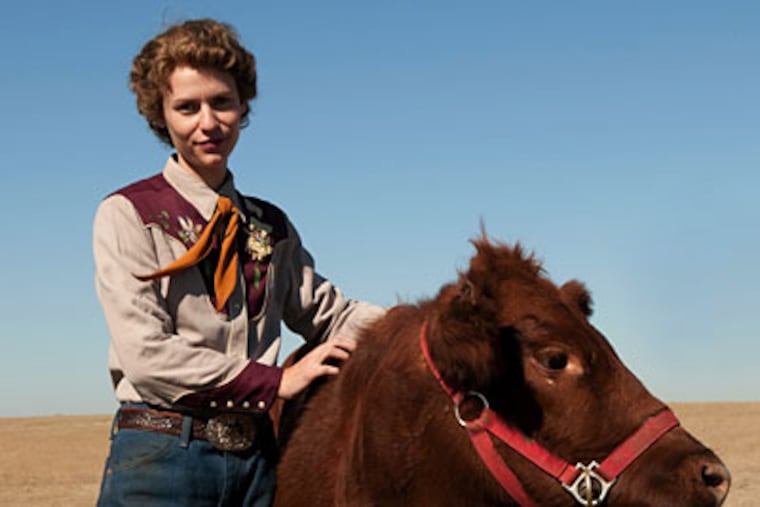
TEMPLE GRANDIN. 8 p.m. Saturday, HBO.
THE MOST impressive review of HBO's "Temple Grandin," which premieres Saturday, may have come from Temple Grandin herself.
A scientist and best-selling author with autism, the 62-year-old Grandin's a visual thinker - she titled one of her books "Thinking in Pictures" - and the details matter to her.
But so apparently do the emotions.
"It's like going in sort of a weird time machine, and just watching the trailer, I'm getting kind of choked up," Grandin said last month in Pasadena, Calif., when I asked her how difficult it had been to watch Claire Danes playing her younger, not yet so successful self on-screen.
"I whispered to Claire, I said, 'Can you believe that's really you?' She said it was kind of weird for her, too,' " Grandin said, adding that Danes "played me really, really accurate" as a student and young animal-behaviorist.
"This is [the] '60s and '70s. This movie ends at the end of the '70s, and the thing about autism is as you learn more and more and more, you keep getting less and less autisticlike. In order for Claire to get some inkling of how to do this part, I found an old TV show tape from the '80s and an old VHS tape from the early '90s for her to watch," Grandin explained.
Danes, last nominated for an Emmy 15 years ago - for "My So-Called Life" - might as well pick out a dress for this year's ceremonies right now. Her performance goes well beyond impression as she disappears into a character whose differences can be seen as both devastating and highly useful.
Grandin's writing and lecturing on autism have helped open a once-hidden world to the rest of us, but her other passion is animals, and specifically, the humane treatment of livestock, a field in which she's pioneered changes using the very differences that have so often puzzled her fellow humans.
Odd as it seems at times - she's been honored by People for the Ethical Treatment of Animals, but some may nevertheless be bemused by her interest in keeping cows calm on their way to slaughter - it's that passion that helps separate "Temple Grandin" from your average made-for-TV biopic.
Because despite a powerful performance by Julia Ormond as Grandin's determined mother, whose efforts kept her daughter in the mainstream at a time when such inclusion was far less common, this isn't so much a movie about a woman overcoming a disability as it is about one learning to know herself and appreciating her strengths while continuing to push her limits.
Surveying a ballroom full of reporters typing away on laptops during the Television Critics Association's meetings last month, Grandin noted that without people like her, people who are interested in things, "you would have no technical equipment here, you would have no hotel here . . . Who do you think made the first stone spear? It wasn't the yackety-yaks around the campfire. That's for sure."
"I'm the yackety-yak around the campfire," chimed in Danes, who said that as part of her preparation, she had a dialect coach meet with her and Grandin to "create a kind of Rosetta Stone of Temple" by recording their conversation.
Danes said she had it on her iPod, "and I was constantly reviewing it. It's so nice to see Temple and hear her voice. It was in my head for so long. And it's very familiar and very dear to me. It's nice. I spent a lot of time thinking about her."
Grandin, for her part, was happy to see her work accurately portrayed.
"They did a beautiful job on my projects," she said. "My actual real drawings had the cattle animated on them. The dip vat was actually built. They recreated all my projects. You know, when I first started out back in the '70s, I never thought I would make as much change in the industry as I did. I mean, now an auditing system I developed is used around the world. It has made a lot of improvements."
"She worried very much about the technical aspects of the film. The storytelling she sort of left to us," executive producer Emily Gerson Saines said in an interview after the press conference.
The challenge for Saines in helping to tell Grandin's story: "At the core, you have someone who's not social. So when you're portraying someone like that honestly on screen, it's difficult because they're not able to directly communicate with the audience. And you don't want to just make it cute, which has been done before."
As for Ormond's role, "one of the hardest things about being the mother of an autistic kid is you really have to give a lot of tough love. And that doesn't exactly make you the warm, fuzzy character in a film, either."
Said Saines, herself the mother of an autistic son: "I couldn't be dishonest to my community and I couldn't be dishonest to Temple. Because the reason she gave me her rights was she knew about my advocacy work in the world of autism and she knew I had an autistic child, so she knew I wasn't going to embellish her story with crazy things like romances." *
Send e-mail to graye@phillynews.com.
