The Vaux mineral collection may be the latest 'deaccession'
The Academy of Natural Sciences has asked to break his trust and sell the collection. Shades of Eakins and Barnes.
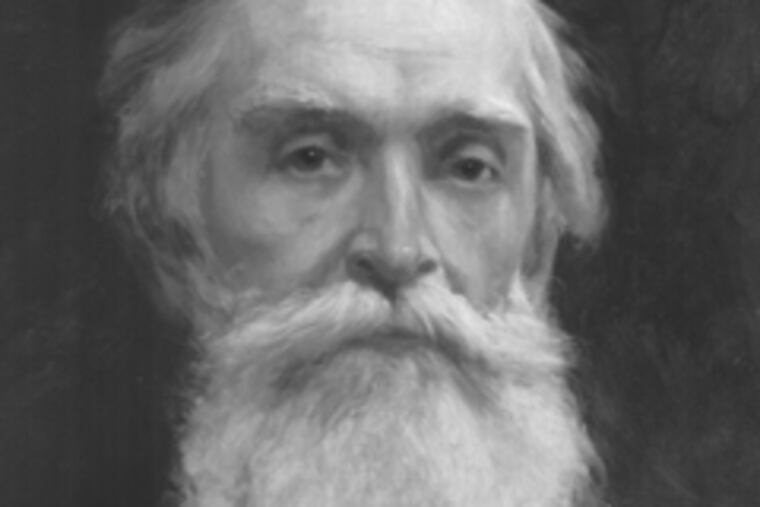
For more than a century, a trove of minerals collected by William S. Vaux - a white-bearded Victorian who listed his occupation as "Gentleman" - has remained at the Academy of Natural Sciences.
Housed in 15 yellow metal cabinets behind a locked door, the minerals range from specimens as valuable as gold to as mundane as quartz.
Now the academy is between 7,300 rocks and a hard place.
Vaux, who died in 1882, left his prized collection to the academy. But with strings attached - one, that it never be sold.
Last week, the academy was in Philadelphia Orphans Court, asking to do just that.
In the wings is a Colorado dealer, Bryan Lees, who has agreed to pay about $2 million. He said he was unlikely to find one buyer, so the collection would be broken up.
The academy says it needs the money for its library, a cache of artifacts, documents and books dating to the 1500s. The money would help pay to digitize the collection and increase staff.
But the plan has outraged mineral aficionados, who have frothed at length on list-serves. Vaux's great-great-niece, Trina Vaux of Bryn Mawr, also opposes the sale. Some in the academy itself are aghast.
The issue echoes the battle over the Barnes Foundation's move to Philadelphia and the quest to save Thomas Eakins' masterpiece, The Gross Clinic.
"The Vaux collection represents the history of natural science in Philadelphia," said Ted Daeschler, a paleontologist and academy assistant curator.
He sees the collection as "a terrific example of the premier institution in the country at the time acquiring what was the premier collection of minerals at the time."
The need exceeds the pain
The Vaux minerals are part of a much larger collection that the academy decided to sell last year - based solely on finances, president William Y. Brown said.
With an endowment of $60 million, the academy was hardly in danger of closing. All the same, choices had to be made.
The academy decided "the need of the library was greater than the pain of the sale," Brown said.
In October, 19,000 minerals were sold for $1 million after Orphans Court Judge Joseph D. O'Keefe agreed they were not part of the Vaux collection.
In December, the academy filed for permission to sell the Vaux minerals, too.
Vaux had left the museum $10,000 of Philadelphia & Reading Coal & Iron Co. bonds. Today, the income is only $4,760 - not even enough for storage and utilities.
The Vaux family was not happy - and hasn't been for some time. Trina Vaux, director of communications at the Shipley School in Bryn Mawr, said her father, George, had approached the academy in the 1970s and suggested a fund-raiser, but nothing came of it.
"So every 30 years," she said with a grin, "we Vauxes erupt."
Four weeks ago, she proposed that the academy transfer the collection - after a five-year "pit stop" at Bryn Mawr College for restoration - to the Wagner Free Institute of Science, a 19th-century national historic landmark in North Philadelphia.
Its cases are full of specimens collected by founder William Wagner, who died just three years after William Vaux.
Wagner director Susan Glassman hasn't yet figured the particulars. "It's really a question of saving this collection," she said.
About the time the academy got Vaux's proposal, it got a new president - Brown - who has said he wants to give the public a better view of the academy's 17 million specimens, most of which are off-limits to visitors.
When Marjorie Schwarzer, chair of the museum studies department at John F. Kennedy University in Berkeley, Calif., heard about the situation, she said, "This must be heart-wrenching."
Museums "deaccession" all the time, she said, "just like I 'deaccession' the shoes in my closet." And the academy's needs for its library "would be an absolute priority."
But, she said, "when a historical collection is deaccessioned, it gets very tricky."
The bounty amassed by Victorian gentlemen - some adventurers, some men who merely loosed the strings of ample purses - forms the backbone of more than a few collections at U.S. museums.
The University of Pennsylvania Museum of Archaeology and Anthropology, for instance, owes much of its Pacific collection to the 1890s travels of three Philadelphians, one a nephew of architect Frank Furness.
It's not clear how many minerals, if any, Vaux dug from the field, although he traveled widely to collect.
Family lore has it that he bargained hard for one specimen in Russia. He "was on the ship, about to leave, when the dealer came running down the wharf to sell the mineral," Trina Vaux said.
Indeed, here in a city some have called the "cradle of mineralogy" because of its early collectors, minerals must have been in the family's blood.
William Vaux's uncle Joseph Sansom amassed one of the first collections in America, which eventually went to Haverford College after his death in 1826. Today, Haverford has Sansom's journals, even some love letters, but no rocks.
William Vaux's nephew George Vaux Jr. also collected. His specimens went to Bryn Mawr College in 1958.
He once funded the trip of a collector who discovered a new mineral. It was later added to the academy's Vaux collection.
Its name: Vauxite.
Six months to consider
All agree that the Vaux collection - frozen in time 30 years ago when its last full-time curator left - has not had the care it deserves. It is dirty, and chemical reactions have caused some specimens to deteriorate.
At Wednesday's hearing, O'Keefe gave everyone six months to consider Trina Vaux's proposal to transfer the minerals to the Wagner.
Brown doesn't want to. "It's not that the academy wants to get rid of these minerals of historic importance." He said that, if there's no sale, the academy can - and will - care for them.
But "we need help," he said. Ask people whether an institution like the academy should keep such collections, he said, and "almost everyone says yes. If you ask them to write a check, almost everyone says no."
By Thursday, Daeschler was excitedly examining the minerals, planning a glass wall in front of open cabinets, confident the academy would now "do the right thing." He said he'd be the first to donate if a special fund was established.
Possible?
Academy scientists are passionate about the collections. They rebelled in 1996 over a plan to get rid of the dioramas - many from gentlemen's hunting trips in the early 1900s - because they weren't "sexy."
Daeschler threatened, somewhat in jest, to chain himself to the 10-foot-tall moose.
The dioramas are still there.