Butterfly ranching
The beautiful subjects for the Academy of Natural Sciences' exhibit are grown on farms in Costa Rica and around the world.
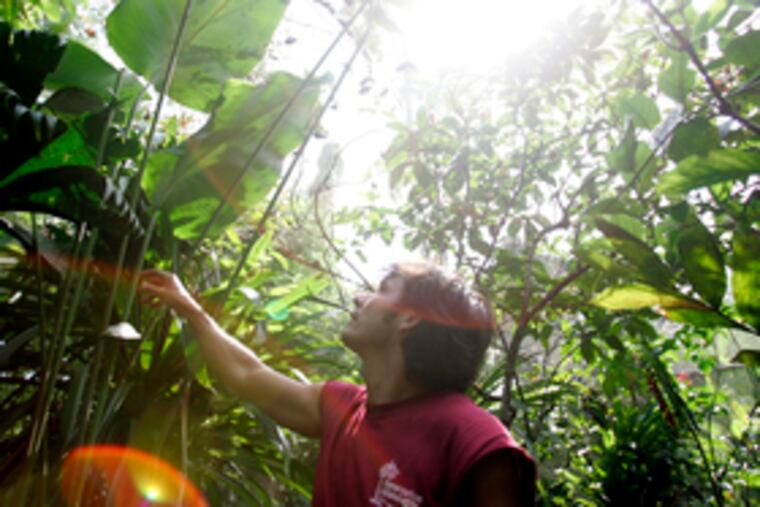
SAN BOSCO, Costa Rica - Down a half-mile of rocky dirt road, past banana groves and cattle swishing their tails through the warm, moist air, Miguel Murillo is pursuing a different breed of agriculture.
Every morning, he walks to his six backyard gardens, each flush with eye-popping tropical greenery, and gingerly removes tiny spheres from the leaves.
They are eggs, and his "crop" is butterflies.
This is a mariposario, a butterfly farm, one of dozens across the Costa Rican countryside. A former Peace Corps volunteer exports their product to museums around the world.
One of them, Philadelphia's Academy of Natural Sciences, opened a permanent butterfly exhibit in November, back by popular demand after two temporary incarnations. Visitors learn of the insects' life journey - from egg to caterpillar to pupa - and see them after they finally emerge as adults in colorful flight.
Lesser known are the details of their journey to Philadelphia. It be-
gins not only here in the lush green lowlands of Central America, but also farther afield in Africa and Asia.
For the farmers, the butterflies are the means to a demanding yet family-friendly way of life that is good for the environment and good for the wallet, providing a leg up out of poverty. And, in the opinion of Murillo's wife, Ligia Gutierrez, good for the soul.
Seated in her cheerful pink kitchen, placing pupae in a box for export, she describes her feeling for the insects as a "profound love."
In the wild, the life of a butterfly is a risky proposition.
After mating with the male - sometimes for hours at a time - an adult female typically lays a total of 100 eggs.
Perhaps two will make it to adulthood. The rest are eaten by lizards, spiders and wasps.
Or, the eggs may never be laid in the first place, because there isn't enough of the right kind of leafy habitat - a growing concern, even in enviro-conscious Costa Rica.
Boosting the odds
In Murillo's gardens, hung with protective black nets, the odds are reversed.
Every morning, the tanned, burly farmer and his three sons collect eggs and put them in small containers. They check the boxes for any eggs from previous days that have hatched into caterpillars, and place those in cages with a supply of leaves - food for the voracious but finicky eaters. Each species prefers a different kind of plant.
After a month or so of feasting, each develops into a motionless, hard-shelled pupa, also known as a chrysalis. These are collected, carefully placed in a blue plastic box, and driven to the bus station in nearby Guápiles in the family's Suzuki Sidekick - which, like the concrete house, was paid for by butterflies.
It is a relentless, seven-day-a-week schedule, as the eggs must always be collected, the plants tended and the caterpillars fed in order to keep the cycle going.
With proper care, 90 percent of the farm-raised eggs will make it to adulthood.
Butterflies are raised in the United States as well. But museums like specimens from abroad, where unfamiliar host plants yield unfamiliar species of the winged insect.
"We want to get butterflies that people wouldn't normally see," says Mike Sikorski, the Academy of Natural Sciences' butterfly keeper.
Among them are sparkling Blue Morphos and earth-toned Caligos, which bear distinctive markings that resemble owl eyes - an apparent trick to ward off predators.
A foam-packed box of pupae arrives once a week via air courier at the academy's red-brick building at 19th Street and the Parkway, where the popular exhibit is on the second floor. One week the box is from Costa Rica, the next from Malaysia, then Suriname, and Kenya.
Sikorski places the pupae in an incubator. Once the butterflies emerge, he sets them free in the exhibit, which is stocked with tropical plants and kept at 80 degrees and 80 percent humidity. Tropical butterfly adults live for just a few weeks in captivity, slightly less than in the wild.
The idea to export butterflies from Costa Rica began one day in 1983, when Joris Brinckerhoff, a New Hampshire native and Peace Corps volunteer, was hitchhiking in the Central American nation.
He was picked up by a butterfly enthusiast who had heard that people in southeast Asia had begun exporting the insects for exhibit. With little formal training, Brinckerhoff decided to give it a try in Costa Rica.
At the time, the economy was in a funk, partly due to the country's reliance on exporting bananas and coffee - nonnative crops for which prices were in global decline. Brinckerhoff, who had majored in economics and political science at the University of New Hampshire, thought butterflies would be a more sustainable export.
The market was almost nonexistent at first, but it grew slowly and he added employees. Eventually, he and his wife started their own butterfly exhibit in La Guácima, near the capital city of San José. They named it the Butterfly Farm.
As museums started to buy the insects, employees, friends and relatives asked how they could start out on their own. Today, Brinckerhoff exports pupae on behalf of 100 local farmers, Murillo among them, under the label of Costa Rica Entomological Supply. Each shipment is inspected in La Guácima for quality and signs of disease.
Dozens of other unaffiliated breeders have gotten into the act, but Brinckerhoff says his farmers account for 80 percent of the country's annual $1.2 million in live exports.
Many, like the Butterfly Farm, also open their doors to tourists.
Devotion needed
Brinckerhoff warns that the painstaking work is not for everyone. He does not train new farmers, saying it is not worth the time, and takes on new breeders only after they've tried it on their own for a year. For every 50 people who try butterfly breeding, just one has the drive to stick with it, he says.
"People who go into this for 'money, money, money,' " he says, "aren't there with the heart that's required."
William Camacho, who raises butterflies not far from Murillo in the town of Horquetas, agrees.
"I don't work for the money," he says. "I work for conservation."
Still, the money is good. If not for butterflies, many of the farmers would likely be in traditional agriculture, perhaps earning just $200 a month on a banana plantation. Butterfly breeders can make four times that, earning $1 or $2 per pupa. And if done correctly, their endeavors are not hard on the land.
Rather than clearing a field to plant a single crop, a butterfly breeder depends on a rich array of native vegetation - and must continue to plant more to sustain the hungry insects, maintaining open space or tropical forest habitat in the process.
Another enviro-plus: because the breeders are raising insects, they generally do not spray their plants with the insecticides used on traditional crops.
None of the 100 or so species Brinckerhoff exports are rare, nor does he ship any butterflies that were caught in the wild.
"Costa Rica has a pretty long history of doing this right," says Scott Hoffman Black, executive director of the Xerces Society, an Oregon-based nonprofit dedicated to conserving invertebrates.
Elsewhere, some breeders are not such good stewards of the earth, he says. Of even greater concern are those who capture rare specimens in the wild for sale to collectors. Unusual swallowtails, for example, can fetch up to $2,000 apiece, Black says.
That is not the way of Miguel Murillo or William Camacho.
They know they are making, at most, a small contribution to the environment, as the world has only so many museums - currently 250 or so - to buy their product.
Camacho worries that his farm may someday be just un gota de agua - "a drop of water" - amid encroaching development.
Still, he says, it is a good way to live:
"We have to be worried about our future. What about our health, the planet?"
View a photo slideshow and pose a question to the Academy's expert, "Butterfly Mike," at http://go.philly.com/earthEndText