Odd - and relevant
The Mutter Museum, turning 150, takes its artifacts off the shelf and puts them to work in today's biological research.
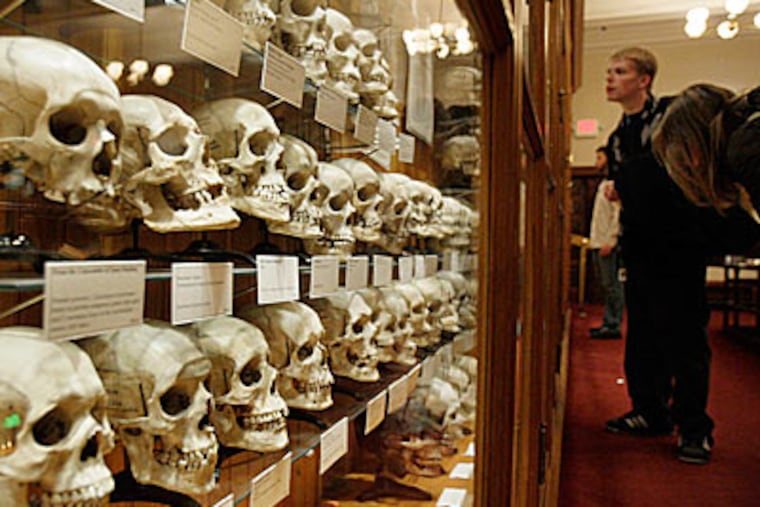
You've probably heard of the Mütter Museum, the 150-year-old Philadelphia institution that is known worldwide for its impressive collection of medical artifacts and oddities.
Besides the primitive surgical tools and macabre organs in jars, the museum is now displaying samples of lipstick, candy, beer steins, antique toy soldiers, paint and pesticide - all pieces in the long and ongoing story of lead's impact on public health.
The two-month-old exhibit is part of a broader effort to make the museum of the College of Physicians of Philadelphia more than just a curiosity.
"I am intrigued by the challenge of creating a 21st-century life for an organization created in the 1800s," says museum director Robert D. Hicks.
For example, Canadian cholera researchers visited several months ago and extracted DNA samples of the bacteria that cause the intense intestinal infection from a half-dozen of the preserved human samples, known as "wet" items, in Mütter's collections. Their goal is to develop new understandings of "cholera epidemiology and evolution."
Other researchers were back at the museum recently analyzing the so-called soap lady, a woman who was buried in Old City and then dug up and sold to the College of Physicians for $7.50 in 1875. They took samples of liver and kidney tissue and X-rays of the mummified remains in hopes of learning more about her.
And the museum is collaborating with researchers from the University of Pennsylvania Museum of Archaeology and Anthropology to add CT scans of Mütter's 139-skull Hyrtl Collection to a growing database for biological research.
"The project both expands the number of people who can use these collections and also permanently preserves the materials for researchers and the public," says Janet Monge, curator of the skeletal collection at the Penn Museum.
So over the next few months visitors to Mütter will notice 30 to 40 skulls missing from the wall display of skulls from a diverse group of Europeans of the 1800s.
The Hyrtl skulls will be added to the database of 5,000 scans, a rich source of data for researchers from a time when people were more geographically isolated than they are today.
For Hicks, who took over as director of the Mütter Museum and of the college's historical library in July, these projects represent a return to the core mission envisioned by Dr. Isaac Parrish. In 1849, he suggested that the college - the oldest medical organization in the country still in existence, founded in 1787 - start gathering and preserving anatomical samples for medical education and study.
Ten years later, Thomas Mütter, a professor of surgery at Jefferson Medical College, left his collection of 1,700 wet specimens, bones, medical illustrations and wax models to the college along with a $30,000 endowment.
Over the next 150 years - the milestone will be celebrated with a dance in the Center City building on Friday - the museum has amassed more than 25,000 items, including the conjoined livers and a plaster cast of 63-year-old Siamese twins Chang and Eng Bunker, whose autopsy was performed in the museum in 1874.
While the 80,000 paying visitors a year are enough to sustain the Mütter Museum as a Philadelphia attraction, Hicks and his colleagues would also like it to be valued for contributions to medicine, science and public health.
The lead exhibit is such an opportunity. Developed at the request of the city's Department of Public Health, which is also a collaborator, "The Devouring Element: Lead's Impact on Health" blends objects from Mütter and from the college's library of medical history. It also meshes nicely with the college's ongoing effort to provide health information to the public through its Web site, www.phillyhealthinfo.org.
"Lead and humans have a deep history," Hicks says. "Despite early awareness that bodily contact with lead is unhealthful, we have been unable to distance ourselves from it."
The exhibit traces the history of humans' use of lead, from nipple shields for wet nurses to cosmetics and plumbing. More than half a million houses in Philadelphia still contain lead paint.
"We are concentrating our efforts on primary prevention, since once children have elevated lead levels in their blood some harm is already done," says Peter Palermo, director of the public health department's Childhood Lead Poisoning Prevention Program.
Mütter's display is one way to get the message out to the public.
The number of city children found to have elevated blood lead levels has fallen from about 80 percent of those tested in 1991 to about 5 percent in 2007.
"We consider that a great success," Palermo said, "but it still means over 1,000 children were lead poisoned in Philadelphia."
Lead poisoning can cause a host of serious problems, from seizures to paralysis, and studies have documented gradual IQ declines and behavioral abnormalities in children who ingest it.
By far the biggest culprit is dust from deteriorating paint. (Lead has been banned as an ingredient in house paint since 1978.)
As the exhibit explains, however, there are other sources. The lipstick on display was recalled in 2008. The candy, made in Mexico, was sold at corner stores several years ago. Antique toy soldiers were actually made of lead, a reminder of recent concern over lead paint on toys from China.
Archives on display from the college's historical library show just how long this issue has confounded us.
"We have 18th-century books that recommend the use of lead as a sweetener in wine," Hicks says, "and texts from the same era that describe symptoms of lead poisoning."
If You Go
Visit the Mütter Museum
Where: College of Physicians of Philadelphia, 19 S. 22d St.
When: Regular hours are 10 a.m. to 5 p.m. daily (to 9 p.m. Fridays beginning Jan. 16).
Cost: General admission is $12 ($8 for ages 6 to 17 and 65 and older).
Information: Call 215-563-3737 or go to www.muttermuseum.org.
Anniversary celebration
What: Disco Inferno* with DJ music, dancing, finger food, dessert; dress "whimsically."
When: Friday from 9 p.m. to 1 a.m.
Cost: Admission is $85 in advance, $100 at the door; must be 21 or over. Tickets may be purchased online.
* A 7 p.m. "Victorian Dinner" costs $200 to $500, including the dance.EndText