Breeding hope
The Philadelphia Zoo's new avian center is more than a place to display birds. A major mission is to propagate endangered species and return them into their native habitat.
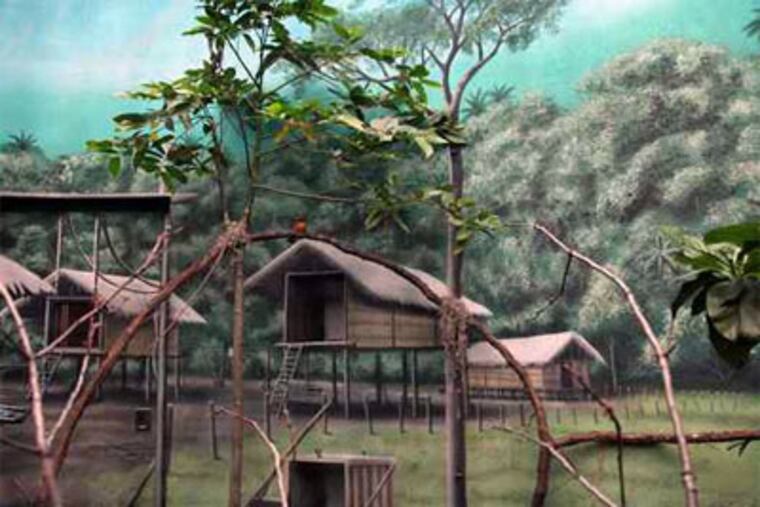
The opening of the original Philadelphia Zoo bird house in 1916 was bracketed by two significant extinctions.
Two years earlier, in 1914, the last known passenger pigeon, a female named Martha, died at the Cincinnati Zoo.
Two years after the opening, in 1918, the last Carolina parakeet died - oddly enough, in the same place.
Now, as the Philadelphia Zoo prepares for Saturday's opening of its new McNeil Avian Center, a $17.5 million reinvention of the original facility, vice president Andy Baker hopes the story will have a happier ending for at least two species in its care: the Guam rail and the Micronesian kingfisher.
Both species, native to Guam, are extinct in the wild. But the Philadelphia Zoo is participating in a captive-breeding program to bolster the population and reintroduce some of the birds into their native habitat.
"If there were conservation efforts then, like we have now," Baker says, "we might not have lost the pigeon and the parakeet."
Conservation is a big part of the new center.
Visitors may get a bigger "wow" from being totally immersed in the birds' world, with brightly colored fairy bluebirds and metallic starlings zinging by, close overhead.
And, potentially, dropping a memento. "We're trying to convince people it's good luck to get pooped on by a bird," says bird curator Aliza Baltz.
It's hot. It's humid. A rainstorm occurs every half hour in the tropical rain forest. Kids can walk inside a replica of the African hammerkop's massive nest. Occasionally, zookeepers will demonstrate with feedings, tossing mealworms to insect-feeding birds that catch the bugs on the fly.
But it's the conservation message that zoo officials hope visitors get.
Perhaps it couldn't come at a better time.
Earlier this month, an analysis of the world's birds by BirdLife International, a global partnership of conservation organizations, found that 1,227 species - or one in eight - were globally threatened.
"Things continue to get worse," says BirdLife's director of science and policy, Leon Bennun.
Consider Hawaii. At the Philadelphia Zoo, the Hawaiian exhibit includes just one native bird, the ama kihi, because there are so few examples.
About 20 to 50 alien species of plants and animals arrive in Hawaii every year, and one of them was the mosquito. It proved an excellent vector for the transmission of diseases among birds, and today most of the surviving avian species live more than 2,000 feet above sea level, where it is too cold for the mosquitoes.
The conservation message is ubiquitous. Bird identification placards plot each species' place on a "threat status" scale, from "critically endangered" to "not in danger."
Another exhibit is a mini-version of a tropical coffee plantation, with the plants growing among other species in the shade. Research has shown that these plantations are far friendlier to birds than large plantations with mono-cultures of coffee plants grown in the sun.
Throughout are posters with the heading "You can help," outlining ways residents here can aid birds everywhere. (Examples: Don't plant invasive species. Put out bird feeders.)
The local and the global also are tied together in what the zoo is calling the "4-D migration theater." Here - where, at last, it's cool and visitors can sit for a while - they show a movie of an animated oriole named Otis.
The proper name is Baltimore oriole, but the species is found throughout this region. Otis hatches in Fairmount Park, where the zoo has been partnering with Audubon Pennsylvania to assess the park's value as a migratory stopover.
Otis learns that he's a migratory species, that he has to leave Fairmount Park in the fall and fly to Central America. Along the way, he learns how to navigate and discovers the plight of other migratory species, such as the red knot.
The red knot migrates from the tip of South America to the Arctic, but along the way each spring, it stops on the beaches of Delaware Bay to refuel on the eggs of horseshoe crabs, which are just then coming ashore to breed.
But the crab numbers have declined in recent decades, and biologists fear that the birds, whose numbers now fluctuate around 15,000, may go extinct within years.
Otis unwittingly shows the perils that migratory birds suffer. He accidentally flies into the window of a large building. He goes through a thunderstorm, as does the audience, when fans and misters activate.
The building itself was constructed with conservation in mind. The wood was sustainably harvested. The windows are colored or textured to prevent bird strikes, both from inside and outside. Much of the illumination is natural daylight. It is heated and cooled by a geothermal system.
Zoo president Vik Dewan says the new exhibit symbolizes "our future, in terms of design, in terms of visitor experience, in terms of commitment to conservation and education."
Phil Wallis, executive director of Audubon Pennsylvania, has consulted on various details of the new exhibit.
He remembers going to the original building as a child with his grandmother. But now, "the place that was magical for me as a child has been exponentially expanded in every way," he says.
Birds, given the vibrancy of their colors, are easily the most aesthetically beautiful of all the zoo's inhabitants, Baker says. But they may not be among the most charismatic. Many visitors gravitate toward the lions and primates.
But Baker says avian species are where the messages of wildlife - and conservation - can resonate more powerfully. "They can link visitors with something they experience in their day-to-day lives," he says. "I hope they leave here looking at birds in their neighborhoods and backyards in a new way."
To that end, the zoo expects to install a retail area in the main foyer of the building, where people can buy binoculars, field guides, shade-grown coffee, and other bird-related merchandise.
Last year, the zoo's education director, Kristen Lewis-Waldron, spent a month visiting schools on Guam and Rota, a neighboring island, helping the children understand the global importance of the birds there.
And what happened to them. Brown tree snakes were introduced on Guam, likely after World War II. Without enemies, the snakes thrived, devouring the native lizards and birds. Today, of 18 native species of birds, seven are extinct.
Before the rail and the kingfisher were wiped out, the Philadelphia Zoo staff and others found and rescued 29 kingfishers and 21 rails.
Now they're part of a breeding program in U.S. zoos, with the ultimate goal of reintroducing them to their native habitats.
So far, rails hatched in captivity have been released in snake-free areas of Guam and Rota. Kingfishers have not yet been reintroduced, but their numbers have grown to 103 in North American zoos.
One lives in Philly, and the search for a mate is on.
If You Go
Where: The Philadelphia Zoo is at the corner of 34th Street and Girard Avenue. Parking is available along Girard at 35th and 38th Streets.
When: 9:30 a.m. to 5 p.m. daily.
Cost: $18; $15 for ages 2 to 11. Parking is $12. Admission and parking may be purchased and printed online.
Information: 215-243-1100 or www.philadelphiazoo.org
EndText