Her pioneering career
Audrey E. Evans, 85, was in the vanguard of oncologists who brought hope to children with cancer.
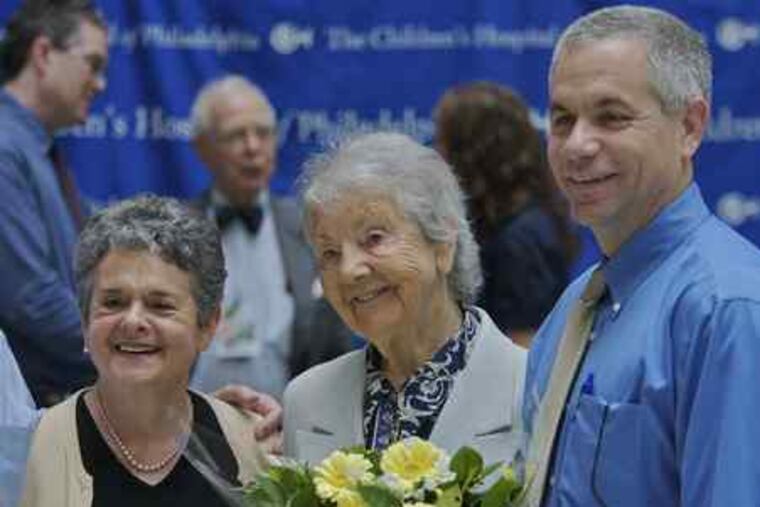
She packed up the pictures of her patients, the ones who lived and those she couldn't save. She took a Physicians' Desk Reference in case she had "to look something up." And she grabbed a few files on groups she planned to work with.
Then, on the Saturday after Christmas, Audrey E. Evans, 85, closed her office door and retired from Children's Hospital of Philadelphia.
It was a quiet end to a storied career.
Evans had built one of the nation's foremost pediatric cancer programs. She cofounded the first Ronald McDonald House in 1974. And she was in the vanguard of pioneering oncologists who transformed children's cancer from a virtual death sentence to a disease that nearly 80 percent of patients survive.
Now she thought it was time to walk away. "I decided that I wasn't needed to do either clinical work or hands-on research," she says. "I didn't want to stay as a decoration."
Besides, her life's work was now in the hand of "her boys," oncologists John Maris and Garrett Brodeur, and a new generation of leaders she helped train.
Both men work on neuroblastoma, the most common solid-tumor cancer in children, which was Evans' specialty.
"It is way beyond me now," says Evans, who still rides horses regularly. Besides, "they're all bright as buttons."
Evans, who never wanted to be "a big cheese," had dreamed about being a doctor as a 5-year-old in York, England. Back then - the early 1930s - she was "willing to treat anybody for anything" with the bandages and antiseptic in her family's first-aid kit.
As a teen she contracted tuberculosis and couldn't attend school regularly. Yet in 1944, Evans still managed to follow her older sister to medical school in Edinburgh, Scotland.
She was confronted there by the patriarchal establishment of the Royal Infirmary of Edinburgh. She wasn't allowed to eat with the men or sleep in the residency despite being on-call 24 hours a day, seven days a week for the entire six-month neurosurgery training program.
She didn't shrink from it. She took it on.
In 1953, she earned a Fulbright fellowship to pursue a residency at Children's Hospital Boston. There her career treating children's cancer was launched by legendary pathologist Sidney Farber, largely because no one else wanted to work for him.
"Who wanted to be with kids that die?" she asks.
Evans wasn't in a position to refuse the opportunity. On Farber's staff, everyone - doctors, residents, nurses, and social workers - collaborated without regard to a rigid medical hierarchy.
"Another door opened and I got into cancer and was completely enamored of it, probably in part because of Farber's total-care approach," she says. "If you couldn't cure the children, you could deal with the problems that arose and you could address the needs of the family."
She would employ that open approach throughout her career.
In the early years, much of Evans' work was on leukemia, but she also became fascinated by neuroblastoma, the most common form of cancer in infants.
In 1965, she was made chief of hematology-oncology at the University of Chicago-affiliated Wyler Children's Hospital. But it was a dead-end job.
"I was not very successful because, unfortunately, I was very untrained in grant writing," Evans says, "and the chief said I would not be promoted."
Meanwhile, at Children's Hospital of Philadelphia, surgeon-in-chief C. Everett Koop had built a large cancer practice "with a particular interest in neuroblastoma." And by 1969, he needed an oncologist.
So, Koop flew to Chicago and recruited Evans as chief of oncology in the red carpet room at O'Hare International Airport.
"To come to a place as big as Children's in Philadelphia and run their cancer program, wow, that really was a cancer program," Evans says.
At that time, Koop says, surgeons ruled the roost, but used their own techniques too much. To improve care, they needed to standardize, Koop says.
"That is where Audrey came in and did very well," says Koop, the former surgeon general of the United States who now lives in New Hampshire.
As a result, Koop says, her effect on pediatric oncology was not only immediate, but it was durable because she led the effort to standardize care and get the patients into clinical trials in Philadelphia and nationally.
At Children's Hospital, Evans focused her research on neuroblastoma while running the oncology division. She developed a staging system to evaluate the cancer's severity and guide treatment.
And she noticed that the tumors in some infants with widespread neuroblastoma would spontaneously regress.
"It is the only cancer where you can have quite a lot of cancer, where if you sit tight, it will go away," she says.
She was able to identify which kids would get better, sparing them highly toxic treatments.
Still, most don't get the "good neuroblastoma" and, even today, many die even after undergoing various combinations of surgery, intense chemotherapy, and radiation.
"I don't think any disease is quite so extraordinary . . . that you have the wide range of universal death or sit tight" and it will disappear on its own, she says.
Evans also focused on the families of sick kids.
In 1974, she teamed with Eagles tight end Fred Hill, whose 3-year-old daughter successfully battled leukemia at Children's Hospital.
Together they formed the first Ronald McDonald House, where relatives of patients could live during lengthy treatment regimens. Worldwide, there are now 284 Ronald McDonald Houses.
Despite all the support, progress with neuroblastoma has lagged that of other cancers. Still there are successes.
Barbara Mullen was one.
She was diagnosed with neuroblastoma at age 4 in 1976. After surgery to remove the tumor that had spread into her right kidney, the little girl underwent six weeks of radiation and then two years of chemotherapy.
"I was a terror on the ward," Mullen wrote in an e-mail about Evans.
The woman, now a lieutenant commander in the Navy, remembers bursting into the oncologist's office with a water pistol as Evans was talking to parents of another sick child.
"What better way to bring dark humor into a situation than to have a 4-year-old with the same diagnosis, IV pole of chemo trailing behind her, running in a room to douse the physician with water," Mullen says.
At home Evans keeps a framed drawing by Mullen alongside a photo collage featuring hundreds of her patients from over the decades.
She remembers them all. Evans always tried to be there at the end when all treatments failed.
"I have learned, because I have done it so often. I have learned to be able to talk about what dying is like and it depends entirely on the age of the child," she says. "One of the best things you can do is to be there and to share."
About five years ago, she stopped taking new patients and cut back her work hours. But she was still there all day.
And at 80 she quietly got married to University of Pennsylvania radiation oncologist Giulio "Dan" D'Angio, a widower. In the 1950s, they began a lifelong research partnership in Boston. Evans is godmother to D'Angio's children and, because his first wife didn't like to travel, she took them on trips around the world.
When she finally decided it was time to retire, she tried to slip out.
"I couldn't stand the emotion . . . people would be crying for Pete's sake," Evans says. "I just felt it was too much, I would rather just be gone."
But D'Angio told her she wasn't thinking of others and persuaded her to return to Children's Hospital to be feted by the cancer community she had committed her life to.
She was given the "Pitcher of Hope Award" by Alex's Lemonade Stand Foundation.
Still, she shook her head vigorously as oncologist Maris said they would give her a proper send-off in the fall when her portrait will be hung among the luminaries in Stokes Auditorium - the first woman to be so honored.
Oncologist Brodeur still hopes to entice Evans back to his lab, where her seat stayed empty for months after her retirement.
Brodeur has started a new line of neuroblastoma research - using tiny nanoparticles to target tumor cells with high doses of chemotherapy.
Evans fears being drawn back. She no longer wants to be consumed by it.
But the new project intrigues her. "It would be terribly exciting," she says.
She may have cleaned out her office but in many ways Evans is still there.