The dish on phosphates
Pennsylvania is joining 15 states that have banned dishwasher detergents containing the compound. But will dinnerware get clean?
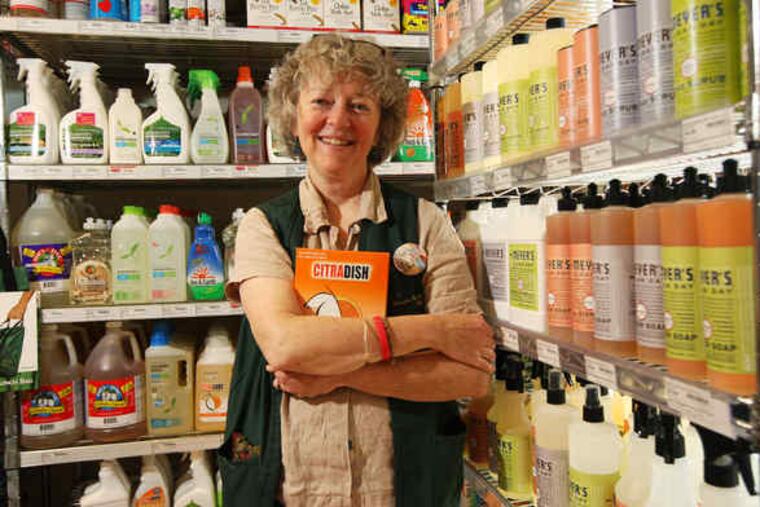
A prodigious task awaits the dishwasher in Andrew Herman's Mount Airy kitchen: a tightly packed, three-day jumble of bowls, plates, cutlery, cups.
Oh, and one glass stained with the sticky remains of a "poor man's Frappuccino" - the family's pet name for a mixture of coffee, milk, and chocolate syrup.
Herman's weapon? An earth-friendly brand of detergent.
For now, he is in the tiny minority, but in a matter of months, you'll be joining him.
Pennsylvania is among 15 states that have banned dishwasher detergents containing phosphates - a family of compounds that are great for sparkling silverware, but become an algae-nourishing problem once they wash down the drain.
The ban will take effect July 1, 2010, and many manufacturers already are offering varieties billed as phosphate-free (though, technically, they'll be allowed to contain a trace amount).
Industry officials say more such products are on the way in the coming months, and before long, it will be tough to find the old kind of detergent anywhere, including states such as New Jersey and Delaware that did not enact bans. Most companies have decided it is not worth the hassle of maintaining separate supply chains.
But will the new kinds work as well?
For the most part, so far, they do not, according to surveys in Consumer Reports. In its August and October issues, the magazine subjected a total of 21 detergents to a tough test: dishes "smeared with a baked-on blend of 17 foods," including chocolate pudding and peanut butter.
Most of the phosphate-free varieties cost about the same, but did not perform as well, though companies say better ones are in the works. Procter & Gamble, which makes numerous varieties of Cascade, has spent a year perfecting its phosphate-free formulations and will continue to supply "immaculate dishes every time," says spokeswoman Susan Baba.
One phosphate-free brand that did well was Smarty Dish by Method.
To be fair, the Consumer Reports tests were brutal. Like lots of people, Gladwyne resident Jennifer Mettler takes the extra step of scraping or rinsing food off dishes before loading them in the machine.
But even then, the phosphate-free products - though they get dishes clean - do not measure up in the aesthetics department, she says.
"Your glasses aren't going to be shiny-sparkly," says Mettler, who uses a store brand of green detergent from Trader Joe's.
Herman, who uses an eco-friendly liquid detergent from Seventh Generation, says he sees no drop-off in performance. Indeed, the poor man's Frappuccino washes out just fine.
There are spots on his glasses, but Herman says he also gets those when he runs out of the eco-detergent and uses what's left in an old box of Cascade - a failing he blames on his dishwasher. Beth Murray of Swarthmore also reports no difference with her eco-brand, though she confesses she "just may not be as picky."
Crystal-clear dinnerware or no, the three early adopters all say green is better. Mettler has switched to greener products in general, not because of phosphates, but because she blames other chemicals for her mother's death from a neurological disease.
For Herman, who shops two blocks from his house at the Weavers Way Co-op, a big reason for phosphate-free detergents is fish.
When growing up, he'd visit his grandparents in Virginia Beach, at the mouth of the Chesapeake Bay.
"We'd fish with a net, and we'd just literally throw the crabs back," the 35-year-old recalls.
The fishing stock is so depleted now, Herman says, that "it's not even worth going fishing most of the year."
Part of the reason is that phosphorus, the element contained in phosphate compounds, is a fertilizer. Together with nitrogen, it promotes the growth of excess algae, which can lead to several problems.
When algae dies and decays, the process robs the water of oxygen, making life tough for fish.
Algae also blocks sunlight, which can harm the underwater grasses that provide habitat for baby fish and crabs, says Rich Batiuk, chief scientist for the federal Chesapeake Bay Program.
Compared with runoff from farms and suburban lawns, dishwashers account for a small amount of the total phosphorus in rivers and streams - perhaps 4 percent to 5 percent of what ends up in the tidal Chesapeake, Batiuk says. In Minnesota, a study found the contribution was about 2 percent.
Still, the industry's Soap and Detergent Association lobbied for the states to adopt the bans, which apply only to residential machines. The goal was to have states pass uniform laws, so that companies didn't have to deal with a patchwork of different rules. (Phosphates were removed from laundry detergents years ago.)
Manufacturers are loath to disclose the new ingredients they are using to replace phosphates for dishwashers. But it's no secret that these workhorse compounds got the job done and that it may take two or three replacement chemicals to perform phosphates' various functions.
Phosphates are not cleaners, but water softeners. They bind to the calcium, magnesium, and iron found in "hard" water - allowing manufacturers to put in less of the cleaning agents called surfactants, which are expensive. With no phosphates, you'd have soap scum.
By binding to those ions, phosphates also prevent them from forming spotty deposits. And to some extent, they help maintain the proper pH, says Kenneth Doll, a chemist with the U.S. Department of Agriculture's Agricultural Research Service.
Doll, who works in the agency's Peoria, Ill., research center, helped develop a couple of phosphate alternatives several years ago, though they did not make it to market. In one, Doll and a colleague used a combination of sodium aspartate, which is a building block in artificial sweetener, and sorbitol, derived from corn starch. Some companies are trying sodium citrate, a citric acid salt, to replace phosphates.
It is easy enough to develop alternatives, but they are likely to cost more, says Jeff Harwell, a professor of chemical engineering at the University of Oklahoma. Phosphates are plentiful; in the United States, they come primarily from mines in Florida and North Carolina.
Fear not for the humble phosphates, however. They remain a key component in a staggering number of products, ranging from strawberry-flavored milk (by binding to iron, phosphates maintain the pink color) to fertilizer. A major supplier is Innophos Inc., of Cranbury, N.J.
But as for detergents, no longer. And if the industry is lucky, most customers will be like Swarthmore's Murray.
"You know, I have four kids and two dogs," she says. "I'm not really looking for how much it sparkles. I'm happy if it gets put back in the cabinet before the kids pull it out again."
at 215-854-2430 or tavril@phillynews.com.