Clowning touch
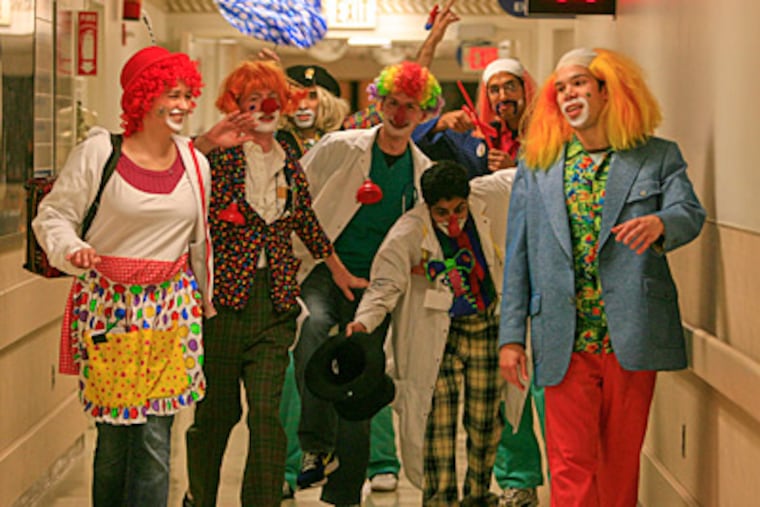
Hoping to help heal with humor, medical students at Thomas Jefferson University Hospital don wigs and clown costumes before visiting patients who need a boost.
'What do you call a frog illegally parked?"
(Wait for it.)
"Toad."
Antoinette Skerski, 90, groaned - and not because she was a cardiac patient at Thomas Jefferson University Hospital.
"That was a bad one," she told the joker, Mike Quartuccio, whose garish wig looked like a Krusty the Clown castoff.
Six other clowns, squished into the small room, began administering RJT (Rapid Joke Therapy), which they warned could cause nausea.
"What is Beethoven's favorite fruit?"
Sing it: "BA NA NA NA AA."
"Good one," said Skerski of Medford Lakes, her arm bruised from intravenous needles.
Everyone knows that laughter - preferably the "genuine belly laughter" that Norman Cousins self-prescribed - is the best medicine.
But the Jefferson medical students who double as Clowns for Medicine have found that grins, guffaws, and groans are good, too. As part of the current generation of "healing with humor" practitioners, they are less about hilarity, more about humanity.
Each Friday evening, their goal is simply to forge a connection, no matter how tiny or brief, with hospital patients, families, medical staff, maybe even people who see them parade down the block.
"Our mission," said Clowns' copresident Paurush Shah of Clarks Summit, Pa., "is to spread some cheer to people who may not have visitors, to people who may be feeling down due to their illnesses, and to make anyone around us smile."
Or cry.
"That young people would do something like this on a Friday night rather than go to a bar . . . ," Skerski said, tearing up and trailing off.
In his 1979 book Anatomy of an Illness, Cousins - a peace activist and editor of Saturday Review - told how he had recovered from a life-threatening illness with sidesplitting comedy and Vitamin C. At a time when "patient empowerment" and the "mind-body connection" were not part of the vernacular, Cousins' chronicle became an instant classic.
Hunter "Patch" Adams, the physician, social activist, and iconoclastic pioneer of clown therapy, shifted attention to the clinician. He and his squeaky red nose took the mean out of professional demeanor, and the eponymous 1998 movie made him a poster boy for the healing-with-humor movement.
By then, laughing was being taken very seriously. There was an International Journal of Humor Research. There were studies of laughter's effects on the cardiovascular, immune, and neurochemical systems. There were professional societies, conferences, courses, Web sites, and enough books to fill a small library - all dedicated to the benefits of yuks and yukking.
But a funny thing happened as therapeutic laughter went mainstream: Clowning and comedy took a backseat to compassion. Indeed, that's the operative word in nurse-humorist Patty Wooten's 1996 book, Compassionate Laughter: Jest for Your Health!
Jefferson family physician Richard Wender, who gives an annual orientation seminar on humor to incoming medical students, said: "I'm interested in humor as a way of communicating, of creating healing relationships. Humor is part of how both patients and clinicians cope."
Kenneth Remy, founder of Clowns for Medicine, has come to prefer the word mirth rather than humor or laughter.
"Mirth connotes a more compassionate, intimate way of interacting," said Remy, who uses it more than ever now that he is completing a fellowship in pediatric critical care at Columbia University.
Remy was a University of Delaware biology major when he created the Clowns in 1997. (If only he had listened to a friend who suggested calling a West Virginia doctor named Patch Adams, Remy says, he could have played a medical student in the movie.)
He added the Jefferson chapter when he entered its medical school in 1999. Initially, Remy recalled, the faculty was skeptical. But by the time the charismatic, enthusiastic 6-foot-9 jester had graduated, Clowns had five chapters - two in high schools - with hundreds of members making merry in nursing homes and day-care centers, as well as hospitals.
Alas, when Remy went on to his residency in Cleveland at Case Medical Center's Rainbow Babies & Children's Hospital, all but Jefferson's chapter faded away. "It was somewhat saddening," he said, "but I was the driving force."
The current group has about a dozen members and includes occupational-therapy students such as Monique Chabot of Katy, Texas.
On a recent Friday night, she wore a Raggedy Ann-ish costume, played accordion, and gave out felt flowers that she makes.
"I'm not an extrovert," said Chabot, who will graduate in May. "That's why I need the extras."
She, Quartuccio, and Shah, both fourth-year med students, were joined by first-year Mike Quinn of Pittsburgh, second-year Devesh Upadhya of Irvine, Calif., and third-year students Amar Patel of Fullerton, Calif., and Stu Greene of Dresher.
All of them had goofy names like Uncle Gizmo or Dr. Flibbertygibbet, and props, such as the little jar with a tiny stool inside. (A stool sample, get it?)
"Shtick," said Greene, holding a two-foot-long thermometer. "We use lots of shtick."
Although they don't visit Jefferson's pediatrics unit - "Some kids are afraid of clowns," Shah explained - they give stickers and handshakes to any willing child who passes by.
Most often, they go to the cardiology floor.
That's why two patients who had been waiting months for heart transplants beat them to the punch lines as they joked with Barbara Kazan, who was in the hospital for a heart stent.
"You guys are wonderful," the Vineland, N.J., resident told them.
The group does little recruitment, just an e-mail to incoming students. New clowns get no particular training, just a piece of paper with corny jokes. And while they are obviously fans of healing with humor, they aren't zealous.
"I figured I wanted to do something good, but low-commitment," Patel explained.
The benefits, they agree, go two ways. Patients get some bedside cheer, while the clowns get a jump on learning bedside manner.
"This will really help me when we get in clinical situations," said Patel. "I feel so comfortable walking into a room and interacting with patients because that's what we do."