Philadelphia-area hospitals adjust to fight swine flu
Underwood-Memorial Hospital in Woodbury yesterday banned anyone younger than 18 from visiting patients. Children's Hospital of Philadelphia counted a record 524 emergency-room patients Monday, and has converted a portion of its soaring atrium into a third emergency room (face masks provided).
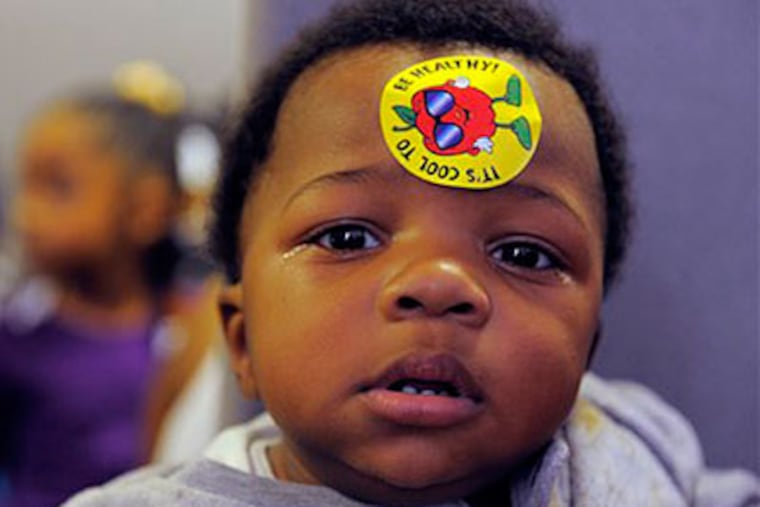
Underwood-Memorial Hospital in Woodbury yesterday banned anyone younger than 18 from visiting patients. Children's Hospital of Philadelphia counted a record 524 emergency-room patients Monday, and has converted a portion of its soaring atrium into a third emergency room (face masks provided).
Confirmed cases of swine flu nearly doubled in the extended Philadelphia region during the last two weeks, triggering a flurry of new hospital policies aimed at slowing the spread of infection.
And yet the devil is in the details as infection rates rise steeply. While the death of a high school student with no apparent risk factors in Burlington County got headlines yesterday, as did a third death in Delaware, nearly all cases continue to be mild.
"A lot of parents asked me specifically about the 17-year-old: 'What happened, and is that going to happen to my kid?' " said Rick Hong, head of emergency medical services at Cooper University Hospital in Camden, where pediatric emergency room visits were double the norm.
Hong said most children are not at risk and should not be in an ER. And yet, "it can happen, just like in a lot of other disease processes," he said.
So hospitals are trying to prevent the spread of the disease to patients, particularly school-age children, who have the least immunity and the worst nose-wiping and candy-sharing habits.
For many acute-care hospitals, which mainly serve adults, that means keeping children out. But digesting the policies is barely easier than finding flu vaccine.
Virtua Health hospitals in New Jersey have banned visitors younger than 18 - and anyone with a cough or fever. Lankenau, Bryn Mawr, and Main Line Health's other hospitals draw the line at 17.
The University of Pennsylvania Health System's cutoff is 16. Ditto for Aria Health's Frankford, Torresdale, and Bucks County hospitals. And Einstein (but only for obstetrics and neonatal areas).
For Jefferson, age 13 (long-standing, newly enforced). Temple, 11. Some other hospitals, including Cooper, have no age restrictions, although that is being evaluated daily, Hong said, as more cases appear in his ERs. And school tours are canceled.
Thomas Grace, vice president for disaster preparedness at the Delaware Valley Healthcare Council, an industry group for more than 60 hospitals in Pennsylvania's five southeastern counties, has been working for days on a consensus policy that, while voluntary, could introduce more consistency.
He is pushing for an age cutoff of 18. But others say less, for reasons of science (who spreads flu how) and family (to minimize disruption). A compromise is likely.
"The argument usually is between 16 and 18," Grace said. "Under 16 or under 13, the concern is the child may not cover the cough and will spread it."
"But there is no magic with 16," he said. Older teens "still have much more social contact" than adults, and the virus spreads rapidly in schools.
A handful of states have come up with uniform visitation policies, and Grace last night forwarded a draft to the hospital association in Pennsylvania.
New Jersey has not been discussing statewide rules, said Cooper's Hong, who is involved with coordinating policies in the state's southern counties.
Unlike most medical centers, pediatric hospitals can't very well keep children out. So Children's Hospital is keeping them in.
All patients - as well as visitors and guardians - must stay in patient rooms. Anyone with flulike symptoms is given a mask and, except for the seriously ill, directed to an ER-for-mild-flu waiting area in the atrium that was set up last week when daily patient volume reached 400 for the first time.
It topped 500 earlier this week, said Richard J. Scarfone, medical director for emergency preparedness.
"Children with fever and cough do not need to go to an emergency room," Scarfone said yesterday at a City Council hearing on swine-flu preparations. If they do, they will not be tested for novel H1N1 influenza and will not be given antivirals "because treatment does not impact a mild disease course," he said.
"So children with mild illnesses will experience very long waits," he said, and could "divert resources from those who truly need them."
Positive tests for influenza, which do not distinguish between mild and severe illness, exceeded 30 percent of specimens sent to a sampling of laboratories in the extended Philadelphia region - from Reading east to Ocean City, N.J.; north to Trenton; and south to Dover, Del. - for the week ending Saturday, according to SDI Health L.L.C., a Plymouth Meeting company that tracks national health data.
That was up from 21.5 percent a week earlier, matching the March peak of the relatively mild 2008-09 flu season, and 16.6 percent the previous week. Only six other regions - Cleveland; Cincinnati; Kansas City; Columbus, Ohio; Richmond, Va; and Buffalo - have higher rates, although several others were higher before dropping, SDI said.
Here as elsewhere, vaccine against swine flu is trickling in. Montgomery, Burlington, Camden, and Gloucester Counties have received enough to schedule limited clinics for people at high risk. Philadelphia's city-run health centers have received only enough to immunize regular patients who are at high risk.
Students at roughly 90 city schools received the FluMist nasal spray - approved only for healthy people - the first three days of this week. The proportion of students who got it at each building varied widely according to parental consent, said Caroline Johnson, director of the Philadelphia Department of Public Health's Division of Disease Control. Eight city parochial schools and five private schools have also run vaccine clinics.
Some people have questioned who got vaccine when, and whether one town, or practice, or private school was favored.
Johnson said basic logistics were the key reason for differences.
The private Springside School and Chestnut Hill Academy got vaccine early, she said, because they have a medical director who could take responsibility and is trained to administer vaccine.
Parochial schools will get vaccine on Election Day because public schools are closed.
Find links to public
swine-flu vaccine
clinics for people in high-risk groups at http://go.philly.com/swinefluEndText