Endangered birds and quirky lists
Like most birds, the cerulean warbler is a fussy sort. The tiny creature, just inches long, nests only in the tops of deciduous trees, those that lose their leaves in winter.
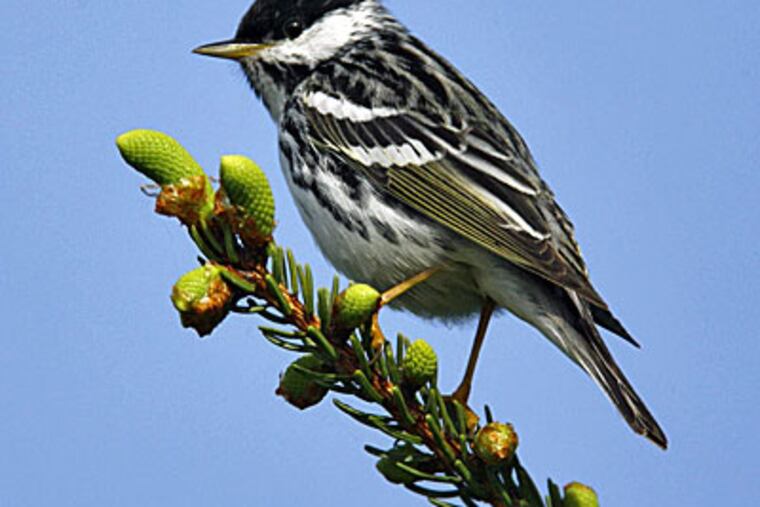
Like most birds, the cerulean warbler is a fussy sort.
The tiny creature, just inches long, nests only in the tops of deciduous trees, those that lose their leaves in winter.
With males a vivid sky blue, it's a "gorgeous bird," says ornithologist Jeffrey Wells.
It's also in trouble. In three decades, its numbers have declined by about 80 percent. It is one of the fastest-declining forest birds in the United States.
So how do we protect the warbler and other creatures in similar deline? Recent research by Wells and others has cast doubt on whether the current methods are working as well as they could.
Indeed, their flaws "could have profound negative consequences" for many species, the authors concluded in a study published last week in the scientific journal PLoS ONE.
In the last few decades, a cornerstone of publicly funded wildlife conservation has been lists.
Under the Endangered Species Act, passed in 1973, the U.S. government makes lists of creatures that are considered threatened or endangered, based on the risk of their going extinct.
States have followed suit with lists of their own.
The problem is that state lists, given their limited geographic scope, often do not reflect the broader reality, the researchers found.
In a study of 48 states, the researchers discovered numerous instances where species that are nationally abundant were listed because, in the state, they were rare.
Conversely, birds that may be in trouble nationally, like the cerulean warbler, might not be listed because they are considered numerous in a particular state.
This is important because state lists often are used as a basis for directing research and funds - in some cases, even regulatory decisions.
Wells contends that the focus is too often being diluted by regionally scarce species, and "those nationally and globally at risk have not gotten the attention they deserve."
Although the study focused on bird lists, Wells says the flaws would likely occur in lists of all species.
Wells is with the nonprofit Boreal Songbird Initiative. His coauthors are Kenneth Rosenberg of the Cornell Lab of Ornithology, David Mehlman with the Nature Conservancy, and Bruce Robertson of Michigan State University's W.K. Kellogg Biological Station.
In Pennsylvania, the cerulean warbler has remained off the list. Yet nationally abundant species like the blackpoll warbler and great egrets, which occupy only niche habitats in the state, have made the list.
In New Jersey, the saltmarsh sparrow, a coastal species that is in sharp decline nationally, is not listed. Yet the savannah sparrow, despite being widespread in the eastern United States, has made the list because of grassland losses in New Jersey.
Greg Butcher, director of bird conservation for the National Audubon Society, says, "It does seem like a good time to reconsider how we do these lists and these priorities."
State officials, conservationists, and even the researchers say the discrepancies aren't necessarily bad.
"We have this mandate to maintain the health of Pennsylvania's environment, not the world," says Dan Brauning, wildlife diversity chief with the Pennsylvania Game Commission, which has oversight for bird conservation.
"We're down to one site for black terns," he says. "What are we going to do, ignore it because it's fairly common in North Dakota? No."
A niche bird population may serve as an early warning system, he says. Its decline can alert researchers to potential problems before the core population is at risk.
The Nature Conservancy's Mehlman says the states face "a philosophic dilemma" over whether to focus on their own biodiversity or the continent's.
Even if losing a niche species here wouldn't really destabilize a nationally abundant population, "Pennsylvania is a much better place with them than without them," says Brian J. Byrnes, Important Bird Area Coordinator for Audubon Pennsylvania.
Then again, if a state-listed species is rare simply because it is at the fringe of its normal range - as is the case with the Southern gray treefrog, which extends only as far north as the southern tip of Cape May County - how many resources should go toward keeping it there?
Many states have argued that if species like the cerulean warbler are in such dire straits, they should be listed as threatened or endangered by the federal government. But the cerulean is not.
Wells points out that the federal listing process, while it has a scientific basis, is also heavily policy-driven. Because funding has been so scarce in recent years, the U.S. Fish and Wildlife Service has a backlog of 249 "candidate" species that it considers worthy of listing but has not yet acted on.
The federal stagnation makes the state lists all the more important, he says. State wildlife agencies are also more nimble, able to add or subtract species with less red tape involved.
A New Jersey spokeswoman said officials there had not yet had time to analyze the report. But in skimming it, Department of Environmental Protection biologist Dave Jenkins said through the spokeswoman that he disagreed with the conclusion that most state lists were predominated by species of merely local concern and that it would have negative consequences.
While lists are key in determining where attention, research, and funds might be directed, they're not the only factor.
In order to qualify for a new source of federal funds, states have had to devise "wildlife action plans" for conservation. "The mantra," Brauning says, is "to keep the species from becoming endangered." These plans, too, have lists; in both Pensylvania and New Jersey, the cerulean warbler is included.
Brauning says Pennsylvania dedicates about $300,000 annually toward nongame bird conservation. But federal funding for the state's wildlife action plan has averaged $1 million. That has allowed the state to actually spend more on the cerulean than it has on the sedge wren, which is listed in the state but is common nationally.
Innovative cerulean research is under way in the Allegheny National Forest, Brauning says, adding that in some cases, listing a bird might actually hamper research efforts. As each individual bird becomes more valuable, it's harder to rationalize, say, capturing a few to extract blood and feather samples to get health data. The risk of their dying is too great.
Many feel the debate is gaining in importance because so many birds are in trouble.
In March, the Fish and Wildlife Service released its first comprehensive report on U.S. birds, showing that nearly a third of its 800 species were endangered, threatened, or in significant decline.
In May, an update of the world's birds for the International Union for the Conservation of Nature added two species, for a total of 192, to its "red list" of critically endangered birds.
In recognition of an "unprecedented loss of the world's species due to human activity," the United Nations has declared 2010 the International Year of Biodiversity. An official launch ceremony is planned for today in Berlin.
Eric Stiles, vice president for conservation and stewardship for New Jersey Audubon, says the new conservation ethic - one the state wildlife action plans help foster - is to look not merely at birds on the brink, but "suites of species" that occupy the same habitat.
Saving a marsh, for instance, can benefit not just the most endangered species in it, but all of them.
And funding should be approached as one would an investment portfolio: Diversify.
"The lists are absolutely critical," Stiles says. "They are a science-based risk characterization of a species' survival."
But we shouldn't ignore the bigger picture, he said. "We really don't want to lose sight of Noah's ark."