'Electricity' show: Ben and brilliant inventions
Ben Franklin brought electricity down from the heavens with his lightning rods: the thin, tapered lengths of wrought iron that could be seen throughout colonial Philadelphia, protruding above the redbrick streetscape.
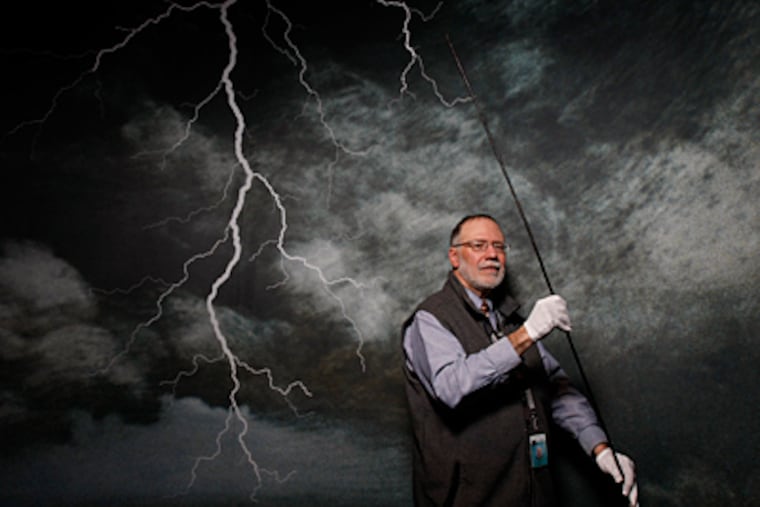
Ben Franklin brought electricity down from the heavens with his lightning rods: the thin, tapered lengths of wrought iron that could be seen throughout colonial Philadelphia, protruding above the redbrick streetscape.
It is safe to say, however, that he never envisioned bringing electricity up from below - at least not with a "sustainable" electronic dance floor, its colored lights powered by the pounding energy of human footsteps.
Nevertheless, one of each item - a 260-year-old lightning rod and an electric dance floor - are part of a new permanent exhibit at the Franklin Institute, titled simply "Electricity." It opens on March 27.
The exhibit contains a few elements from previous installations on Franklin and electricity, but most of it is new or reworked, featuring an array of eye-catching displays.
Besides the dance floor (more later on how that works), there is a wall that lights up vividly in response to the electromagnetic transmissions from nearby cell phones.
From the ceiling there hangs a giant Tesla coil - a device that periodically emits brilliant, four-foot-long sparks. (Don't worry, it's grounded.)
And of course, in a museum named for the statesman-inventor, there is plenty of history.
The lightning rod in the exhibit, actually a fragment measuring more than five feet long, dates to about 1750. It was originally mounted at the now-demolished West family mansion at Third and Dock Streets, says John Alviti, senior curator of collections.
Museum officials do not know who made the rod, but it is of Franklin's early design, and he wrote a letter concerning its installation.
In preparation for the new exhibit, the slender, blackened length of metal got a careful cleaning and anti-corrosion treatment from Kory Berrett, an independent conservator in Oxford, Pa.
The rod illustrates what is surely Franklin's most practical contribution to science: a reliable way to protect houses from fire.
In his own words
Some of his early writings on the topic are to be displayed alongside the rod, in a rare edition of Franklin's Experiments and Observations on Electricity - a collection of letters and papers published in 1751.
Franklin described how metal points worked better than wood at drawing "electrical fire," and he proposed using metal rods to conduct lightning from rooftops down to the ground - literally, the source of our modern term for grounding a circuit.
"Would not these pointed rods probably draw the electrical fire silently out of a cloud before it came nigh enough to strike, and thereby secure us from that most sudden and terrible mischief?" he wrote in an entry from 1749.
The museum owns several early editions of the book. In order to minimize any harmful effects from light exposure, it will rotate to a different copy every few months, says Alviti, the curator.
"It was almost a popular science-type book, like something by E.O. Wilson, or Stephen Jay Gould," says exhibit developer Kristin Qualls. "That's what gave him a reputation, especially in Europe, as a man of enlightenment, a man of reason."
Next to the actual book will be a touch screen so that visitors can page through a digitized version. It includes Franklin's descriptions of his successes as well as some early false starts:
"I considered the sea as the grand source of lightning," he wrote in one entry, "imagining its luminous appearance to be owing to electric fire, produc'd by friction between the particles of water and those of salt."
He went on to concede that he had formulated that theory "too hastily." For Qualls, who studied the history of science at Vassar College, such writings illustrate the path to discovery.
"The beginning of the modern study of electricity is really with Ben," says Qualls, who, in institute tradition, always refers to the famous man by his first name.
Thinking green
Other items on display:
A crank that visitors can turn to light up three different kinds of bulbs: incandescent, LED and compact fluorescent. Guess which one requires the least amount of cranking to light up?
Two murals by artist Thornton Oakley, depicting Franklin's seminal kite and key experiment.
A model city that lights up in various intensities of green or red, giving visitors an idea of their energy consumption. Museum-goers must describe various lifestyle choices: how they travel, how they get their news, where they live. The lower a person's overall energy use, the greener the city appears.
When the museum was testing some of the exhibits, a group of Mennonite visitors tried the one with the model city.
"They made it green," Qualls says.
Then there's the dance floor.
Made by Sustainable Dance Club, a company based in the Netherlands, the floor is fitted with a vivid rainbow of LED lights. The harder you dance, the brighter they glow.
The company is a little cagey in explaining just how its proprietary technology works. But basically, the energy from the dancers operates advanced dynamos - small electrical generators - that are embedded beneath the floor's surface. The up-and-down motion causes the rotation of wire coils, which generates electricity in the presence of a magnetic field.
In the museum exhibit, the placement of the wacky floor alongside artifacts from the early study of electricity makes for quite a contrast.
But museum officials are confident that they can imagine the reaction of Franklin, whose taste for gadgets - not to mention social gatherings - was well known.
He would've loved it.
Contact staff writer Tom Avril at 215-854-2430 or tavril@phillynews.com.