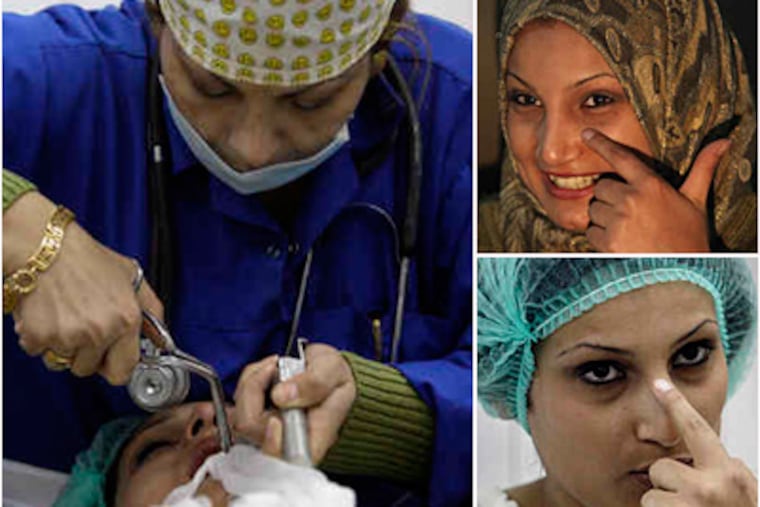
BAGHDAD - Dr. Abbas al-Sahan's patient wasn't a war victim. She didn't have a scar that needed cosmetic surgery. All she wanted was a cute nose. And she got it.
Speaking after the surgery, bandages and swelling gone, Sarah Saad Abdul-Hameed, 23, was ecstatic. Friends who visited "were surprised with the change in my face," she said. "They compared my nose to Nicole Kidman's!"
Even in the worst spasms of violence that followed the 2003 U.S.-led invasion, cosmetic surgery didn't go out of style. Now, as the country has quieted down, nose jobs, Botox, and liposuction are all the rage.
Sahan, one of Baghdad's premier plastic surgeons, said he averaged 20 cosmetic surgeries a week - 70 percent on women. During the height of the fighting, reconstructive surgery for the wounded made up the bulk of his practice, but now most of it is cosmetics unrelated to the war, he said.
Interest in plastic surgery has blossomed since the fall of Saddam Hussein's dictatorship and the end of economic sanctions that had isolated Iraqis from the influences and pop culture of the outside world.
Also, doctors who fled the violence are trickling back.
But availability of cosmetic surgery is limited. Sahan says fewer than half a dozen cosmetic surgeons operate in Iraq - and patients have to provide their own Botox or silicone.
Sahan's clinic in the upscale Mansour neighborhood, with its worn sofas and stairwell smelling of cats, hardly evokes Nip/Tuck, the American TV show about high-end cosmetic surgery.
Still, his waiting room on a recent afternoon was so full that clients spilled out into the hallway.
Most of Baghdad's cosmetic surgeons play dual roles: They do reconstructive surgery, mostly on war-wounded patients, at government hospitals, and cosmetic surgeries at private hospitals.
The cosmetic surgeries tend to be their bigger earners because patients pay cash - about $600 for a nose job.
Breast augmentation costs $1,200, and clients must import the silicone from abroad. Botox, injected to relax muscles and head off wrinkles, can be found in Iraqi pharmacies.
Demand cuts across religious divides, but all the same, Iraq being overwhelmingly Muslim, some have inevitably sought guidance from the Grand Ayatollah Ali al-Sistani, the country's most revered Shiite religious figure.
The verdict on his Web site? Hair implants are preferred over a wig, which can fall off during prayer. Liposuction to remove fat, and surgery to make breasts smaller or bigger, are OK as long as female patients go to a female doctor.
But cosmetic surgeons in Baghdad say patients rarely raise the religious question or demand a particular gender of surgeon.
Many bring pictures of famous people they want to look like - Lebanese pop stars Nancy Ajram or Elissa are the most popular.
Cosmetic surgery requires an artist's touch, Sahan said. "If you have no art in your brain and your hand, I don't think you can do aesthetic surgery," he said. "No nose is like another nose. Every patient is a particular case."
A 30-year-old woman said she was having trouble with a prospective suitor's mother, who didn't like her nose.
"I am getting older and time is running out. One should take care of oneself to look more beautiful," she said, adding that she saw no religious issue at stake. She requested anonymity, saying she did not want it known that she was getting a nose job.
"Day after day, the number of clients is increasing," said Falah Abdul Hussein al-Shimmari, a doctor who runs an outpatient clinic in Baghdad.
"Iraqis were deprived before of such cosmetic services because they were unable to travel," he said. "But after the war, there has been some openness to the outside world. People are becoming interested in having such plastic surgeries."
Another change is that doctors, one of the most targeted professions for kidnapping during the insurgency, are coming back from self-imposed exile. Shimmari spent 2005-07 in Lebanon.
But security is still a concern. Sahan will not advertise his clinic address.