A little significant help
A Penn student's nonprofit focuses like a laser on Zimbabwean girls affected by AIDS, providing vital education resources. Its name is Tariro - "hope."
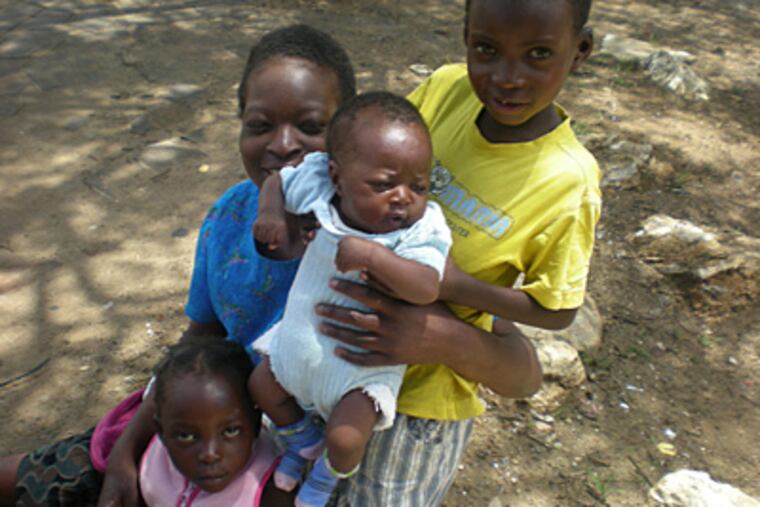
HARARE, Zimbabwe - Ashleen Chipirare's typical day begins in school. But afterward she joins the rest of her family begging on the dusty streets of Zimbabwe's capital.
A pretty, doe-eyed 7-year-old, Ashleen would be begging full time in this southern African city were it not for Jennifer Kyker, a graduate student at the University of Pennsylvania, and Tariro, the group Kyker founded in Zimbabwe in 2003.
The U.S. nonprofit works to prevent the spread of AIDS by ensuring that Ashleen and dozens of other girls receive an education.
The effort, while small compared with others, shows what one passionate graduate student can do in a place like Zimbabwe where many people cannot afford to educate their children, and HIV remains a devastating epidemic. Ashleen's father succumbed to the disease, which afflicts an estimated 15 percent of the adult population, and has left one million orphans in Zimbabwe alone.
The country itself has been in perpetual turmoil. Zimbabwe is under international economic sanctions because of President Robert Mugabe's refusal to step down from power after more than 30 years of rule. The country's economy has also been in free fall since the late 1990s, suffering bouts of hyperinflation and a loss of foreign investment.
How this place came to dominate the thoughts of Kyker, 31, is a story in itself. Kyker is studying ethnomusicology at Penn, writing her dissertation on the music of Oliver Mtukudzi, one of Zimbabwe's most famous musicians. His best-known song in the United States, "Hear Me Lord," was covered by blues singer Bonnie Raitt on her 2002 album Silver Lining.
Kyker was 10 when she began playing a traditional Zimbabwean musical instrument, the marimba. She was inspired by a Zimbabwean group that visited her elementary school in her hometown of Eugene, Ore.
The music's verve led her to spend time in Zimbabwe as a teenager, and she continues to travel there every 18 months or so for her nonprofit and her research.
Kyker speaks fluent Shona, a native language, and feels the country's political gridlock arises from the failure to address social needs.
"Zimbabwe's strength lies in the fact that its people are so flexible in times of crisis," Kyker said. "They always find a solution."
That can take some doing. Consider the tangled past of Blantina Chauruka, who was part of Kyker's host family when she first traveled to the country at age 15.
Chauruka taught Kyker how to speak Shona and to become so at home in the country that she would soon claim it as her second home.
"As young teenaged girls, Blantina and I shared similar hopes and dreams despite our different backgrounds," Kyker said. "Little did we know how differently our lives would turn out."
By the time Kyker returned to Zimbabwe on a Fulbright scholarship in 2002, Chauruka's father had died of AIDS. She had been forced to leave school, was working as a maid, and was practically homeless, sleeping on a relative's kitchen floor.
Kyker managed to help Chauruka return to school. And her experience inspired Kyker to start Tariro, which means "hope" in Shona, and assist other young women whose families are affected by poverty and HIV.
"During my time in Zimbabwe, I started to see real discrepancies between the opportunities I had and how little some of my peers did," Kyker said. "I wanted to do something small to try and help girls who had lost their parents so they could at least finish high school."
Tariro now pays tuition fees for 65 girls. The Zimbabwean government funds a public school system, but families must still pay school fees, and that excludes many poor children.
The organization also provides what Kyker referred to as "comprehensive educational support," which includes school uniforms and even sanitary pads, to make sure the girls do not miss school for lack of them. Tariro funds mostly girls who have lost a parent or two from AIDS.
Tariro also provides HIV counseling and dance and music lessons, and works with several churches to find children who need help, but on a smaller scale.
"Our model is different from a bare-bones paying school fees for a hundred thousand children and hoping that a few of them turn out OK," Kyker said. "We do a much more intensive model of comprehensive care, and the results are much more spectacular."
One girl is already attending the University of Zimbabwe. Three others are eligible to attend college, and Tariro will pay their tuition.
Four permanent staff, led by director Tafadzwa Muzhandu, who attended Mount Holyoke College with Kyker, work in Harare to handle administration and oversee the girls' education and counseling.
Kyker leads the executive board, based in Eugene, Ore., which does most of the fund-raising. The group's budget is about $75,000 a year.
The U.S. Embassy in Zimbabwe used to provide a stipend to Tariro, but it ran out. Most of the nonprofit's funding now comes from foundations and individuals in the United States, Muzhandu said.
Other far larger groups operate in Zimbabwe. One is World Vision, which works with more than 30,000 children in Zimbabwe alone. Each child is matched with a donor who pays school fees and other costs.
World Vision supports the child's community as a whole, not the child in isolation, said Bwalya Melu, who served as the group's national director in Zimbabwe in 2009. Aid is given to the entire community for education costs, food, and even water.
"The child is the seed, and the community is the ground," Melu said. "We have to look after the ground, too, for the seed to grow."
Tariro takes a narrower approach, focusing on teenage girls in part because in sub-Saharan Africa they bear most of the new HIV cases. Muzhandu added that in Zimbabwe, more value is placed on the education of boys than girls. Also, since teenage girls are susceptible to becoming pregnant, they can pass HIV on to their unborn children.
For children like Ashleen, providing her with an education could save her life. Her mother, Edna, 28, has three other children. Ashleen's father died three years ago, leaving the family to fend for itself. Because she did not complete high school, Edna feels she can earn more money by begging.
The family is not homeless, but Edna said she makes more money begging than she did when she acquired a sewing machine and tried to make clothes.
"If Ashleen lived in the United States, she'd be in foster care," Muzhandu said. "Zimbabwe just doesn't have the means to provide that infrastructure."
Or to provide universal health coverage. Take the family of Noleen Chandamare, 12, who has been in a wheelchair since birth.
Noleen has spina bifida, a defect that causes the spinal cord to protrude through undeveloped spinal vertebrae. Her mother, Crysa, is still paying hospital bills from Noleen's birth.
Since 2008, Tariro has been paying for Noleen to attend St. Giles, a private school for disabled children. The tuition is $1,300 per three-month term. While this may not seem like a large amount, Crysa, who sells fish and vegetables for a living, earns just $100 a week.
"It's very hard," Crysa said. "Before 2008, Noleen was not attending school because of the finances."
Noleen's father disappeared after he went to South Africa in search of work, as so many other Zimbabweans have done over the last decade. He kept in touch for a while, but eventually stopped all communication. Crysa's income is all the family of three, including Noleen's 2-year-old sister, have to sustain them. "Tariro has done what we can't do ourselves," she said.
That's Kyker's strategy, saving as many girls as she can and seeing what they can become. "Changing a girl's life can change an entire community and a nation," Kyker said. "We're just doing the groundwork for these big effects."