Drexel's new president reveals plans to overhaul campus, add autism institute
Describing his ambitions for Drexel University as "outsize," the school's new president on Friday announced bold plans, including overhauling its campus and neighborhood, and creating an institute to study autism.
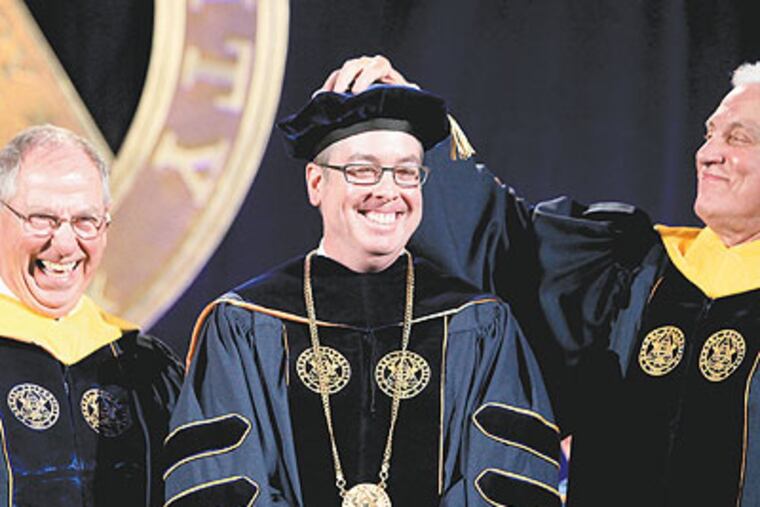
Describing his ambitions for Drexel University as "outsize," the school's new president on Friday announced bold plans, including overhauling its campus and neighborhood, and creating an institute to study autism.
"Make no mistake: Drexel will become a world-class university," John Anderson Fry said in his inaugural address at the school's recreation center. "Drexel can play an even larger and more beneficial role on the local, regional, and national stages while also becoming a powerful force for shaping the future in this complex, complicated, and often confounding world."
But first, Fry, said, Drexel must clean up its own home.
"Who among us could walk around our campus, take full stock of all our spaces, resources, and supports for faculty and students, and then say, 'This is a campus befitting a world-class university'?" he asked.
In an interview before his speech, he said his plans included $200 million in investments over the next four years. The school is working on building a residential and retail complex but also will focus on small projects, such as pocket parks.
Fry steps in at a crucial moment for Drexel. Its previous president, Constantine "Taki" Papadakis, died in spring 2009 of lung cancer. He had been credited with transforming the school from a small institution known mostly for engineering into a major university that enrolls more than 23,500 full- and part-time students, including graduate students.
"I am mindful of Taki's enduring legacy," Fry said. "He left indelible footprints on our university."
Fry, 50, had been president of Franklin and Marshall College in Lancaster, and before that was executive vice president at the University of Pennsylvania. There, he oversaw a dramatic re-creation of Penn's neighborhood that added stores, restaurants, housing, and a popular public school.
Like Penn, Drexel will strive to improve the blocks around it, said Fry. Poverty and hunger in nearby Powelton Village and Mantua put "our academic enterprise at risk," Fry said, and "also offers a harsh rebuke to the core democratic and social values for which our university stands - values that we want to instill in our students."
On Thursday, the school announced a $15 million gift from real estate investor Philip Lindy that will attempt to solve some of those problems by helping to put healthier food in corner stores, and providing nutritional counseling and other services to improve residents' health and education.
Fry also wants area universities to work more closely together to create technologies and businesses that bring jobs to Philadelphia.
"Somehow," he said, "we haven't found the spark to make our regional network as powerful as our counterparts at the Research Triangle Park in North Carolina; Cambridge, Mass.; and Silicon Valley."
Fry said Drexel could provide that spark through its leadership in engineering, nanotechnology, and women's health.
He described the autism institute as the first of its kind, and said its objective would be to "discover and implement approaches for preventing the morbidity and disability associated with autism."
Fry said the center would build on $14.5 million in grants Drexel recently received from the National Institutes of Health and from Autism Speaks, an autism science and advocacy organization that funds research.
Fry said Drexel's center would take a public-health approach to studying the disease, meaning it will focus on large populations and trends. He also wants the center to bring together Drexel's public health, arts and sciences, medical, and nursing schools to do autism research.
Fry said Marla Gold, dean of Drexel's School of Public Health, and Craig Newschaffer, chairman of the department of epidemiology and biostatistics and an autism researcher, would lead the new institute.
Newschaffer said he had already collaborated with researchers at the Center for Autism Research at Children's Hospital of Philadelphia and hoped to continue to do so.
Like Fry, Newschaffer said Drexel's focus on public health would make it different from any other autism research center. That means in part focusing on ways to identify autism early to increase the chance that a child gets treatment as quickly as possible, he said. It also means studying which interventions work, and seeking ways to make them more widely available. For example, if an intervention works in a controlled university setting, Drexel's center might look for ways to train parents to do it in their own homes.
"The goal is to translate some of the leaps of knowledge that I think are going to be happening in the next few years," Newschaffer said.
Fry said the lack of understanding about autism drove the decision to create the new institute, but he also had a personal motive. He has an autistic nephew.
"This is not just in my head but in my heart," Fry said.