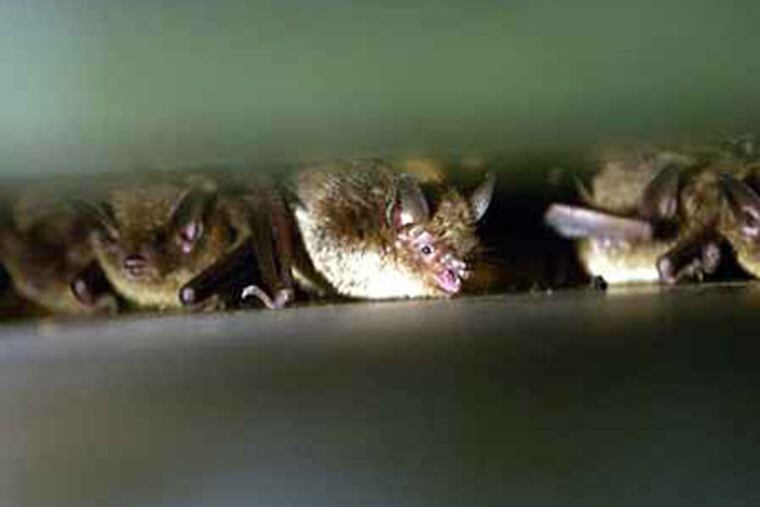
It was another devastating winter for the bats of upper Bucks County.
In an abandoned mine in Durham Township, where as many as 10,000 bats hibernated only two years ago, just 192 were counted this spring.
"And those 192 didn't look good," said DeeAnn Reeder, a Bucknell University biology professor who helped survey the Durham Mine bats in March. "So I wouldn't count those animals as survivors."
Across Pennsylvania, and in a growing number of other states, the news is similarly grim for many species of bat. For the last five years, a baffling malady has been decimating their ranks.
"Overall, we are looking at above a 90 percent decline of all bats in Pennsylvania," said Pennsylvania Game Commission biologist Greg Turner, an endangered-mammal specialist, who also took stock of the Durham Mine toll.
The culprit is an affliction known as white-nose syndrome, which has spread through much of the Northeastern United States and appears to be moving west.
The condition, first documented in New York in 2006, takes its name from a white fungus found on the wings and muzzles of afflicted bats.
Researchers have not determined exactly how white-nose syndrome spreads or kills, but its victims tend to be emaciated and dehydrated.
Studies have found that bats with the fungus are roused from their hibernation more frequently than other bats, perhaps in hunger, and behave erratically, often flying out of their sanctuaries to die in the cold.
It's estimated that white-nose syndrome has claimed between one million and two million bats nationwide, prompting dire predictions for some species of the small, flying mammals.
"I think that there are species that are likely to go extinct," Reeder said, "and species that are likely to go down to very low numbers."
That could be good news for bugs and bad news for farmers. Bats are voracious insect eaters and help save the industry from millions of dollars in crop losses and pesticide costs.
The Durham Mine, a 19th-century iron-ore source near the northern tip of Bucks County, had long been one of Pennsylvania's larger bat hibernation sites, protected from human meddlers in recent years by bat-friendly metal bars at its entrance.
Today, it is typical of many Eastern Pennsylvania bat havens that have been ravaged since the illness first appeared in the state in 2008.
Last year, the Durham Mine population was found to have fallen by half. This year, only about 2 percent of its former inhabitants survived.
The best hope, Turner said, is that the die-off has ended and that the few remaining bats may have developed enough of an immunity to begin to repopulate.
"Theoretically, those that survived have some degree of resistance, whether it is genetic or something else," Turner said. "Whatever it is, hopefully, they can pass that on."
Even under that hopeful scenario, recovery will be gradual, Reeder said.
"Even if they can rebound, they only have one pup a year, and each of those pups has only about a 50 percent chance of survival," she said. "So it will take a very long time."
Bucks County is the only county in the Philadelphia area where white-nose syndrome has been confirmed, although suspected cases have been identified in northern Delaware.
A lot of the estimations are educated guesswork. Pennsylvania, for example, has about 4,000 abandoned mines and about 2,000 caves where bats might hibernate.
"We can go in and survey only about 30 sites a year," Turner said. "We are only scratching the surface because we know of about 700 or 800 sites that have bats, and every year we find new ones."
Many Pennsylvanians would never miss seeing bats, which are mostly nocturnal. But evidence of the white-nose plague may be as close as your next mosquito bite.
A female little brown bat, Pennsylvania's most common species, consumes about 4,500 insects per day for about 220 days per year, Turner said.
That works out to just under a million bugs per bat.
"They are the top predator of insects, especially nocturnal insects," Turner said. "If we lose a million bats or more in Pennsylvania, that's a lot of insects that will not be consumed."