Final countdown for a costly carrier
About $1 billion per flight and 14 lives lost. Still, the shuttle program changed how we view space.
The launch of the space shuttle Atlantis will mark the end of a 30-year program that changed spaceflight from an awe-inspiring event that gathered families around their televisions to a routine activity that rarely made the evening news.
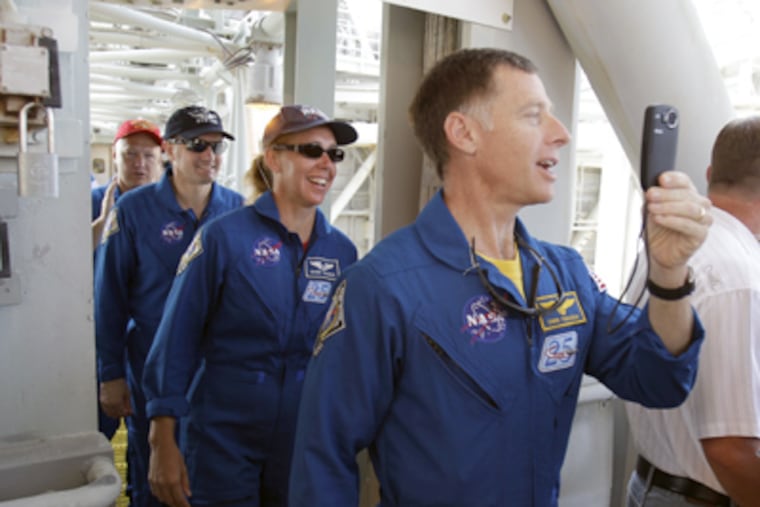
Atlantis, the last shuttle to be grounded, is scheduled to begin its final flight Friday. It will carry a crew of four, including Philadelphia native and Drexel University graduate Chris Ferguson.
"You hate to see the space shuttle go, but in order to take steps further, we have to do it," Ferguson said Thursday at a news conference.
The shuttle was the costliest U.S. spaceflight program ever undertaken, costing $192 billion from 1970 to 2010, two independent experts found. Among the high and low points were the repair of the Hubble Space Telescope, the historic docking with the Russian space station Mir, the flight of then-77-year-old John Glenn, and two deadly accidents in 1986 and 2003. But most of the 135 missions flew below the popular radar.
"We don't think of spaceflight as anything out of the ordinary, and that's strikingly different from what I like to refer to as the heroic age - the age of the Mercury, Gemini, and Apollo astronauts and the Russian cosmonauts," said historian Roger Launius, senior curator for the National Air and Space Museum.
"You're looking at 30 or 40 people going up in a single year," said Jonathan McDowell, a Harvard University astrophysicist and writer of a newsletter about the space program. "That's huge compared to any program before the shuttle."
During that time, astronauts and ground control learned how to maneuver at hypersonic speeds and how to do repairs and even major construction in space.
Some scientists have questioned the purpose of the program. The shuttle was conceived and designed during the Cold War, when the imperative was to stay ahead of the Soviet Union. While robotic probes have skimmed over the exotic frozen seas of Jupiter's and Saturn's moons and other bodies millions of miles away, the space shuttle is confined to "low Earth orbit," just 200 to 300 miles off the ground.
The shuttle never lived up to the promise NASA made in the 1970s to make spaceflight cheap, said Launius. The missions were each supposed to cost less than $10 million, but cost about $1 billion apiece.
Still, the shuttle was used to build the International Space Station, which can house six astronauts and will stay occupied, with Russian rockets doing the transportation.
Launius compared the station to a mountain base camp and the shuttle as the transport vehicle to that camp. And so, after the final shuttle flight, the station will continue to orbit, and research will continue on the effects of spaceflight on the human body in the hope that astronauts will go beyond base camp to walk again on the moon and reach Mars and beyond.
The first shuttle took off in 1981, and seemed to be working toward the expected goal of one launch every two weeks, said Launius.
But then, in January 1986, the shuttle Challenger exploded soon after launch, imprinting on American minds a picture of destruction as indelible as the collapse of the twin towers.
The crippled shuttle program continued, but much more slowly. Some began questioning its role. The initial plan was for the shuttle to be a transport vehicle to a space station, which had been on the drawing board since the 1970s but was still nowhere to be seen by the late 1980s.
There were satellites to be launched for spying, communication, weather, and science. Some of the more notable payloads were Galileo, which explored Jupiter and its moons; Magellan, which probed Venus; Ulysses, which studied the sun; and astronomy satellites Chandra, Compton Gamma Ray Observatory, and Hubble, which explored the universe. But why not send these up on unmanned rockets, which would be cheaper? "That's a question NASA could never answer," said Harvard's McDowell.
The one advantage of the shuttle was the ability to repair satellites and return them to Earth, but that was often impractical.
"If you had launched a $100 million satellite and it broke, should you build another $100 million satellite or fix it with a billion-dollar shuttle flight?" McDowell asked.
But then the shuttle found an ideal mission in the early 1990s when the $3 billion Hubble Space Telescope urgently needed repair. The telescope had been billed as a way to give humankind an unprecedented view of the cosmos by observing above the distorting effect of our atmosphere.
But soon after launch, NASA found that through a manufacturing error, the telescope's enormous mirror was flawed, blurring its vision.
In 1993, a shuttle mission was sent to install optics that, like eyeglasses, corrected the telescope's blurred vision to its intended sharpness. Another historic mission was launched in 1995 when the shuttle was slowly connected to Mir, allowing astronauts and cosmonauts to mingle and exchange scientific data and supplies.
The first component of the International Space Station was launched in November 1998, and some questioned the scientific value of the estimated $100 billion project.
NASA had promised scientific research that would benefit mankind, including manufacturing in space and biology experiments on cells and proteins with medical benefits. That same year, the American Society for Cell Biology found that space-based work on proteins had "made no serious contributions to scientific knowledge."
Disaster struck again in February 2003 when the shuttle Columbia burned up on reentry, killing all seven astronauts aboard.
Slowly, however, construction resumed on the space station. In November 2008, a decade after the first component was launched, Ferguson commanded a mission to install new living quarters. The expanded quarters would finally allow six astronauts to occupy the station, which was the initial plan. His mission was also charged with installing a refrigerator, exercise apparatus, a water-recycling system, and a new toilet. By this time, the main point of the space station had become clearer: to study the way the body adapts, or fails to adapt, to space.
A Mars mission would last at least six months each way, possibly exposing astronauts to many risks - weakened bones, heart problems, atrophied muscles, cancer, depression, accidents, and premature aging.
One of the biggest and most poorly understood hazards is radiation. The space station and the shuttle routes remain inside much of the Earth's protective magnetic field, but missions to the moon and Mars would expose astronauts to particles from the sun and deep space.
There's some evidence that this radiation is responsible for the observation that astronauts suffer a disproportionate number of cataracts. Studies are investigating the cancer risk and accelerated aging that might result as well.
Another serious hazard is sleep deprivation, since space can disrupt the circadian rhythm that guides our daily cycles, leading to a sort of extreme jet lag. In the space station, astronauts see a new day every 90 minutes. On the moon, they'd see 14 days of light followed by 14 days of darkness.
McDowell said the space station should test a proposed plan for an inflatable living space, which hardens on exposure to sunlight.
That might be a practical way to create an easy-to-launch living quarters for astronauts on the way to Mars.
"All of these kinds of things . . . we can try them out in Earth orbit before we do the Mars thing," McDowell said.
Will the space shuttle have a successor? Last decade, the George W. Bush administration proposed an ambitious project, called Constellation, that would send spaceships to the moon and eventually build a moon base. The Obama administration killed it.
"The funding was unrealistic from day one," said McDowell. "Obama got flak for it, but it was the right thing to do."
Today it's likely the next U.S. spacecraft will be made by a private company. One called Space-X has developed the Falcon 9, which has flown two successful unmanned tests. And the bigger companies, Boeing and Lockheed, are developing capsules that can house astronauts and be launched on rockets.
Whatever comes next, Ferguson hopes to be part of it. "This business gets into your blood," he said. "I would love nothing more than to parlay my experience whenever we go back to low Earth orbit or beyond."
The big question still looms: Why do this, when robots can take us so much further and beam back amazing pictures? The answer seems a matter of both philosophy and faith.
"Human spaceflight is about getting off this planet on a permanent basis, since we can't survive here forever," said Launius.