Caregivers regret angry words born of frustration
Not long after Mary Gemmill's husband, who already had chronic obstructive pulmonary disease, learned he also had lung cancer, she had one of those caregiver meltdown moments that people don't talk much about.
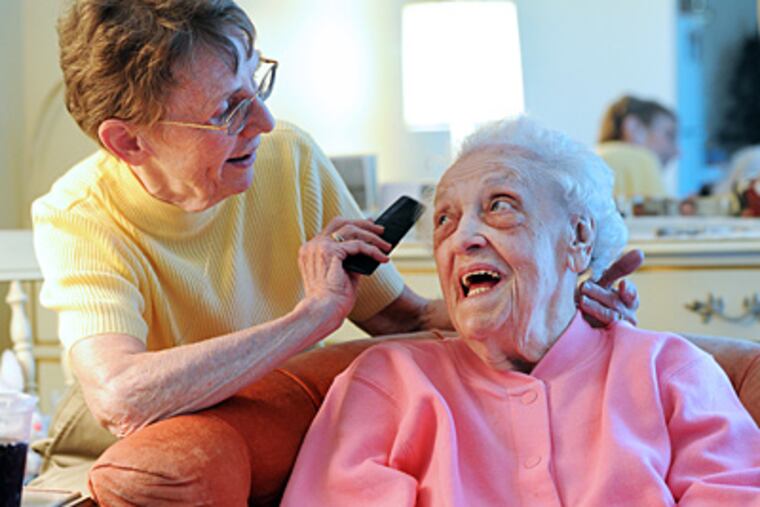
Not long after Mary Gemmill's husband, who already had chronic obstructive pulmonary disease, learned he also had lung cancer, she had one of those caregiver meltdown moments that people don't talk much about.
She caught her husband hiding cigarettes, and she exploded. A retired nurse, she knew he was going to die - the death came two months after his diagnosis - and it didn't really matter much whether he smoked. But she also knew his addiction to cigarettes had made him sick in the first place.
"We had World War III. And now, of course, I feel so bad because I look back, I was so nasty," said Gemmill, 72. The couple were married 47 years. "It was everything coming in on me. Here he is, he's so sick he can't really breathe and he still wants those damn cigarettes. . . . I was angry with the whole situation. I knew he was going to go away from me and I couldn't control this."
She never apologized and neither did he.
A year and a half later, Gemmill wishes she'd been kinder. She questions whether she had a right to be angry with him. But she also recognizes that she was flooded with emotion, that caring for him as he died - as he left her - was the hardest thing she ever did.
"We're human," she said, "and it was a human reaction and I think perhaps we need to be a little kinder with ourselves."
Amen.
After my husband was diagnosed with brain cancer in 2007 and died last year, friends who have been caregivers have confided stories like this, and I've told them myself. We're sheepish about our weakness, guilty that we didn't live up to some Hallmark-movie-standard of saintly caregiver behavior. We think everyone else is always patient and loving, but I've now heard these tales from enough people to suspect just the opposite. This is one more aspect of how Americans die that we're too squeamish to reveal, so we end up feeling bad about behaving like normal, flawed, frightened, exhausted human beings.
Patience has never been one of my strengths. Having two sons made me better at it, but I still struggled with living with a man who was slowly losing his ability to think, feel, and navigate normally. While I worked, I took care of the house and kids, and gradually added all of his duties to mine. It felt like time was slowing down for him and speeding up for me.
I confess I felt a little exasperated in his last months as I dragged him through the halls of the hospital, not so much because he was so slow and unaware of other people as because he thought he was normal and wouldn't listen to me. I confess that when he told me he thought he was well enough to start driving again a few weeks after his fifth brain procedure - one of them had damaged his peripheral vision enough that he was walking into door frames - I said, "Absolutely not," in an abrupt, mean-Mommy way that certainly could have been more sensitive, and that left him looking crushed.
And, I confess that I was at my wits' end on the worst night of my life as a caregiver, the night before the hospital bed arrived. Jeff had been unable to stand since that morning. I knew if he fell that night, I wouldn't be able to get him up. He didn't realize he couldn't walk anymore. I spent the night holding him in bed, sometimes quite forcefully, while he struggled to make it to the bathroom. "Why are you being so mean to me?" he finally asked, so plaintively that I felt like an ogre. "Because I have to keep you safe," I said.
That was true, but it was only part of the story, just as Mary Gemmill's husband's surreptitious cigarettes were only part of her story. My husband couldn't understand the whole of it - that I was terrified of his death and of life without him, and that the person who had always been best at calming my fears not only was the cause of my distress but also was unable to help me.
I only feel a little bad about these things. I know I did my best and I know my husband did, too. I see end-of-life caregiving as one of those domains in life, like child-rearing and marriage, where we really want to be perfect but need to learn to accept being good enough. Still, that's easier said than done.
I asked some experts on caregiving and grieving whether the experiences that Gemmill and my friends and I had were typical.
"People hold themselves to an almost inhuman standard," said Margaret Lazar, director of patient and family services at the University of Pennsylvania's Abramson Cancer Center. They think, "This person's sick, I have to love them and be kind no matter what."
Beth Hopkin, who runs a bereavement group for Cancer Support Community of Philadelphia, said she's a fan of support groups, therapy, or just telling a friend because it's so painful for caregivers to be alone with their shortcomings. "I think that people have very high expectations for themselves to be absolutely perfect . . . to only have loving emotions, to be always kind, always compassionate." She thinks there's an unspoken, possibly unconscious, belief that perfect caregiving will make a loved one well.
For the most part, my husband was a great patient. He was even-tempered, thankful, and surprisingly good at adjusting to increasing disability. A friend's wife was remarkable. She told her husband how much she appreciated the wonderful life they had together and the care he gave her. We know our spouses gave us an amazing gift that has freed us from some of the mixed emotions that other caregivers face.
The person who is dying can really complicate emotions by being cranky and difficult, experts pointed out. Pain, pain medicines, spreading disease, weakness, increasing dependence, and fear of dying often don't bring out the best in people. And, the truism that people are hardest on the ones they love most is, well, true.
Plus, the emotional experience of dying is far different from that of being left behind and watching a loved one suffer. You're not on the same path anymore.
"Sometimes the person who's sick sees the other person that's going to live on," Lazar said, "and it's very painful. They'll get to raise the kids. They'll get to have another life, and meanwhile this person is suffering terribly."
Stuart Shafer was still madly in love with his wife, but concedes she was "very, very demanding" while she was sick. (She died in 2009.) He never told her when he felt angry. "I thought if she saw me cracking, it was going to make her feel emotionally or physically worse," he said. "I knew that some of the stuff she was saying and the emotion she was expressing wasn't her."
Karen Neyer, assistant program director at Cancer Support Community of Philadelphia, said caregivers often just swallow their anger and walk away. An alternative, she said, is to say, "I really don't know how to help you. Please tell me because I don't want to be yelled at anymore."
So, what can we do to minimize the guilt? Ideally, we'd talk more about how we're feeling while we can, say all those unsaid things that weigh on hearts later. Apologize or tell your wife how much you love her while she's alive. Don't be afraid to admit, together, that this is scary and hard. "Putting simple things into words - those thank yous, those I forgive, those I love yous, that kind of feeling when it's truly there - can be huge," Hopkin said.
We all bring our histories into caregiving, the experts told me. If we didn't talk out all our feelings or resentments when all was well, we probably won't start when things are terrible. The comforting thing to remember is that our spouses or parents already knew we weren't perfect and they probably loved us anyway.
"We need to remind ourselves," Neyer said, "of how the person we lost reacted to our imperfections when all was well."