A visit with Destiny, one of St. Christopher's extra-needy preemies
Destiny Clarissa, the youngest child of Yolanda and Aaron Dent, was born in Abington Memorial Hospital on March 4. She weighed 1 pound, 2 ounces, less than a can of spaghetti sauce.
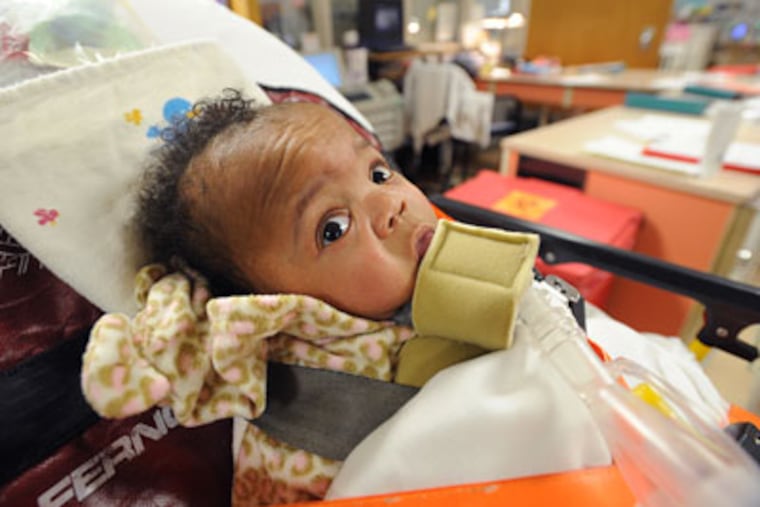
Destiny Clarissa, the youngest child of Yolanda and Aaron Dent, was born in Abington Memorial Hospital on March 4. She weighed 1 pound, 2 ounces, less than a can of spaghetti sauce.
Twelve days later, she was whisked to the neonatal intensive-care unit (NICU) at St. Christopher's Hospital for Children. No one there could predict when she would leave - or whether she would live.
The NICU at St. Christopher's is classified as a Level IIIC; only the most fragile babies, the ones with a tangle of complicated problems that other area hospitals are unable to treat, find their way to the 136-year-old hospital.
"We don't see routine preemies," says Jane McGowan, the NICU's medical director. At any given time, from 30 to 40 babies are living in the unit, in heated isolettes at first, later in tiny cribs, each decorated with a colorful mobile - a felt duck, a bunny, a horse, all swinging from a bright canopy. Two-thirds of the babies, like Destiny, are preemies; the others are full-term but born with serious anomalies that make them candidates for the most skilled and specialized medical wizardry.
Twenty years ago, many of these babies would not have survived. Today, advances, including the meticulous team care they receive in NICU units like this one, give them a more hopeful prognosis. Most of the infants will leave eventually, says McGowan, although the quality of their lives often remains unknown. They will remain at high risk for a medley of complications - including cerebral palsy, mental retardation, growth deficiencies, vision and hearing problems, fragile lungs, and school difficulties. Some, despite the most heroic efforts, won't make it. "You never get used to it," McGowan says. "When a baby dies, I still cry."
"In my 25th week of pregnancy, I stopped feeling her move," says Dent, Destiny's mom, who was being treated for preeclampsia, a leading cause of premature birth and fetal complications. The condition is characterized by the mother's dangerously high blood pressure and protein in her urine. "I was so scared and nervous and numb," Dent says. "I didn't know what to feel." A few hours later, her baby was delivered through a cesarean section. "My husband, Aaron, and I were both traumatized," Yolanda remembers. "All I had dreamed about was having a healthy baby. I cried for days."
Even in the NICU where every baby is in crisis, Destiny's condition was extreme. Every one of her organs was underdeveloped. She had chronic lung disease, low blood sugar, abnormal blood vessel development in her eye, a heart defect, an abnormal pulmonary valve, a dilated loop of bowel in her upper abdomen, and a weak thyroid gland. Miraculously, she showed no evidence of neurological damage.
Her parents were told to brace for months of touch-and-go moments. Their daughter would be on and off a respirator, would likely get infections, be unable to maintain her body temperature, perhaps experience congestive heart failure, endure several surgeries, and possibly develop serious eye problems. That is, if she lived.
More than half a million babies in this country are born prematurely each year, according to the March of Dimes; despite dramatic advances, not all will survive. Those who do - especially the tiniest ones - may endure more medical emergencies as they develop.
"Having a baby this sick is a crisis for the whole family," says Candy Nyce, manager of Child Life Services at St. Christopher's.
She and Kelly Conlin, a child life specialist, help parents, siblings, and other relatives cope. "It's hard on the siblings," says Conlin. "Why didn't the baby come home from the hospital with Mom? Those old enough to visit the baby worry about why she has all those tubes. Sometimes, they feel like the left-out member of the family as they get shipped off to grandparents or neighbors."
Conlin may connect them with their tiny brother or sister by asking them to draw a picture that can be placed in the baby's crib or encourage them to help their parents make a scrapbook of their journey through this traumatic time. They create and paint memory boxes where they keep pictures of the baby, store messages to her, a lock of hair, the hospital bracelet. Sometimes Conlin refers the family to a support group.
The family of Samuel Benique will always treasure its scrapbook. "Making it is helping us get through this," whispers Samuel's mom, Ivelisse Roche, as she lovingly turns the pages of a picture-filled album.
Unlike Destiny, Samuel was born full term - he weighed 7 pounds, 10 ounces - but he has underdeveloped lungs because of polycystic kidney disease. "We think it happened because his mom leaked amniotic fluid during her pregnancy, depriving Samuel of the fluid needed to develop healthy lungs," says McGowan.
Samuel is being treated for pulmonary hypertension (in the arteries of the lung) and systemic hypertension. "The first weekend he was here, we thought he might not make it," says Laurie Stewart, the social worker attached to the unit. She looks over at his crib and smiles. "But here he is. He looks like a little Buddha." Samuel is still learning to eat and won't go home until he is able to take in at least 10 ounces of fluid a day.
Trinity Shore is in surgery. Born at 4 pounds, 3 ounces on Nov. 8, 32 weeks into her mother's pregnancy, she was rushed from Pottstown Memorial Medical Center to St. Christopher's because her intestines were outside her body, a condition called gastroschisis. Trinity was put on a silo that looks like a mesh stockinette. It was sewn to the skin around an opening in her abdomen and covered her protruding bowel. Each day for a week or so a bit of the mesh was tied off and some of her bowel was pushed into her belly. When the process was complete, doctors were ready to close the opening in the operating room.
Trinity will return to the NICU with a ventilator in anticipation of temporary breathing problems that may follow the procedure. Like Samuel, Trinity will have feeding issues as her body adjusts.
Last Monday was a jubilant day for Destiny and her family. The NICU was jammed with the staff members who had been part of her world for the previous eight months.
Some smiled, some stifled tears as Destiny was tucked into a transport carrier with a carload of equipment - a ventilator and the oxygen tank that goes with it; a tube that goes through Destiny's stomach wall, attached to a pump with a bag full of formula; and home and portable suction machines.
Destiny's parents had received extensive training in managing her medical care at home and know that she may not be free of life-sustaining medical equipment for two years.
But Diane Lavery, the NICU's charge nurse for 23 years, is optimistic that the family can manage it. "Destiny may have developmental delays and it will take her longer to reach milestones. But she has made such strides, and I would expect it to continue."
Destiny's parents are grateful to Fred's Footsteps, a foundation that supports families struggling with the staggering costs of caring for a critically ill child. A foundation grant allowed the Dents to buy larger living quarters in Norristown with a separate room for Destiny and to install an electrical system to accommodate her extensive medical equipment.
Commercial insurance will cover the cost of nursing care full time for two weeks, then l6 hours a day to supplement that given by her parents. Only 3-year-old Jessica was at home with her dad when Destiny and her mom finally came through the door. She was curious about her new sister and kept whispering, "Baby Destiny." When 5-year-old Nathaniel arrived from school, he dashed into Destiny's room and wanted to toss toys into her crib. A few days earlier, he had asked his mom, "Will Destiny be able to play cars with me?" Thirteen-year-old Shamire had seen Destiny in the hospital and couldn't keep his eyes off her. All through the evening, the children kept popping into Destiny's room. They wanted to give her good-night kisses.
The family is planning a quiet Thanksgiving, just the five of them. They can't risk the presence of anyone who might bring a runny nose or respiratory infection into their home.
"Our family has been through so much," says Yolanda. "Through all of the surgeries, all of the near-death moments, I walked beside Destiny. Now, as we sit around the table on Thanksgiving, we'll be thanking God for blessing us with her and for keeping her safe. I'm so grateful. She's my angel, and I couldn't stand the thought of losing her."
See photos of babies in St. Christopher's NICU at
EndText