Check Up: Small sacrifices can keep weight off
Everyone knows the secret to losing weight: eat a healthier diet and get more exercise. The question is, once you slim down, how can you indulge without porking back up?
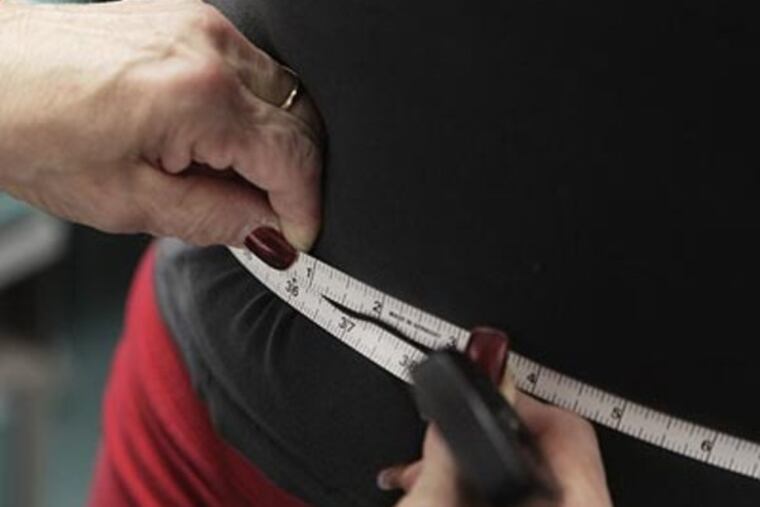
Everyone knows the secret to losing weight: eat a healthier diet and get more exercise.
The question is, once you slim down, how can you indulge without porking back up?
A University of Pittsburgh analysis has found that the secret to long-term weight control may be sticking to fairly painless changes, such as eating less meat and cheese.
"It's not as hard to do as giving up french fries forever," said Bethany Barone Gibbs, a Pitt epidemiologist who led the analysis, published last week in the Journal of the Academy of Nutrition and Dietetics.
The study involved 481 postmenopausal women who were overweight or obese. Half were in an "intervention" group that took brisk walks and got help for 30 months from nutritionists, psychologists, and exercise experts. The "control" group was simply offered quarterly seminars on topics such as exercise and smoking cessation.
All the women reported their eating habits at the start, at 6 months, and at 48 months.
Predictably, the intervention group did better over the short term; at six months, 27 percent had lost substantial weight (at least 22 pounds), compared to 5 percent of the control group.
But surprisingly, at four years, the control group was doing a bit better than before, with 6 percent down 22 pounds, while the intervention group was doing worse than before, with 15 percent down that much. The same pattern was seen with smaller losses.
Using statistical analyses, the researchers looked for links between changes in long-term weight and changes in eating habits, namely frequency of consuming fried foods, fish, fruits and vegetables, restaurant meals, and meat and cheese. (They also mathematically controlled for the effect of brisk walks.)
In the intervention group, "the only factor that came up as important for long-term weight loss was decreasing intake of meat and cheese. That was a surprising finding," Barone Gibbs said.
For the control group, long-term weight loss was linked to fewer desserts and sugary beverages, along with more fruits and vegetables.
The study did not ask about habits such as snacking or drinking alcohol, so the findings are limited. Still, if sustained weight loss doesn't require huge self-denial, "it's fantastic," Barone Gibbs said. - Marie McCullough