Fleeing nightmare of Syria for dream in Center City
Ayman Suleiman did not come from a medical family. His father was a truck driver, his mother a housewife. But as a young man in Syria, he was influenced by a close friend's physician brother who told him, "You are a better person if you are helping sick people and your family and your neighborhood."
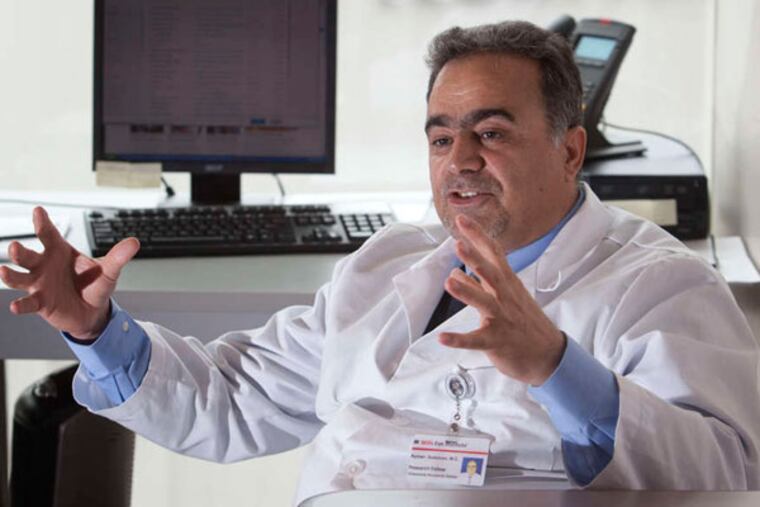
Ayman Suleiman did not come from a medical family. His father was a truck driver, his mother a housewife.
But as a young man in Syria, he was influenced by a close friend's physician brother who told him, "You are a better person if you are helping sick people and your family and your neighborhood."
Suleiman took the words to heart and became an ophthalmologist. Little did he dream that decades later, he would be practicing in the United States, driven here by a fellow eye specialist, British-trained Syrian president Bashar al-Assad.
"I want everyone in America to know about the monsters controlling Syria," said Suleiman, 49, a research fellow at Wills Eye Institute in Center City. "A thousand people disappearing in one night . . .."
A compact, intense man, Suleiman sat in a Wills office with a view quite different from embattled Damascus.
His dual citizenship, obtained when he served residencies and fellowships here between 2000 and '09, makes him different from nearly all the 200,000-plus refugees of Syria's civil war, now threatening to split the country. But his experiences there were similar, including the death of a brother who had protested against the regime and had gone into hiding.
"They attacked his house maybe 10 times," Suleiman said. "About 20 soldiers. They'd go to the house and start screaming, 'Where is your husband? Where is your father?' "
"Finally, they caught him and said they'd bring him back in two hours. Those two hours took one month. Someone called and told us he was dead."
Suleiman still doesn't know who called. He was told to go to a hospital morgue, where he saw his brother's body.
Frozen.
It was late 2011. Thousands were dying. The civil war was growing in intensity, especially with attacks by Assad's Alawite minority against Sunni Muslims such as the Suleimans.
He said the store of another brother, a pharmacist, was trashed, and a third, a dentist, fled to Oman so he could practice there. The pharmacist brother went into hiding, and Suleiman still does not know where he is, although they talk by cellphone.
"I was against leaving in the beginning," Suleiman said. "Sometimes, when you see the people are suffering, you want to be part of those people."
He kept practicing medicine, but soon found leaving the house difficult.
At times, he said, an entire neighborhood would be locked down. "They put snipers on the rooftops. They close the streets. You can't even go out on the veranda."
Everyone fears being caught with an incriminating cellphone, he said, so some people swallow the memory card when stopped at a checkpoint.
By late last year, he had had enough.
"You look at the faces of your kids, and you see you are trapped, and you aren't a hero anymore. They're bombing everywhere, and you can't feel secure for them. You just have to protect them."
He paid bribes to emigrate to Jordan with his wife and four children - now ages 21 months to 10 years - and flew to the United States, settling in a Northeast house borrowed from a friend. Two months later, he was admitted to the Wills program, where he helps design research studies.
"He's been a very welcome addition," said L. Jay Katz, chief of the hospital's glaucoma service.
Later this year, Suleiman will search for a job. A graduate of medical school in Bulgaria, he faces stiff competition and may need more training, Katz said.
"It's difficult for someone like him," Katz said, "but it doesn't mean it can't happen. He's bright, he's charming, and hopefully he'll get a spot."
Suleiman has no wish to return to Syria, partly because his wife, Halah, 37, has a congenital heart condition he feels could not be treated there.
"I don't hear the right voice in the United States" to oppose Assad, he said.
Even as he and his family settle in here, the scars of Syria remain.
He recalls taking his oldest daughter, Laila, to elementary school and seeing her panic at the sight of a woman at the entrance wearing a uniform.
"Daddy, Daddy, there's a security," she said.
"In Syria, you see security, you hide," Suleiman said. He explained his daughter's fear to the guard and asked, "Can you make her relax?
"And she was so nice, she took the time to do it."