Phila. baby first to be born after new genetic test
Connor Levy was "made with love (and science!)," as a onesie he was given points out. The Philadelphia baby is the first to be born after an experimental fertility test that may improve the odds of a successful pregnancy after in-vitro fertilization.
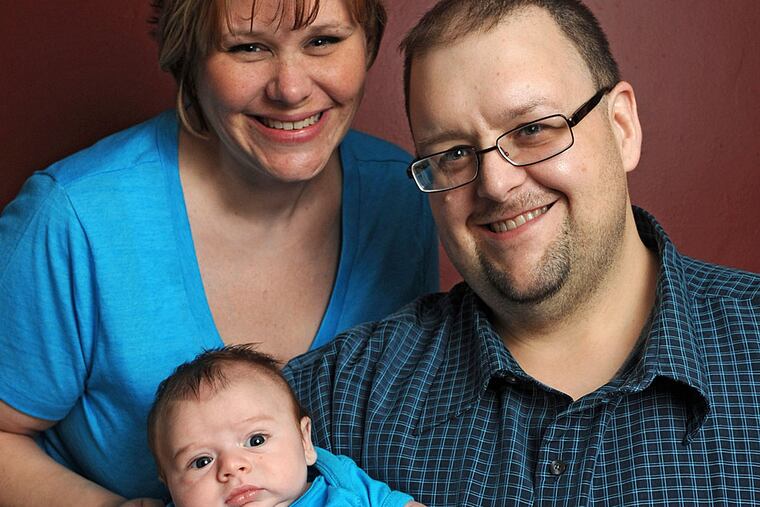
Connor Levy was "made with love (and science!)," as a onesie he was given points out.
The Philadelphia baby is the first to be born after an experimental fertility test that may improve the odds of a successful pregnancy after in-vitro fertilization.
The "next-generation screening" test helps identify the healthiest embryos, and would let doctors implant just a single embryo in a uterus. The resulting high likelihood of a full-term pregnancy would reduce costs, multiple births, and miscarriages related to in-vitro fertilization. According to its developers, the test is cheaper, faster, and more accurate than existing screening.
About 10 percent of couples deal with infertility, according to the American Pregnancy Association. Men are as likely as women to be the cause.
For Connor's parents, the issue was low sperm count and poor quality of sperm. They spent five years looking for the right fertility clinic. One recommended invasive surgery. Another urged them to consider adoption. A study at Cornell University offered them experimental treatment, but the consultation would cost $500.
Finally, based on a friend's advice, Marybeth Scheidts, 36, and David Levy, 42, went to the Main Line Fertility Center of Bryn Mawr Hospital. Under the care of Dr. Michael Glassner, they endured another futile year with three rounds of intrauterine insemination that cost a total of $2,000. But Glassner earned their trust with his attentiveness.
Last August, he offered an alternative.
Glassner had been contacted by Reprogenetics, a New Jersey-based diagnostics company, about a test just developed by researchers at the University of Oxford who were looking for their first patient.
"Time worked itself out, and that's how we got to where we're at now," Levy said. "Dr. Glassner basically told us we hit the lottery with this new research. All we had to do was sign a paper."
Thirteen of the couple's embryos were grown in a laboratory. When they were five days old - at the "blastocyst" stage - geneticists sent less than 1 percent of cells from each embryo for testing in England.
The test identified which embryos contained just the right number of chromosomes, the packages that carry DNA in every cell. By the time women turn 36, Glassner said, 60 percent of their embryos will carry an abnormal number of chromosomes. That percentage increases with age.
Only 30 percent of embryos grown by IVF ever implant in a uterus, and chromosomal abnormalities may be a reason. Even in children carried to term, too few or too many chromosomes result in developmental conditions like Down and Klinefelter syndromes. In theory, the new test could simultaneously screen for genetic mutations known to cause disease. But using it that way, Glassner said, could raise "ethical and moral questions."
Testing revealed that only three of the couple's embryos were viable. "At that point," Levy said, "our geneticist at Main Line said he would stake his reputation that with just one of those embryos, we would get pregnant."
The couple selected a male embryo for implantation, and on May 18, Connor was born at Abington Memorial Hospital.
While insurance companies may cover IVF treatment, embryonic screening costs an additional $5,000 to $10,000, paid out of pocket. Glassner expects the new test to cost 50 percent to 80 percent less. Scheidts and Levy paid nothing because the test is experimental. A randomized clinical trial including Main Line is to begin by the end of this year.
Another couple who underwent the same testing at New York University's Fertility Center await their own baby.
Dagan Wells, a pioneer of the testing, spoke at the European Society of Human Reproduction and Embryology's annual meeting in London on Monday. The accuracy of the test was confirmed by using it to analyze 45 embryos known to have chromosomal abnormalities.
Until a month ago, Scheits and Levy did not know the details of the testing. But they remain open to having more children. "We didn't expect any of this," Levy said, "other than the fact that we wanted to start a family."