A lens solution that looks like saline burns many
Emergency physician Terry Fairbanks first knew Clear Care was a problem when his wife began screaming in pain one day after using the contact lens cleaning solution.
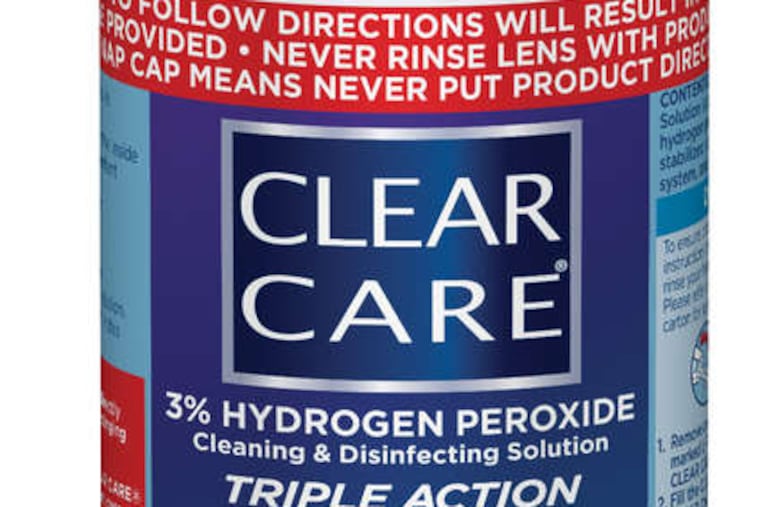
Emergency physician Terry Fairbanks first knew Clear Care was a problem when his wife began screaming in pain one day after using the contact lens cleaning solution.
Like many others, she had mistaken the bottle of hydrogen peroxide solution for salinesolution and squirted it onto her contacts. After fitting one chemical-soaked lens onto her eyeball, she felt a stabbing pain as her eye began to burn.
Made by Novartis, Clear Care contains 3 percent hydrogen peroxide, a chemical that, at higher concentrations, can cause severe eye damage and possibly blindness. Three percent may not be strong enough to hurt the eye permanently, but Clear Care's history is rife with complaints. Injured users often go to an emergency room, and later visit an eye specialist.
Warning labels on the bottle state that Clear Care should be used only with the special lens case provided. The case has a platinum-coated disc that neutralizes the hydrogen peroxide, converting it into saline solution after 6 hours. After this deep clean, the contacts can safely be put in the eyes.
A company spokeswoman said it often reevaluates products, and is in the midst of another label redesign.
Still, many consumers have confused Clear Care with saline or multipurpose solution - the white squeeze bottles look virtually identical.
"Clear Care needs to think about [its] users: they're just waking up, they don't have their glasses on or contacts in yet, so they can't see," said Fairbanks. "There's 100 percent certainty that you will have human error."
Fairbanks studies the design of medical products and how to limit harm. "In presentations, I use Clear Care as an example of bad design," he said.
Another critic is Michael Cohen, president of the Institute for Safe Medication Practices and a contributor to the "Check Up" blog. His nonprofit focuses on medication errors and receives a steady stream of complaints about the lens cleaner.
The Food and Drug Administration has received 190 reports about Clear Care since 2002. But most do not reach the FDA. Cohen thinks that Clear Care has hurt hundreds of thousands of consumers.
One of those was Trish Laughter's 20-year-old daughter, Colleen, of Westwood, Mass. Last June, Colleen was babysitting when her contact lens fell out. One of the children gave her a bottle of Clear Care, thinking it was regular saline solution.
"The poor kid who gave her the solution was panicking because my daughter was screaming." said Trish, who then rushed to her daughter in a panic. "She couldn't drive; her eye was almost swollen shut, like a slit."
They didn't go to the ER because Trish's husband had recently lost his job and the family's health insurance. She later saw an eye doctor, who gave Colleen antibiotic drops. She couldn't see out of her eye for days. After a flurry of contact with the company, it covered her medical bills. But Trish still fumes over the firm's response. "They apologized for the 'inconvenience,' " she said. "A chemical burn to the eyes is slightly more than an inconvenience."
Alcon, the product's maker, was bought by Swiss drug giant Novartis in 2010. Clear Care packaging was redesigned in 2012, putting a red warning label on the bottle. Also, the tip of the squeeze bottle is bright red to alert users. But has it helped?
"I don't see any drop-off in complaints," said Cohen. "I just got another one yesterday."
Christopher Rapuano, chief of cornea service at Wills Eye Hospital, thinks the product is fine if used properly.
He has seen injured patients, but has never heard of anyone getting permanent eye damage. Still, the complaints show the warnings aren't working. "The onus should be on the company to provide a good warning, and they believe they have - but in reality, it's not good enough," said Rapuano.
Donna Lorenson, Alcon's head of communications, said "we understand the potential that some consumers may have confusion with multipurpose saline solution. We did recently make a change to the bottle: the flip top is red."
The red flip top and red nozzle tip - previously it was a white flip top with a red tip - will remind users that it isn't saline solution, she said. The new bottle started to reach store shelves in January. Cohen and Fairbanks are not impressed.
"The color red is not any kind of standard and is essentially meaningless to consumers; if you unscrew the cap right now, you will see that it has a red nozzle," said Cohen. He has urged Alcon to make a bottle that cannot be used unless it's attached to the special lens case.
Fairbanks doesn't believe the new bottle will have a major effect, since it still looks like a saline bottle, except for the cap. "It's 'solutions theater' that looks like a solution, but when you look at the scientific facts, it isn't."
857-205-6920