What made Ish the bearded dragon start dragging?
Ish has always been content to lounge in the yard with his owner, occasionally showing his "silly side" by zipping around the house before slumping down in front of the screen door to gaze outside.
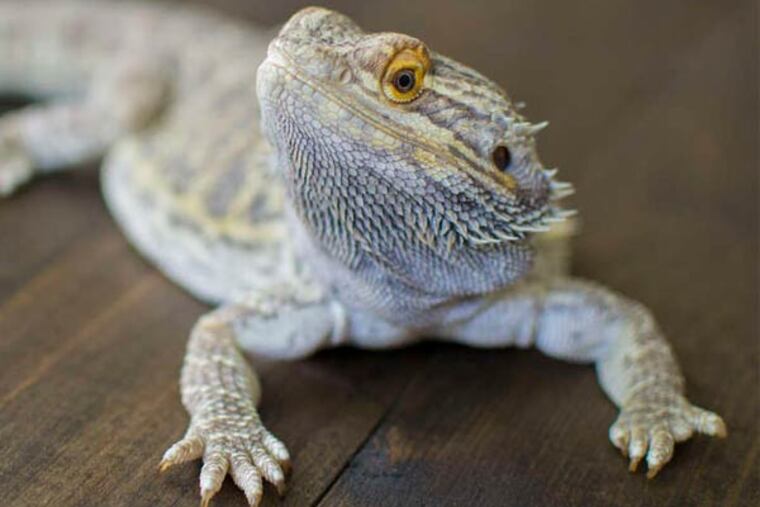
Ish has always been content to lounge in the yard with his owner, occasionally showing his "silly side" by zipping around the house before slumping down in front of the screen door to gaze outside.
"He just fits me," said Stephanie Stepansky, of Harrisburg, who purchased the orange-flecked bearded dragon from a pet store six years ago, at age three months.
But in January, Ish went from leaping lizard to lump. His normal fervor for daily playtime became uninterrupted rest in the log hollow within of his 75-gallon tank.
Bearded dragons are named for their spiked "beards," fleshy throat pouches that they puff out and darken in mating displays or aggressive warnings, and can also turn darker with sickness or stress. Ish's beard was now jet black.
He ate and weighed less, and began "gaping." Although it is normal basking behavior for heat regulation in lizards, constant open-mouthed breathing may signal respiratory distress, possibly from infection or parasites, or abdominal discomfort.
Ish had had his share of upper respiratory infections, typically in August, but they had always cleared up. Whatever was going on this time seemed to have taken hold; his abdominal muscles strained hard with each breath.
Stepansky's local veterinarian put the 20-inch lizard on antibiotics. When he was still declining a week later, the vet ordered blood work, an X-ray, and a fecal exam for parasites; all were normal. Ish was referred to Len Donato, who specializes in exotics at Radnor Veterinary Hospital in Wayne.
Donato delved into Ish's diet and housing.
Bearded dragons are native to Australia, where they occupy moister, rocky crevices and wooded areas in arid regions of the country. In the wild, they spend much of the day basking in the sun.
The vet determined that the mercury vapor bulb delivering critical UVB light in Ish's tank was well beyond its three- to four-month lifespan. And the humidity was low, at 35 percent.
The lizard's diet consisted mainly of various worms, plus some butternut squash and occasional collard greens. Bearded dragons require opposite proportions: 80 percent leafy greens, 10 percent each of veggies and insects.
An X-ray showed excess chitin - insect protein - in Ish's abdomen, further evidence of nutritional imbalance.
Despite negative fecal exams - false negatives are common - Ish was treated for two classes of parasites that frequently afflict reptiles.
After a week of treatment, changed diet, and tank improvements, Ish's breathing had improved - but his appetite had decreased and he appeared dehydrated. Donato administered fluids.
What was his problem? Bearded dragons are indiscriminate eaters; perhaps Ish had twigs in his gut. Or, more likely, the body's inflammatory response to parasites had caused lesions in his gastrointestinal tract. Donato ordered an ultrasound.
Solution:
The ultrasonographer found nothing amiss in the bearded dragon's stomach or intestines. When she angled the probe upward, however, she saw fluid in the sac around his heart. Pressure from accumulated fluid, known as pericardial effusion, can hinder contractions of the heart muscle.
Pericardial effusions are rare in people, but occur infrequently in mammals ranging from dogs to cattle, usually associated with infection or malignancy.
Heart disease of any kind is hardly ever diagnosed in cold-blooded creatures, and can be associated with a range of conditions, from infection to parasites, nutritional imbalances, and substandard living conditions.
In Ish's case, poor diet, inadequate lighting, and perhaps fluctuations in tank temperature likely ambushed the reptile's immune system, enabling naturally occurring parasites and bacteria to proliferate around his heart and elsewhere - a rare response to immune dysfunction.
Ish was sent home with antibiotics and a guarded prognosis but declined after a day. Switching antibiotics made a difference; an ultrasound two weeks later showed a 70 percent reduction in pericardial fluid, and his heart was beating more efficiently.
The exact cause of the fluid buildup still had not been found, but Donato suspected the parasite Coccidia and treated him again with an antiprotozoal medication.
For weeks, his breathing and appetite waxed and waned, and fluid began accumulating again. More medications - an oral antibiotic for the anaerobic bacteria that had likely proliferated throughout the lizard's body, and a broad-spectrum, injectable antibiotic - were started.
The once-emaciated lizard appeared healthy, even slightly overweight by mid-summer.
"He's interested in stuff, instead of just sleeping," said Stephanie Stepansky, his relieved owner.
Donato rates Ish's prognosis for a full lifespan - 10 to 12 years in captivity - as fair to good.