Thomas Jefferson University researcher's Ebola vaccine shows promise
In a bleach-white laboratory on the fifth floor of an austere building at Thomas Jefferson University, Matthias J. Schnell plays with biological grenades.
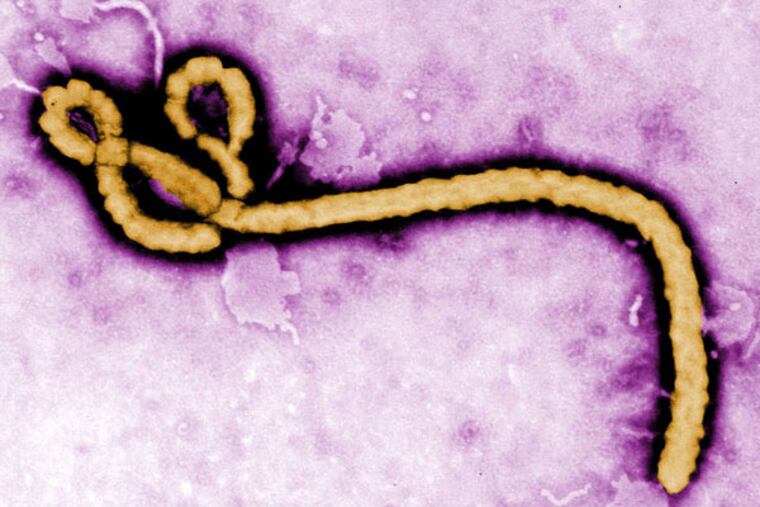
In a bleach-white laboratory on the fifth floor of an austere building at Thomas Jefferson University, Matthias J. Schnell plays with biological grenades.
Schnell is a microbiologist who specializes in filoviruses - the microorganisms that cause hemorrhagic fevers, such as Ebola. For more than a decade, he has been working on vaccines to prevent the kind of tragedy now ravaging thousands of people in West Africa.
"Filovirus research was a very unimportant field," said Schnell, director of the Jefferson Vaccine Center. "Until recently."
Within the next few weeks, he said, production will begin on 2,000 doses of a promising vaccine he has developed. By mid-2015, he expects clinical trials in humans to begin.
Schnell uses microscopic snippets of two strains of the virus: the Zaire strain that has killed at least 3,300 so far in Liberia, Sierra Leone, and Guinea, and the less-virulent Sudan strain. He also works with the Marburg virus, another lethal pathogen that causes multi-organ failure and, like Ebola, is hosted by fruit bats.
None of the Ebola viruses he works with are alive, he said. They cannot infect researchers, nor would they put anyone who received the vaccine at risk for contracting these diseases. But the genetic material, which produces glycoproteins, has enough power to trigger an immune response and produce antibodies that stop an infection from taking hold.
What distinguishes Schnell's work from that of other scientists seeking to prevent these gruesome diseases is that he is piggy-backing them onto a rabies vaccine.
Other Ebola vaccines are using cold or other viruses.
"Rabies is a neglected disease," Schnell said. Although, according to the World Health Organization, rabies threatens more than 3 billion people in Asia and Africa and kills more than 50,000 a year - primarily children under 15 - it can seem less terrifying than other viruses because it is transmitted by animal bites rather than by human-to-human contact.
"We think everyone in equatorial Africa should be vaccinated against both rabies and Ebola," he said.
Progress toward that goal has been steady but slow.
Since the first cases of Ebola were recorded in 1976 in Sudan and Zaire, (now the Democratic Republic of the Congo), the disease has appeared sporadically, usually in remote areas of Africa.
Because it was so difficult to know when and where it would occur, and because the outbreaks ended almost as quickly as they appeared, "Ebola had no market," Schnell said.
It certainly does now.
With predictions that tens of thousands may die in cities as well as in rural areas of West Africa, and the news Tuesday that a traveler from Liberia was diagnosed with Ebola in Dallas and may have exposed as many as 80 others, the world's attention has been snapped into focus.
Among dozens of vaccines under investigation across the globe, Schnell's is one of three promising efforts receiving support from the National Institutes of Health.
"A vaccine is very simple," Schnell said. "It either works or it doesn't."
In a trial completed in September, his vaccine proved 100 percent effective in a small group of monkeys. Though he is optimistic, he said, "We just don't know enough yet."
Walter Reed Army Medical Center is expected to complete production of the batch of 2,000 experimental doses by the end of November, Schnell said. Then the vaccines must be "validated," analyzed to be sure they meet the higher standards for purity required for use in people.
Schnell, 54, a native of Stuttgart, began producing clones of the rabies virus in the mid-1990s so the genetic material could be modified and used for vaccines.
It is delicate, painstaking work.
On the wall next to a machine used to isolate genes, Ben Davis, one of Schnell's research assistants, has taped up a picture of a strawberry from which someone had removed every seed and placed each of the 200 or so tiny black specks on a flat surface.
"That," said Davis, "gives you a rough idea of what it's like to do genetic research. It's kind of Zen."
Under normal circumstances, it takes two to three years for vaccines to be properly tested and approved, Schnell said, but if "appropriate investments were made," he said, his combination Ebola and rabies vaccine could be ready in six to 10 months for the first round of human tests.
He cautions, however, about the risks of moving too quickly. It would be unethical, he said, to vaccinate large populations in Africa without carefully monitoring their health, measuring their immune response, and following up to see whether they suffer any side effects or illnesses.
Given the current chaotic state of care in the countries most severely affected by Ebola, he said, that kind of careful scientific study is practically impossible.
In the race for a vaccine, he said, the victory will go not to the fastest, but to the safest and most effective.
"It is possible that ours might fail," he said. But he doubts it.
Within three years, he said, he expects large populations can be vaccinated against Marburg, Ebola, and rabies.
"And I think ours will win."
215-854-2590