U.S. border agents on the look for destructive insects
The dreaded Khapra beetle has a voracious and varied appetite. Resistant to insecticides, it's all but indestructible. As such, it is considered one of the world's most fearsome pests of grains, rice, beans and other "stored products."
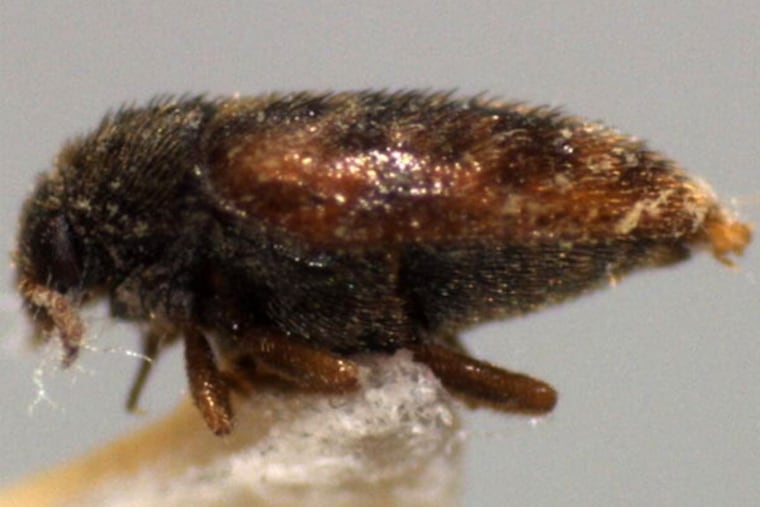
The dreaded Khapra beetle has a voracious and varied appetite. Resistant to insecticides, it's all but indestructible.
As such, it is considered one of the world's most fearsome pests of grains, rice, beans and other "stored products."
And it is high on the least-wanted list at U.S. borders.
Yet, there it was.
Twice in September, officials at Philadelphia International Airport discovered - and hastily dispatched - the beetle and its larvae.
The insects had come into the country aboard food that passengers carried with them on Qatar Airlines flights from Qatar's capital, Doha.
The flights began in April. For whatever reason, passengers on those flights routinely carry a lot of food, so U.S. Customs and Border Protection officials have been vigilant.
Most of the passenger luggage gets an extra inspection by agriculture agents, said Angela Allen, a supervisory agriculture specialist with the border protection office at the airport.
In both cases, on Sept. 3 and 10, the passengers had originated in Sudan, an African country that has the Khapra beetle. Other countries are in northern Africa, the Middle East, and central Asia.
Both passengers declared the food they carried - not doing so can result in a $300 fine - and agents inspected the material, Allen said.
They found telltale insect holes in fava beans and acacia seeds. Could it be Khapra?
"It is a vicious pest," Allen said. "Agents seize whatever they find to mitigate the risk at that point."
The agents confiscated the food and put it into a device that operates on the principle that many insects that live in soil, litter and grains respond negatively to light.
Called a Berlese funnel, the device includes a light that shines on the food from above. The insects move down through the funnel and drop into a container of an alcohol solution, where they die, but aren't destroyed. That way, they can still be identified.
The insects were then sent to a U.S. Department of Agriculture specialist at Philadelphia's Navy Yard for a final ID confirmation, which came recently.
"I'm sure this won't be the last time we'll find it in grains on that flight," said Robert Hunt, spokesman for U.S. Customs and Border Protection.
Border agents throughout the U.S. have been on the alert for the Khapra, which can go long periods without food. But when it starts eating, it is a grain and legume omnivore, feeding on oats, lentils, garbanzo beans, soybeans, barley, rice, wheat, corn, cowpeas and safflower seeds.
It is often found in luggage, personal goods, used burlap, spices, dried fruit and other plant and animal materials.
Between 2007 and 2010, border agents intercepted about 17 Khapra beetles a year nationwide.
But the insect was considered such a threat that officers were trained to look out for Khapras in particular. Between 2011 and 2013, interceptions averaged about 200 a year.
Exotic pests - as well as foreign animal diseases - are among the greatest risks to the $1 trillion a year U.S. agriculture industry, according to the U.S. Department of Agriculture. Pennsylvania and New Jersey have large agricultural sectors.
Although that wasn't the case with the two flights from Qatar, many airline passengers entering the country encounter members of the customs agency's Beagle Brigade - a team of dogs trained to sniff out food, which is often how insects get into the country.
Beagles have been chosen because of their of their keen sense of smell, their small size (nonthreatening), gentle disposition and, like many dogs, their "high food drive," meaning that if food is there, they'll notice.
Customs and Border Protection works at more than 300 ports of entry and in 2013 performed more than 23 million passenger inspections and 743,000 cargo inspections.
Among those, they found 73,199 "reportable pests."
But they're not always successful.
With increasing imports and air travel to the United States, many pests have snuck in.
According to a tally by the Center for Invasive Species and Ecosystem Health, a partnership between the University of Georgia and USDA, the U.S. now harbors 484 invasive insects, including the hemlock woolly adelgid, the Asian tiger mosquito and the boll weevil.
The emerald ash borer, an insect now chomping its way through Pennsylvania and New Jersey ash trees, is believed to have entered the country on packing materials via the port of Detroit. It was discovered in 2002, and millions of ash trees have subsequently died.
New Jersey has fought off the Asian long-horned beetle, a tree-killing pest discovered in New York in 1996. But both New Jersey and Pennsylvania are still considered to be at risk.
In September, the Pennsylvania Department of Agriculture confirmed the Berks County presence of the spotted lanternfly, a plant-hopper from Asia. It is the first known presence of the insect in the United States.
It is considered an invasive insect in Korea, where it was introduced in 2006, and where it has since attacked 25 species that grow in Pennsylvania, including grapes, apples, pines, stone fruits and more than 70 additional species.
A quarantine is in effect for at least seven Berks County municipalities. The measure prohibits the movement of yard waste, landscaping and construction waste, logs or any other tree parts, firewood, grape vines and other materials.
215-854-5147 @sbauers