Scientists team up to find toxin targeting babies and lambs
A few hundred times every year in the United States, a mysterious agent attacks the bile ducts of a newborn baby, often leading to a liver transplant.
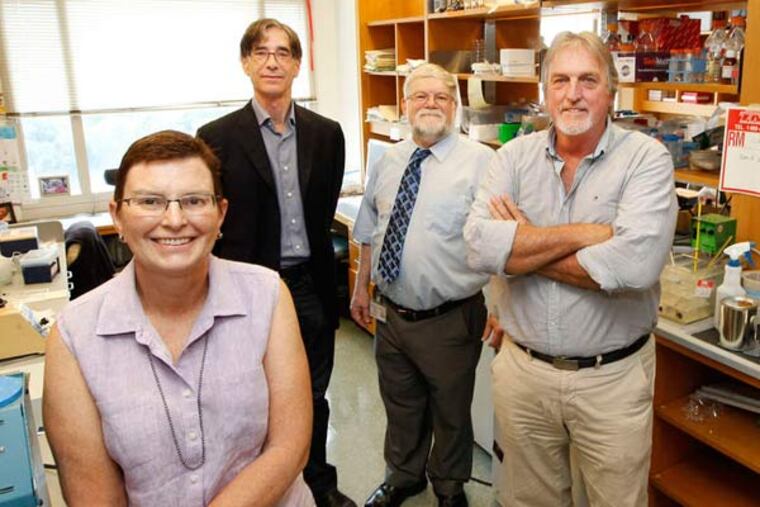
A few hundred times every year in the United States, a mysterious agent attacks the bile ducts of a newborn baby, often leading to a liver transplant.
And several times over the last century, a mysterious agent attacked the bile ducts of lambs and other livestock in Australia, killing hundreds of animals in all.
Plenty of pediatric liver researchers have wondered whether there was a connection. Could it be a virus? Genes?
Rebecca G. Wells, a physician scientist at the University of Pennsylvania, dropped a line to Australia to see whether she could find out.
The eventual result was a tale involving fluorescent fish, an odd-smelling plant, and painstaking chemical detective work to ferret out one fateful substance in that plant.
Working with the University of the Sciences and Children's Hospital of Philadelphia, Wells and Penn colleague Michael Pack published their research in May, offering the hope that this grave disease, called biliary atresia, might be prevented in humans simply by telling pregnant women what not to eat.
They are not there yet. The team discovered a chemical compound that appeared to cause the disease in livestock. They isolated the compound in samples of an Australian plant commonly known as pigweed, which is different from the American plant of the same name.
But people do not eat pigweed, so the hunt is on for other foods that might contain the same chemical, or perhaps a related substance.
Still, the study has jump-started research into a disease that has baffled physicians for centuries, said Jorge Bezerra, medical director of the pediatric liver care center at Cincinnati Children's Hospital Medical Center.
"This paper is like switching the light on," Bezerra said.
The story begins during winter break in 2007, when Wells decided to look up a 1990 report of Australian lambs that had died of the illness.
"I was basically just curious," she said.
Instead of finding the old report, she came across a new one. Lambs were dying in Australia once again. She eventually reached veterinarian Stephen J. Whittaker, who had studied the new outbreak, along with Peter A. Windsor, author of the 1990 report.
The vets thought the culprit might be a plant called Dysphania, commonly known as pigweed, because it was growing in the area. The plants are ordinarily underwater, but a drought was underway during both outbreaks, and the pigweed was exposed.
"We normally never see it," said Windsor, who took part in the study and is now at the University of Sydney.
Which of the many substances in the pigweed was causing the damage? With Windsor's help, Wells arranged to have plant samples flown to the U.S. - an arduous task that required special permission from the U.S. Department of Agriculture.
Then she enlisted the help of John R. Porter, a biology professor and natural-products chemist at the University of the Sciences.
Porter and postdoctoral researcher Kyung A Koo used solvents to narrow down the list of suspects.
In the first round, they divided the plant into three fractions: waxy, fatty materials; water-soluble substances such as sugars and salts; and a third group of compounds that dissolved more readily in methanol.
Each fraction was sent to Pack, Wells' colleague at Penn, who tested the substances on zebrafish larvae to see whether any would cause a disease similar to that in humans and sheep.
The scientists first administered the compounds to the translucent creatures, each shorter than the width of a pencil eraser, then several days later gave them a green, fluorescent dye to illuminate their digestive systems.
The first round of tests revealed some sort of toxic agent was contained in the methanol fraction. Little to no green dye could be seen in the fish gallbladder, as that organ, along with the large bile ducts that drain into it, had been destroyed - much as in babies with biliary atresia.
But that fraction contained hundreds of substances, so Porter separated it again and again, each time sending off samples to Pack's lab to be tested on the larvae.
The team went through nine rounds of tests in all and ultimately hit on an unknown compound they dubbed biliatresone, described in the journal Science Translational Medicine. In addition to conducting tests on fish, the scientists also showed the chemical was toxic to biliary cells from mice.
But how are humans exposed? The researchers have tested foods related to pigweed, such as beets and Swiss chard, and so far have not found them to contain biliatresone.
Given the disease's rarity, it could be the culprit is some food that contains biliatresone or a related substance only in certain circumstances, such as being under stress from a fungus, the scientists say.
Perhaps the pregnant mother has to eat the food in question at just the right time of pregnancy, or maybe certain key microbial agents are active in her digestive tract. Certain babies also may have a genetic susceptibility to the disease.
Still another clue: The disease occurs in as few as one out of 15,000 live births in this country, but is more common in Asia.
"We're spending a lot of mental energy now," Pack said, "figuring out what women might be exposed to, how, and when."
Even if scientists cannot pinpoint a dietary culprit, the discovery of the toxin might lead to the development of a drug.
For now, babies with biliary atresia typically undergo a delicate surgery in which their blocked bile ducts are replaced with a section of their own intestines. If that is not successful, they need a liver transplant. Even if the bile duct surgery works, many will still need a transplant years later.
The research was funded by the National Institutes of Health and by the Biesecker Pediatric Liver Center at Children's Hospital.
Cincinnati's Bezerra, who was not involved in the study, called it a prime example of interdisciplinary success, with biologists, chemists, physicians, and veterinarians.
But for all that cooperation, they cannot agree on one thing: what pigweed smells like.
Wells calls it "noxious."
Porter prefers "distinctive but also sometimes a bit pleasant."
"It strikes me as somewhat like creosote, but not that strong, with a hint of pine and something else resinous," he said. "It also has an odor of freshly mowed grass."
If the team can crack this rare disease, it will smell pretty sweet.
215-854-2430
@TomAvril1