Medical students use self-reflection to improve patient care
Scrunched around a long table, a group of third-year medical students listened sympathetically as Charles McCann recounted a sad, frustrating, real-life story that illustrated the challenges they will face for a professional lifetime.
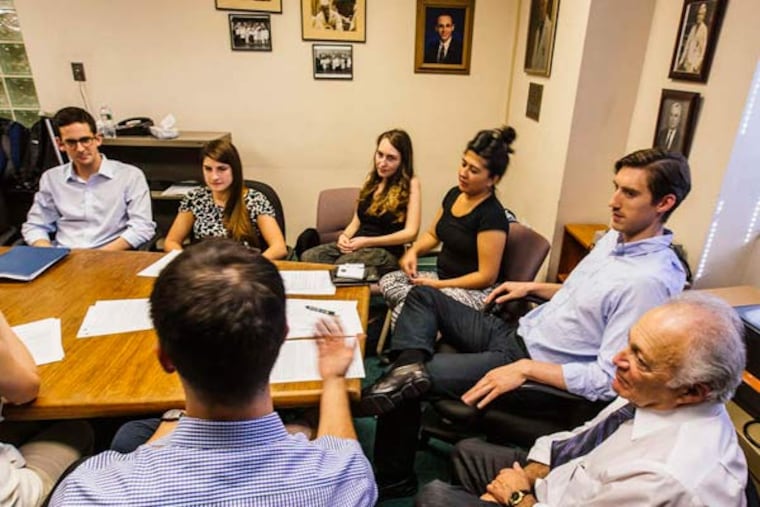
Scrunched around a long table, a group of third-year medical students listened sympathetically as Charles McCann recounted a sad, frustrating, real-life story that illustrated the challenges they will face for a professional lifetime.
McCann had seen a homeless man in clinic. The man had multiple health problems that couldn't be fixed without addressing his social problems, a big job that was out of McCann's hands. He told McCann he thought he'd be better off - medically - in jail.
"That was like the first moment of true helplessness I've felt as a medical student. It was very hard to deal with," McCann said.
McCann and his fellow academic superstars had come to a classroom at Thomas Jefferson University to do something unusual for them: talk about their feelings.
They were participating in Reflection Rounds, an experimental protocol meant to help students stay in touch with a sense of spirituality - very broadly defined - that might help them keep their hearts open and protect them from cynicism and burnout as they encounter the suffering, disappointment, and limitations that permeate medicine.
McCann decided the best thing he could do to help the man was to organize and record his story. "It felt like such a hollow gesture," he told his friends.
The blunt voice of experience - Joseph Leggieri, director of the pastoral care and education department at Thomas Jefferson University Hospital and co-leader of the group - jumped in.
"Get used to the feeling of helplessness, and don't stop helping," he said.
"Over and over and over again, you're going to feel helpless. In relating to people, you can only bring them so far."
Fred Markham, a doctor who is the other co-leader of the rounds, said studies had shown that empathy drops among medical students in the third year. That happens to coincide with when they transition from textbooks to encountering large numbers of messy, obstinate, and deeply sad real-life patients and families.
"I think some of the things that they see are detoxified by sharing with everybody," he said.
During a recent one-hour session, students talked about how powerless they felt when patients put themselves at risk by ignoring doctors' advice. One student said she knew her emotional sensitivity was a positive quality, but it made her uncomfortable at work. The students were not sure how to handle the complex interplay between patients and family. And how exactly were they to balance passion and empathy with professional boundaries?
Plus, they don't get much respect from some patients.
"When I go into a room, I introduce myself as a medical student. Occasionally you see the big eye roll," said Graham Peigh. His classmates smiled knowingly.
"They know at the end of the day, it's the next person coming into the room who can actually do something."
Afterward, students said they loved having a place where they could let down their guard.
"I love it so much I wish it would be incorporated into every single rotation and even work, forever and ever," Malika Mukhamedova said.
The rounds stem from a partnership between the George Washington University Institute for Spirituality and Health and the John Templeton Foundation, an organization based in the Philadelphia suburbs that supports the scientific exploration of spirituality.
"If successful, this project would help demonstrate how spirituality can be an important, well-integrated component of not only patient care but also the training and formation of doctors," said Kimon H. Sargeant, the foundation's vice president of human sciences.
Christina Puchalski, director of the George Washington program, said it grew out of an attempt to help students develop a "compassionate presence" and an ability to "attend to the suffering of others."
A palliative care doctor, Puchalski said that these skills are "not amenable to didactics."
The rounds, which were piloted in 2010 and have now been tried at 18 schools, are meant to help students become better listeners and focus on repeatedly aligning their behavior to what called them to medicine. A big goal is for students to understand "this whole concept of being transformed within the doctor-patient relationship."
Jefferson received a grant to start the program two years ago, then decided to continue it on its own for students going through the family and community medicine rotation. The Penn State College of Medicine also got an initial grant and now requires the rounds for all medical students.
The rounds are used to address burnout, depression, spiritual well-being, empathy, and patient centeredness.
Maggie Kreher, a palliative care doctor who leads the program at Penn State, wants students to "reflect" on what gives their lives purpose and meaning, the things that will help them recharge when their jobs feel overwhelming. She thinks it is valuable for students to be able to recognize "spiritual distress" in themselves and patients.
"In medicine, there's this huge lack of acknowledgment of the intensity of some of the things that we are witness to or involved in," she said.
Students need new cognitive tools. They "have come straight up through, 'I have to have the right answer,' " she said. "In these situations, there's no good answer. There's no right answer."
In Quaker meeting fashion, the rounds are punctuated by awkward periods of silence that can take some getting used to. The idea is to let emotions bubble up and reveal themselves, and to learn to just be present in an uncomfortable moment. "We don't need to fix it," Kreher said. Not jumping to fill the silence allows students to "recognize that there's actually power in silence and just bearing witness."
At the Jefferson session, students spoke one at a time without interruption.
They talked about how even fixable medical crises could leave patients feeling frightened and in need of an empathetic ear.
An attending doctor told Erica Tan to tell a patient he had diabetes and explain what he'd need to do to manage it. "I told him as gently as I could," she said. "He was just so vulnerable." She could see that he felt shocked and guilty. She knew she couldn't give him what he needed in the usual 15 minutes. "I kind of sensed that he needed the time for it to just sink in," she said.
Markham asked how she knew. Had an older doctor modeled the right behavior?
"I could see his whole expression change," she said. "He wasn't even making eye contact any more."
Another student said he was frustrated by a patient who wasn't taking her diabetes seriously enough. It's easier to feel compassionate, he said, when patients obviously feel vulnerable.
Markham said the best defense against burnout is to celebrate the successes.
"What really helps is a best friend," Leggieri added.
Peigh said the third year was about hands-on experience - seeing lots of cases. "For whatever reason," he said, "patients are often called cases. This helps turn those cases back into patients."
215-854-4944
@StaceyABurling