Hoarding is no ordinary disorder
Sandy Stark always loved pretty things. When she was a girl, she collected unusual rocks, birds' nests, crooked sticks, and dolls. As an adult, she gravitated to white ceramics and china, paperweights, kitchenware, and art. Year by year, the treasures accumulated until the only way she could navigate her San Francisco apartment was through a narrow line of what she called "goat paths."
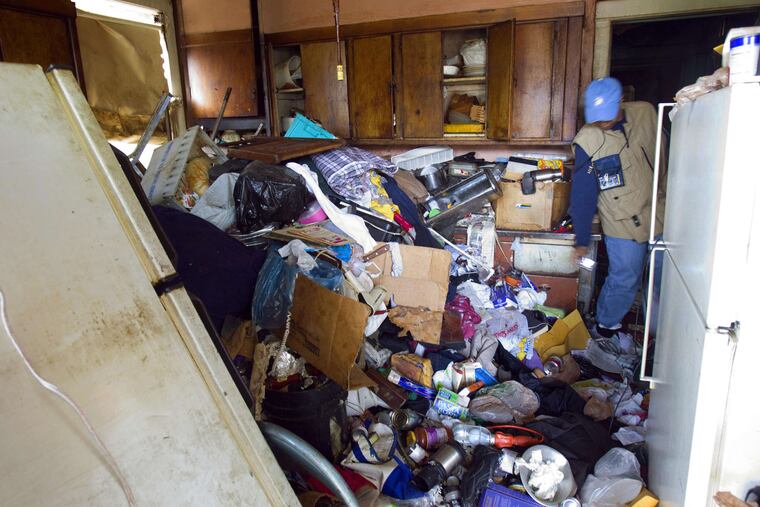
Sandy Stark always loved pretty things. When she was a girl, she collected unusual rocks, birds' nests, crooked sticks, and dolls. As an adult, she gravitated to white ceramics and china, paperweights, kitchenware, and art. Year by year, the treasures accumulated until the only way she could navigate her San Francisco apartment was through a narrow line of what she called "goat paths."
That was when her two grown daughters swooped in and cleaned the place out. All her treasures, gone. On re-entering her house, seeing it so sterile, so empty, Stark, now 71, says she felt traumatized. Almost immediately, she began reacquiring things - with a vengeance:
"You're pulling everything in around you, building the hamster's nest, building the wall. Part of it is for the high. It's an addiction, sort of. But it's also to fill a void. It fills a lot of void."
Within 18 months, Stark, who was at one time so organized that she supervised payroll for the Pacific Stock Exchange, could barely negotiate the way to her bedroom. Everywhere she turned, boxes. She was then going on 60, and her life had become defined by "the hoard."
While the stockpiling of stuff is often pinned on America's culture of mass consumption, hoarding is nothing new. But it's only in recent years that the subject has received the attention of researchers, social workers, psychologists, fire marshals, and public-health officials.
They call it an emerging issue that is certain to grow with an aging population. That's because, while the first signs often arise in adolescence, they typically worsen with age, usually after a divorce, the death of a spouse, or another crisis.
Hoarding is different from merely living amid clutter, experts note. It's possible to have a messy house and be a pack rat without qualifying for a diagnosis of hoarding behavior. The difference is one of degree. Hoarding disorder is present when the behavior causes distress to the individual or interferes with emotional, physical, social, financial, or legal well-being.
"If you aren't able to use the stove and your refrigerator is stockpiled with expired items, if you're so disorganized you aren't able to file for Medicare or make a primary-care appointment, hoarding becomes a major problem," says Catherine Ayers, a geriatric psychologist at the University of California at San Diego who has developed a cognitive behavior therapy for older people with the disorder.
Studies show that compulsive hoarding affects up to 6 percent of the population, or 19 million Americans, and it has been found to run in families. The rate is twice that of obsessive-compulsive disorder, the condition under which hoarding was listed until 2013 in the Diagnostic and Statistical Manual of Mental Disorders, the bible of the American Psychiatric Association. The DSM's latest version now categorizes it as a separate mental illness.
Brain-imaging studies of hoarders have revealed abnormally low activity in the anterior cingulate cortex, which governs thinking and emotion. When these people are shown trigger images - such as pictures of objects being shredded and discarded - that area of their brain lights up and turns hyperactive.
Hoarding is "underdiagnosed and undertreated," says Sanjaya Saxena, director of the Obsessive-Compulsive Disorders Program at the UC San Diego health system. "Though people realize it's a problem, they never conceive of it as a medical disorder rooted in brain abnormalities."
Awareness, though, is growing. In the last five years, more than 100 task forces on hoarding have sprouted around the United States and Canada. Most involve training and education - teaching clinicians and community figures such as firefighters how to recognize and deal with the disorder.
Compulsive hoarding is associated in various studies with serious health risks such as household falls, obesity, respiratory problems (caused by dust mites and squalor), and poor medication compliance.
A 2012 study in New York found that 22 percent of people threatened with eviction and seeking intervention had a hoarding problem, and the condition has been associated with homelessness.
Among the most serious concerns is the potential for fire.
"A lot of these people don't use their front door; a lot of times they don't use a door at all," says Ryan Pennington, a paramedic and firefighter who maintains a website called Chamber of Hoarders and who lectures widely to fire departments about the issue. "Firefighters who crawl into these houses often don't get the full force of radiant heat. Many times, they don't realize how hot the fire really is until it's too late."
Medications - most commonly antidepressants - have been used with some success, but the primary approach to hoarding behavior is psychotherapy and harm reduction. Cognitive behavior therapy is also used, to teach people how to organize, prioritize, and plan while working to ease their emotional attachment to the objects they have collected.
Cognitive behavior therapy has its limits, however, said Randy O. Frost, a Smith College researcher who has helped develop a model used around the country to help hoarders address their emotional reactions to reducing their possessions.
"Between 60 and 80 percent of people are improved after treatment, with an average decrease in symptoms of about 30 percent," he said.
And relapse is common.
Stark says her own experience is "several steps backward while moving forward."
She dates the beginning of her recovery to the time, about seven years ago, when she saw a psychologist on TV discussing hoarding behavior and characterizing the people who suffer from it as perfectionists.
"And I thought: 'That's me! I'm not this lazy, dirty person! I have a problem.' "
Group therapy proved helpful, but it wasn't until she found a comrade - a "clutter buddy" - that she began her real recovery.
"It took me three years to accept her offer, and even then I cried as she came over the threshold," Stark says. It was the first time in many years that she had allowed anyone inside her house.