Diabetes: Let's get serious
The stakes are seriously high: More than 20 million Americans have Type 2 diabetes, according to estimates by the Centers for Disease Control and Prevention, and 57 million more are at risk for it.
The way some people talk about diabetes, you'd think they were talking about toejam.
It's not really something to worry about, the thinking goes-just "a little sugar." And there's nothing you can do about it, anyway.
False.
And false.
Poorly controlled diabetes leads to heart attacks and strokes-the causes of death for at least two-thirds of all diabetes patients. It blinds 12,000 to 24,000 in the U.S. every year, leads to about 70,000 amputations and is the No. 1 cause of kidney failure.
Yet a new study by the American Diabetes Association shows that only 3 percent of Americans fear diabetes (with cancer, the figure is 49 percent), a complacency that worries experts. "It's so much more than a drop-the-doughnuts disease," says Antoinette Maciolek, spokeswoman for the local branch of the ADA.
More importantly, there's a world of things that you
can
do to live a long healthy life with diabetes-and a game plan you can follow to prevent the Type 2 form of the illness.
The stakes are seriously high: More than 20 million Americans have Type 2 diabetes, according to estimates by the Centers for Disease Control and Prevention, and 57 million more are at risk for it.
Type 2 to-do list
The big four priorities for people with Type 2 diabetes are to lose weight, be active, keep good control over blood-sugar numbers and take the prescribed medications — not only to control the diabetes, but also blood pressure and cholesterol.
"It's pretty demanding," acknowledges Dr. Richard Wender, chairman of family and community medicine at Thomas Jefferson University. "Successfully managing all the aspects of diabetes is a hard task."
Patients typically take six or seven medications a day, he notes, all for a disease with no obvious symptoms.
And that's on top of testing their blood three or four times daily to check glucose levels ... and paying regular visits to a phalanx of specialists in diabetes care, eye care, foot care, exercise, nutrition and more ...and reading food labels to spy hidden sugars and off-limits carbs ...and pushing themselves out the door to exercise.
"There are a lot of things to be thinking about," Wender says. "The good news is that everyone can be successful at some things."
Indeed, says Dr. Mark Schutta, medical director of the Penn Rodebaugh Diabetes Center, "There is no disease that I can think of where the patient has as much as impact."
This special section of the Daily News is designed to give you maximum impact, with advice from local diabetes experts and inspiration from your neighbors who are thriving with the illness — or in some cases actively preventing it. We've also included two pages of clip-and-save coupons with health information that can literally save lives and limbs.
Diabetes 19107
In the Philadelphia area, about 10 percent of the population has diabetes, 2 percent above the national rate, according to the ADA. But there are also deep resources here to help people learn to control the disease, and, as Wender notes, "This is an illness where knowledge is power."
Our region has three nationally recognized hospital diabetes centers, at Penn, Jefferson and Delaware's Christiana Care Health System. There's embedded neighborhood diabetes care at hospitals like the Albert Einstein Medical Center and Temple University Hospital. And dozens of health facilities offer diabetes education classes that the ADA has recognized for excellence. (To find one near you, call 1-800-342-2383, or visit www.diabetes.org.)
As you'd expect, the city's research hospitals are also making inroads in exotic realms of medicine that will lead to new treatments and possibly cures.
Penn's Dr. Mitch Lazar, for example, discovered a hormone called resistin that's one of the foundations of current diabetes research. Temple's Dr. Guenther Boden made a groundbreaking connection between fat cells and diabetes that has been another major springboard for science.
No one expects a cure soon. Indeed, Dr. Arthur Chernoff, another member of the region's research elite, estimates that doctors and scientists know maybe 3 percent of all there is to be known about the biochemistry behind this maddeningly complex illness.
"This is rocket science," says Chernoff, chairman of the division of endocrinology at Albert Einstein Medical Center. But they're on it.
In the past five years alone, lab insights have led to an explosion in new classes of medicines. The newest, like Byetta and Januvia, regulate hormones in people's guts that no one even fingered as suspects in diabetes until recently.
Rocket science for beginners
The ADA-approved diabetes-education classes are an especially valuable local resource for patients, the ADA's Maciolek says.
These intense mini-med schools offer guidance on diet, exercise and blood-sugar monitoring. They also explain how the pancreas and other organs in the body go haywire in diabetes, and teach patients about the head-spinning variety of medicines available to fix trouble spots.
If it sounds impossibly technical, the RNs and other certified diabetes educators who lead classes in and around Philly have a bag of tricks to keep the sessions lively.
Nadine Uplinger, director of the Gutman Diabetes Institute at Einstein, sometimes wears a smock with little pillows shaped like the pancreas (where insulin is made) and other organs sewn onto to it. Frances Love, a nurse-educator at Penn Rodebaugh, uses terms like "leaky liver" and "pooped-out pancreas" to explain what happens inside the body when diabetes takes hold.
Without being too touchy-feely, diabetes educators also acknowledge the emotions of living with their illness and help patients handle them.
Insulin is one hurdle. "Going on insulin doesn't mean the end is near. It means your body needs insulin," Love tells her students matter-of-factly.
The blame game is another emotional minefield, Penn's Lazar says. "Everyone wants to blame the person with diabetes." Educators like Love and Uplinger stress that diabetes is a problem with the way your body handles food — and is not a moral defect.
Students in diabetes classes also walk away with handy technical advice. Which blood-glucose monitor is best? Love says it's often the one your doctor knows best — especially if the doctor's office is equipped with a dock that can download data from certain monitors to see how you're blood-sugar numbers are doing.
What if it malfunctions on the weekend? An 800 number for tech support is listed on most units.
Not diabetic? Get moving
This Friday, in recognition of World Diabetes Day, Boathouse Row and some Center City skyscrapers will be decked out with blue lights. Temple University's School of Podiatric Medicine, at 8th and Race streets, will offer free screenings and health information from 10 a.m. to 3 p.m.
The hoopla is meant to serve as a reminder that diabetes is, indeed, something to take seriously — and the sooner the better if you are overweight or have other risk factors for the illness. (See "Time to Get Tested" on Page P-11.)
An encouraging national study called the Diabetes Prevention Program (DPP) has shown that losing 7 percent of your body weight, exercising regularly and making healthier food choices can prevent diabetes if you're at risk for it, or at least delay its onset.
The stunner: These lifestyle changes worked even better than a protective medicine called metformin.
Success class in session
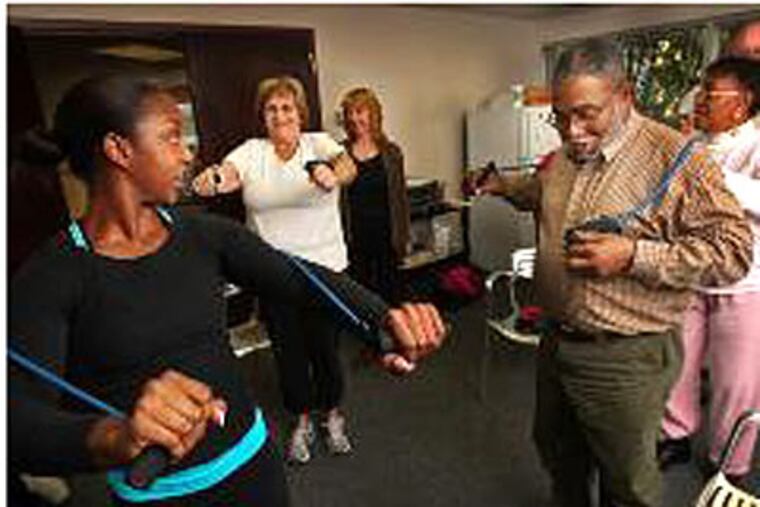
Last month, five local study participants reunited at Thomas Jefferson University Hospital, one of 27 hospitals around the country involved in the DPP, for a fitness class using elastic resistance bands. "We don't ever let the band control us. We control the band," instructor Brittany Wright told the exercisers.
Not a problem, as it turned out. They'd been controlling their diabetes risk for better than a decade.
Among them was Kathy Ashenfelter, 62, a Fox Chase woman whose parents died from diabetes complications and whose three siblings have the illness now.
Ashenfelter is down 30 pounds from her weight in 1996, when she joined the DPP study. "I stopped drinking soda," she says. "I don't use butter in cooking or on vegetables," she says. "I try to eat fiber whole-wheat bread, and I try to buy portioned-out packaging. I try to take fruit to work to snack on."
For exercise, she logs about 12,000 steps a day on her pedometer. "Walking is my saving grace," she says. "I don't drive. I'm too impatient to take buses. I walk. I walk. I walk."
Twelve years into the program, she's still diabetes-free. "I'm the only one in a family of six without diabetes," she says.
Living, butter-free, power-walking proof that you can do a lot about it. *